
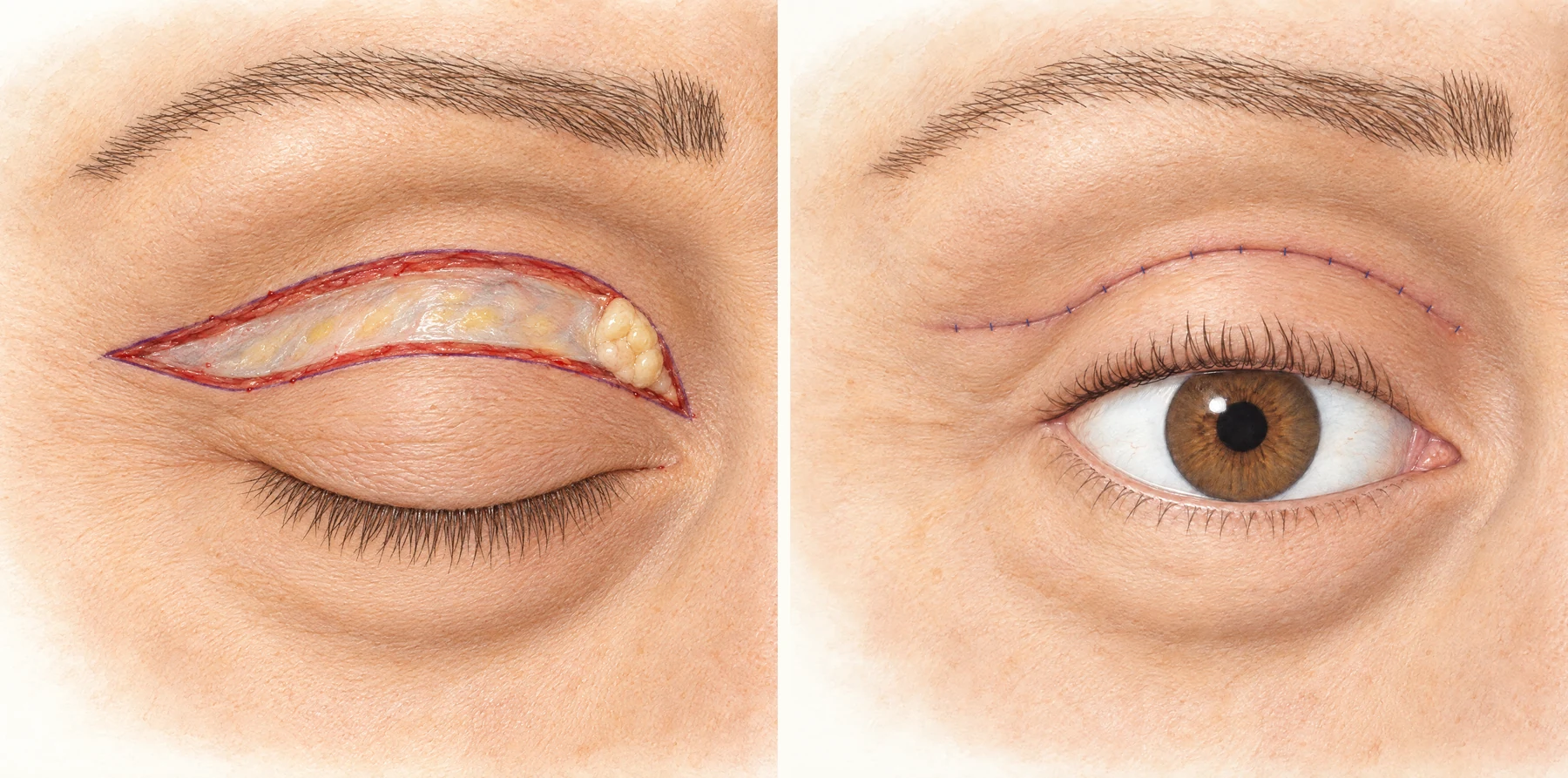
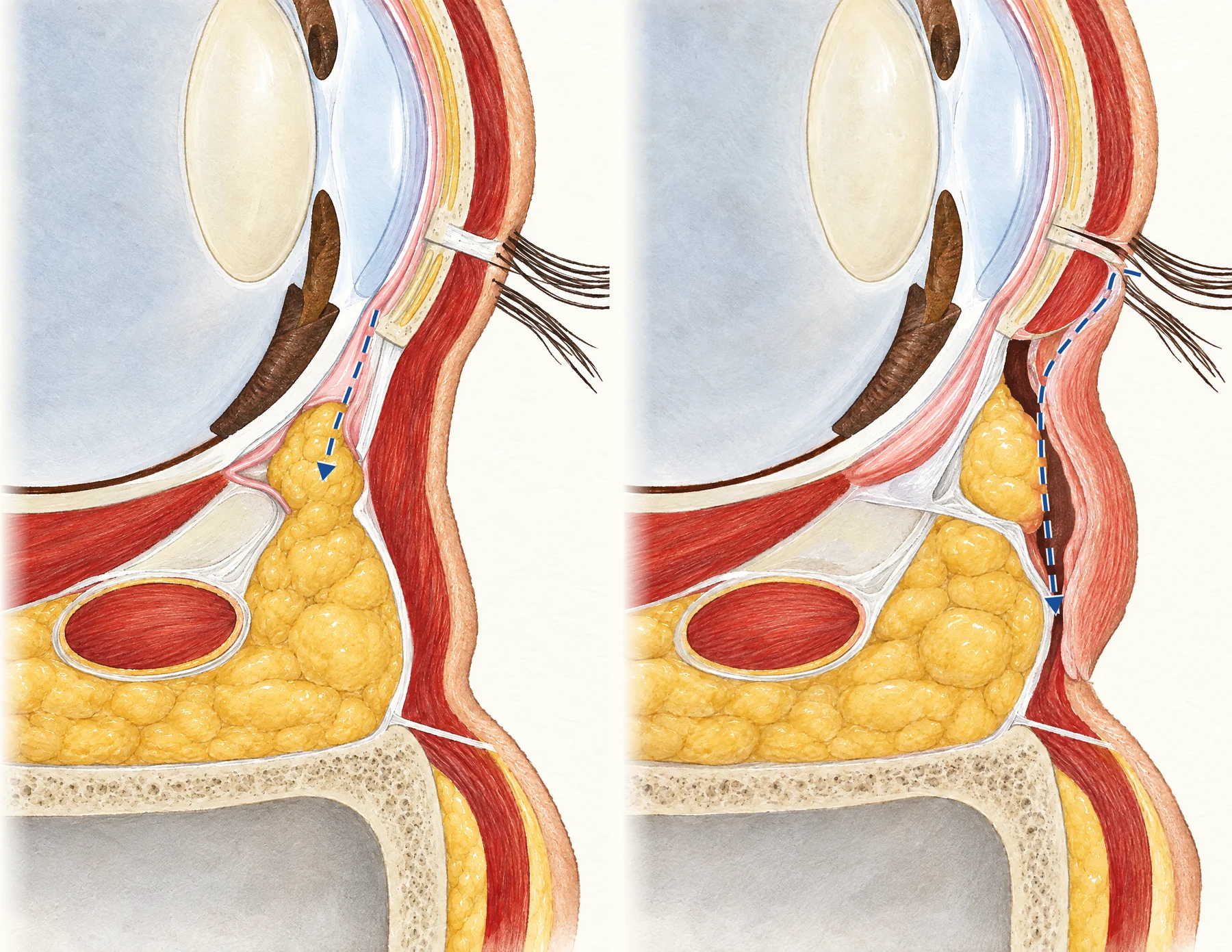
Incision placement
- Upper blepharoplasty places its incision within the natural upper eyelid crease, where the scar is hidden by the fold of skin above it; detail on crease-height planning is in Upper blepharoplasty (PMID 15536308).
- Lower blepharoplasty places its incision either just below the lower lashes, where the lash line conceals it once healed (see Lower blepharoplasty), or on the inner surface of the lid, which leaves no visible external scar. The inside-the-lid approach caused no lid retraction or ectropion in the consecutive cases reported; full detail is in Transconjunctival blepharoplasty (PMID 2771349).
- A skin pinch removes a fold of loose lower lid skin without undermining, placing its scar along the same lash line. About 8 mm of skin was removed on average, and a few patients had temporary scleral show (PMID 18434828).
- Darker Fitzpatrick skin types carry a higher risk of a more visible scar after upper blepharoplasty regardless of incision placement. Vancouver Scar Scale scores at 6 months rose with darker skin type, driven by pigmentation change rather than vascularity, pliability or scar height (PMID 42557456).
- Blepharoplasty scars were more visible than scars from tear-duct surgery (external dacryocystorhinostomy) on two scar scales 1 to 3 years after surgery, though patient satisfaction did not differ between the two groups (PMID 40355707).
- Asian and White patients perceive blepharoplasty scars differently: White facial-surgery patients, blepharoplasty patients among them, rated scar appearance, psychosocial impact and career and sexual well-being more positively than Asian patients (PMID 41263428).
Suture technique trials
- Incision tool (scalpel, radiofrequency or CO2 laser) and suture material did not change the final scar in a 2026 evidence review of upper blepharoplasty scar optimization (PMID 41193896).
- In a paired-eye trial, intradermal and continuous 6-0 nylon closure gave equal scar quality at 6 months, and about 4 in 5 patients rated the result much or very much improved regardless of suture technique (PMID 42118953).
- A systematic review comparing absorbable and non-absorbable sutures in upper eyelid blepharoplasty found equal scar quality and complication rates. Running against interrupted technique affected early swelling but not long-term scar outcome, and no included study measured whether absorbable sutures actually reduced follow-up visits (PMID 41062983).
- Botulinum toxin injected into the lateral orbicularis muscle at wound closure produced narrower lower-lid scars on the treated side in Asian patients, though blinded scar-scale scores were the same between sides (PMID 34128526).
- A survey of plastic, facial plastic, oculoplastic and dermatologic surgeons found nearly all use neuromodulators in their practice, but only about 1 in 5 use them to optimize scars and about 1 in 8 to optimize blepharoplasty outcomes (PMID 39989708).
Scar outcomes and hypertrophic scarring rates
- A systematic review of eyelid procedures found hypertrophic scarring in about 1% of patients and no keloid after cosmetic eyelid surgery (PMID 36797842).
- Contour change, asymmetry and visible scarring tend to present later in the postoperative course than bleeding or lid-position problems, which present in the first weeks (PMID 20195127).
- In a single-blinded trial of intraoperative platelet-rich plasma (PRP) in upper blepharoplasty, patient- and observer-reported scar scores were significantly lower in the PRP group at both 1 and 6 months, though PRP gave no added benefit on anxiety, depression or quality-of-life measures (PMID 42788940).
- In a trial of injectable platelet-rich fibrin (i-PRF), with one eyelid treated and the other as control, the treated side had less swelling and pain and more favorable Vancouver Scar Scale scores (PMID 41735797).
Risks and complications
- Hypertrophic scarring and keloid are both more likely with wound tension, infection, and individual scarring tendency than with the specific incision tool or suture used, per the 2026 evidence review (PMID 41193896).
- Patients with darker Fitzpatrick skin types and patients of Asian ethnicity are each reported to carry a higher risk of a visible or distressing scar after blepharoplasty than lighter-skinned or White patients, based on separate objective scar-scale and patient-reported-outcome studies (PMID 42557456), (PMID 41263428).
- Eyelid keloid, though rare, does occur and has been studied with laser and growth-factor treatment, discussed under Treatment below (PMID 39197180). Rates of hemorrhage, dry eye, lid malposition and wound dehiscence are reported by procedure in Blepharoplasty complications.
Treatment
- Topical silicone gel showed no advantage over plain petrolatum ointment on redness, elevation, pigmentation or patient satisfaction in a double-blinded trial of patients having bilateral upper blepharoplasty or ptosis repair, with follow-up of about 11 weeks (PMID 39946309).
- Despite that trial, an earlier series found a silicone-based scar cream cut the need for triamcinolone or 5-fluorouracil injection for hypertrophic or cicatricial scarring after upper blepharoplasty from about 4 in 10 eyelids to about 2 in 10, so silicone is used as a first-line, low-risk option before injection therapy (PMID 31141848).
- Injectable 5-fluorouracil (5-FU), with or without a low-dose steroid added, was used safely after periorbital skin grafting: no skin thinning, telangiectasia or infection, and about 9 in 10 patients were satisfied (PMID 25025385).
- Fractional CO2 laser, personalized to each scar's characteristics rather than delivered at uniform settings (the "Manual One-shot Learning Technique," MOST), was used for hypertrophic or keloid eyelid scars. 1 to 3 sessions brought about 9 in 10 patients to more than 75% scar clearance, and about 1 in 10 had recurrence (PMID 40574505).
- Ultra-pulsed CO2 fractional laser combined with recombinant human epidermal growth factor gel beat the laser alone for eyelid keloid, with a greater fall in scar and itch scores and a lower 1-year recurrence rate (PMID 39197180).
- A low-fluence 1064-nm Q-switched Nd:YAG laser, a wavelength usually used for pigment, was reported as a novel treatment for hypertrophic scarring after combined blepharoplasty and epicanthoplasty in a single case (PMID 26820981).
- Topical Hypericum perforatum (St. John's wort) extract applied after upper blepharoplasty gave significantly better wound-healing (REEDA) and Vancouver scar scores at 2 weeks and 1 month than no treatment, but no significant long-term difference in final scar appearance by 2 months (PMID 40877601).
- In a small split-face trial of topical Aloe vera, early (1-week) reduction in scar vascularity and pigmentation correlated strongly with higher patient satisfaction at 3 months, a correlation that did not hold in untreated control eyelids in the same patients (PMID 42428186).
- Botulinum toxin injection at closure is used by a minority of surgeons specifically for scar optimization, and trial data for lower blepharoplasty show it narrows the visible scar without changing blinded scar-scale scores; see Suture technique trials above (PMID 34128526), (PMID 39989708).
Recovery
- Scar redness and swelling in the first weeks are normal healing, not a sign of hypertrophic scarring (full timelines are in Blepharoplasty recovery timeline). The first week's appearance has prognostic value: less vascularity and pigmentation at 1 week predicted higher patient satisfaction at 3 months in a small split-face trial (PMID 42428186).
- Topical Hypericum perforatum's benefit over no treatment was measurable only in the first postoperative month and had faded by 2 months, consistent with an effect on early healing rather than final scar quality (PMID 40877601).
- Laser treatment of an established hypertrophic or keloid eyelid scar is given after the scar has matured, in 1 to 3 sessions, rather than in the immediate postoperative period (PMID 40574505).
Current questions
- Whether topical silicone meaningfully improves eyelid scars is unresolved: a rigorous double-blinded trial found no advantage over petrolatum (PMID 39946309), while an earlier series found it reduced the need for injection therapy (PMID 31141848).
- Absorbable sutures are theorized to reduce follow-up burden by removing the need for suture removal, but no study identified has quantified this benefit in visits or resource use (PMID 41062983).
- Regenerative adjuncts (platelet-rich plasma, platelet-rich fibrin) show early positive scar-quality signals in small trials, but longer-term, multicenter confirmation is not yet available (PMID 42788940), (PMID 41735797).
- Neuromodulator use for scar optimization remains uncommon in practice (about 1 in 5 surveyed surgeons) despite trial evidence of a narrower resulting scar, a gap between evidence and adoption that has not been explained (PMID 39989708), (PMID 34128526).
- Ethnic and skin-type differences in scar visibility and in how patients perceive that visibility are now documented by objective scar scales and by patient-reported quality-of-life instruments, but counseling and treatment protocols tailored to this difference are not yet standardized (PMID 42557456), (PMID 41263428).
Terms
- Hypertrophic scar: a raised, red scar confined to the original incision, the main scar complication tracked after blepharoplasty (PMID 36797842).
- Keloid: scar tissue that grows beyond the original incision; rare after cosmetic eyelid surgery (PMID 36797842).
- Vancouver Scar Scale (VSS): a scored assessment of scar vascularity, pigmentation, pliability and height, used to grade blepharoplasty scars objectively (PMID 42557456).
- Manchester Scar Scale: a separate scored scar assessment tool, including color, contour, texture and distortion, compared against the Vancouver scale for periocular scars (PMID 40355707).
- Fitzpatrick skin type: a classification of skin's response to sun exposure, from Type I (lightest) to Type VI (darkest), that predicts scar pigmentation risk (PMID 42557456).
- Transconjunctival incision: an inner-lid incision used in lower blepharoplasty that leaves no external scar (PMID 2771349).
- 5-fluorouracil (5-FU): an injectable antimetabolite drug used off-label to soften hypertrophic or cicatricial scar tissue (PMID 25025385).
- Fractional CO2 laser: an ablative laser delivered in a pixelated pattern, used to resurface and soften an established eyelid scar (PMID 40574505).
- Platelet-rich plasma / platelet-rich fibrin (PRP/PRF): a concentrate of the patient's own blood platelets and growth factors, applied or injected at the incision to support healing (PMID 42788940).
- REEDA scale: a wound-healing score (redness, edema, ecchymosis, discharge, approximation) used in early postoperative scar research, distinct from scar scales used later in healing (PMID 40877601).