



















Home / Procedures / Brow lift / Endoscopic brow lift

Endoscopic brow lift

An endoscopic brow lift raises low eyebrows through a few short scalp incisions and a camera, without the ear-to-ear coronal incision, and weakens the frown muscles between the brows. It is used for brow droop and frown lines, and it was the most frequent brow lift technique in American Society of Plastic Surgeons member surveys in 2000 and 2020.

Medical illustrations

Labelled. The numbers match the key.

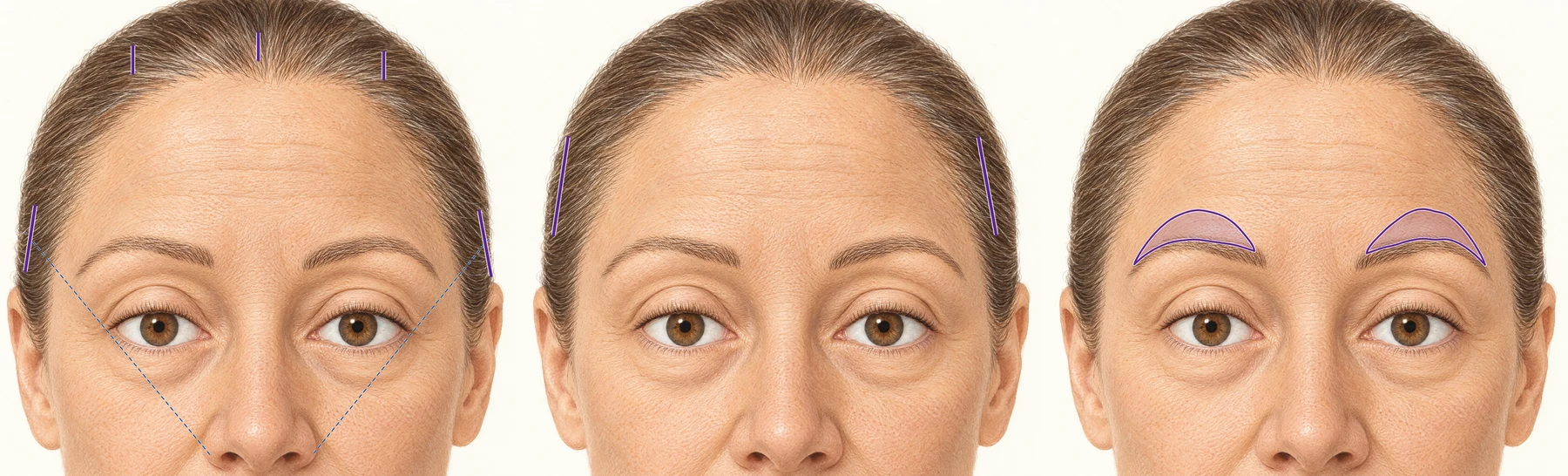
Three front views of the same woman about 55 with her hair pulled back. Left: violet marks for an endoscopic brow lift, one median and two paramedian incisions just behind the frontal hairline and one incision behind each temporal hairline on a dashed line drawn from the side of the nose through the outer corner of the eye. Middle: one violet incision in the hair of each temple for a temporal brow lift. Right: a shaded violet ellipse just above each eyebrow marking the skin removed in a direct brow lift.

Brow lift incisions

Incision sites for three brow lifts. Left, endoscopic: three short cuts behind the frontal hairline and one behind each temporal hairline. Middle, temporal: one short cut in the hair of each temple. Right, direct: an ellipse of skin removed just above each eyebrow.

  1. Median incision
  2. Paramedian incision
  3. Frontal hairline
  4. Temporal incision
  5. Line from the nasal ala through the lateral canthus
  6. Temporal brow lift incision
  7. Temporal hairline
  8. Skin removed above the eyebrow
  9. Eyebrow

Anatomy checked against StatPearls. Endoscopic Brow Lift, Turin SY et al. Simplified Lateral Brow Lift under Local Anesthesia. Plast Reconstr Surg Glob Open 2019; Foustanos A. Lateral Brow Lift. Arch Plast Surg 2015, Perry JD, Hwang CJ. Direct Browlift. Clin Plast Surg 2022.

Every eyelid illustration

See the work

Surgeons whose own sites show brow lift: before-and-after photographs first. Choose your state for the surgeons near you.

Surgeons by stateAlabamaAlaskaArizonaArkansasCaliforniaColoradoConnecticutDelawareDistrict of ColumbiaFloridaGeorgiaHawaiiIdahoIllinoisIndianaIowaKansasKentuckyLouisianaMaineMarylandMassachusettsMichiganMinnesotaMississippiMissouriMontanaNebraskaNevadaNew HampshireNew JerseyNew MexicoNew YorkNorth CarolinaNorth DakotaOhioOklahomaOregonPennsylvaniaRhode IslandSouth CarolinaTennesseeTexasUtahVermontVirginiaWashingtonWest VirginiaWisconsin

Oculoplastic surgeon
Plymouth Meeting, Pennsylvania
See the before and after
Oculoplastic surgeon
Austin, Texas
See the before and after
Plastic surgeon
Houston, Texas
See the before and after
Plastic surgeon
Carmel, Indiana
See the before and after
Oculoplastic surgeon
Wayne, Pennsylvania
See the before and after
Oculoplastic surgeon
Denver, Colorado
See the before and after
Plastic surgeon
San Diego, California
See the before and after
Oculoplastic surgeon
Philadelphia, Pennsylvania
See the before and after
Facial plastic surgeon
Park City, Utah
See the before and after
Facial plastic surgeon
Aliso Viejo, California
See the before and after
Plastic surgeon
Tysons Corner, Virginia
See the before and after
Plastic surgeon
Los Angeles, California
See the before and after

What brow lift costs

Self-pay prices, and what insurance pays when the operation is covered.

Published prices
$8,000

Most practices that publish a price for it charge between $6,750 and $8,750.

When insurance covers it
$428

Medicare's average payment to the surgeon (Brow ptosis repair, CPT 67900). The surgery center is paid separately; you pay your deductible and coinsurance.

What eyelid surgery costs, in full · Prices in your state are on your state's page.

What it treats

  • Brow droop (brow ptosis) usually starts in the outer (lateral) brow, which has less deep support than the inner brow (PMID 8643714).
  • Forces on the lateral brow: forehead muscle tone holds the brow up only on the inner side of the temporal fusion line; beyond it, soft tissue slides down over the temple fascia, and the frown muscle and the outer eye-circling muscle pull the brow down (PMID 8643714).
  • The brow does not fall evenly with age. Women in their 50s had brows about 3 mm higher above the eye than women in their 20s at the inner corner and pupil, with little difference at the outer corner (PMID 19935315).
  • The same study concludes that raising the inner and middle brow does not give a youthful result and that selective lateral lifting does (PMID 19935315).
  • The supraorbital nerve has a superficial division over the forehead muscle and a deep division running between the scalp's tough layer and the bone; injury to the deep division causes most scalp numbness after forehead lifts (PMID 7638280).

How it is done

Origins

  • Vasconez described the technique in 1994: the frown muscles and forehead muscle were divided or weakened, and excess skin was taken up by dissecting the scalp back toward the back of the head (PMID 7972423).
  • Isse's 1994 series of endoscopic forehead lifts gave results comparable to coronal lifts (PMID 8122572).

Standard steps

  • The surgeon dissects under the periosteum through three small incisions, releases the periosteum at the upper orbital rims, removes the glabellar frown muscles, and suspends the brow temporarily until the periosteum reattaches (PMID 12409778).
  • A 35-year single-practice account describes wide subperiosteal dissection to the cheekbone arch and orbit, cuts through the brow depressor muscles, and lateral suture fixation (PMID 41203333).
  • Three dissection planes are in use (subgaleal, subperiosteal, and combined); they differ in risk to the deep branch of the supraorbital nerve (PMID 42465865).
  • In cadaver faces, tension in the supraorbital nerve limited the lift to roughly 2.5 to 5.5 mm, and the fat pad under the forehead muscle layer accounted for most of the brow's mobility (PMID 36727814).

Fixation

  • A review of the fixation literature found about 11 methods in use; the most common were sutures, bone tunnels, Endotine implants and screws (PMID 40804547).
  • With sutures through bone tunnels, brow elevation of about 6 mm was held at more than 3 months; with fibrin glue it fell from about 6 mm to about 4 mm (PMID 15083028).
  • Percutaneous K-wire fixation had very few hematomas, and under 2% needed a second one-sided lift (PMID 31361803).
  • In cadaver skulls, cortical tunnels drilled at 45 degrees and Mitek anchors never went through the inner skull layer; one Endotine post and three miniscrews did (PMID 16977357).

Frown muscles

  • Removing the corrugator and procerus muscles improved moving frown lines more than leaving them in place (PMID 31046060).
  • Lifts without frown-muscle removal still raised the brow 2 to 3 mm at the inner, middle and outer brow, with complications under 1% and revisions under 2% (PMID 40820940).

High or receding hairline

  • Incisions and Endotine anchors placed in forehead creases raised the brow about 3 mm at the inner end to about 5 mm at the outer end, with forehead length unchanged (PMID 34593745).

Results and evidence

  • Pooled long-term results show the brow stays up about 3 to 4 mm: roughly 3.3 mm inner, 3.9 mm middle and 4.4 mm outer (PMID 39542644).
  • Across all brow lift types at about 21 months, the outer brow held about 3.8 mm, the middle about 3.0 mm and the inner about 2.4 mm (PMID 40788666).
  • A 2026 review found the highest long-term elevation in any study did not exceed about 5.6 mm; elevation fell gradually over time, and the inner brow was lifted least (PMID 42077543).
  • Over an average of 7 years, satisfaction was very high at 6 months and lower at 2 years or more, and about 1 in 80 patients had a reoperation (PMID 34269765).
  • Endoscopic and pretrichial open lifts both kept a meaningful elevation at about 6 years, with no difference between them (PMID 35653546).
  • Endoscopic lifts gave more early elevation than pretrichial lifts; long-term retention and complications were similar (PMID 41239801).
  • An endoscopic temporal brow lift raised the brow about 2 mm, with complications in about 1 in 70 (PMID 31764641).
  • Endotine fixation combined with upper blepharoplasty raised the brow about 1.6 mm, stable up to about 4.5 years (PMID 33631951).
  • Endoscopic and coronal/pretrichial lifts gave comparable elevation at 1 year; coronal/pretrichial brow position dropped gradually over 5 years (PMID 11322395).
  • In an early large series, about 70% of patients were satisfied, half of the surgeons surveyed were pleased with long-term results, and the hospital's endoscopic brow lift volume fell sharply afterward (PMID 12900626).
  • Analysis with the eyes closed showed forehead height did not change; the increase seen with eyes open was attributed to a relaxed forehead muscle (PMID 42012844).

Risks and complications

  • Across endoscopic subperiosteal lifts, numbness or tingling (paresthesia) occurred in about 6% and hair loss in about 3%; asymmetry and incomplete eye closure were each under 4% (PMID 23388642).
  • Endoscopic lifts had the highest hair-loss rate of all brow lift types, about 3% (PMID 30534495).
  • Temporary effects were common: itching in about 1 in 7, and headache and one-sided facial nerve weakness each in about 1 in 16. Lasting effects were undercorrection in about 1 in 14 and hair loss in about 1 in 24; forehead irregularity and a surprised look were each under 3% (PMID 34269765).
  • In open and endoscopic forehead and eyebrow lifts together, hematoma drainage was needed in about 1 in 140; bleeding was more frequent in men (PMID 41870876).
  • Neurological complications were the most common fixation-related problem, followed by aesthetic and wound problems; bone tunnels had the lowest complication profile and screws the highest (PMID 40804547).
  • Pooled complication rates were under 3% with few exceptions; permanent fixation had more asymmetry, contour irregularity, cysts and corrective surgery than temporary fixation (PMID 41697229).
  • Double vision from superior oblique muscle weakness after endoscopic brow lift has been reported and resolved within 3 months (PMID 39746538).
  • With vertical internal brow suspension, suture extrusion occurred in about 1 in 15 and temporary hair loss at incisions in about 1 in 20 (PMID 39378135).

Recovery

  • In a patient survey, most used pain medicine for under 1 week and had swelling for under 2 weeks; about 6 in 10 had some numbness, about 3 in 10 noticed hair loss at an incision, and most rated scars unnoticeable (PMID 23699709).
  • Forehead numbness took about 2 to 3 months to recover on average (PMID 34269765).
  • Open lifts left less scalp sensation than endoscopic lifts for the first 18 months, with no difference after that; nearly all patients said numbness would not stop them repeating the surgery (PMID 21079105).
  • In a bone-tunnel series, small areas of temporal hair loss recovered in under 3 months, and one frontal branch weakness recovered by 4 months (PMID 15083028).
  • The same authors cite experimental evidence that periosteal fixation must hold for at least 6 weeks to be secure (PMID 15083028).
  • Half of the patients who had headaches before surgery reported fewer or milder headaches afterward (PMID 23699709).

Combined procedures

  • The forehead lift was first described as an adjunct done alone or with facelift and blepharoplasty (PMID 887657).
  • The complication rate did not markedly increase when endoscopic forehead lifts were combined with other facial procedures (PMID 12409778).
  • Patients who also had a facelift more often took 2 weeks or longer to return to normal activities; pain medicine use, swelling, numbness, hair loss and satisfaction did not differ from brow lift alone (PMID 23699709).
  • In deep-plane facelift patients, including groups with forehead lift and endoscopic forehead lift, result ratings did not depend on the procedure group (PMID 20966814).
  • Most patients in the frown-muscle study had the endoscopic brow lift together with other procedures to the brow, midface, jowl and neck (PMID 31046060).
  • Brow lift with blepharoplasty had the same major complication rate as either alone, under 1% in each case (PMID 29369102).
  • Upper blepharoplasty at the same operation did not change long-term brow height (PMID 15083028).

Current questions

  • Durability: pooled long-term elevation of about 3 to 4 mm (PMID 39542644) against a 2026 review that finds long-term maintenance poor, especially at the outer brow (PMID 42077543).
  • Fixation: a trial found bone tunnels held the brow better than temporary tape at 9 months, with longer operating time (PMID 42441344); pooled data found no difference in revision for lost fixation between permanent and temporary bone fixation (PMID 41697229).
  • Tined implants gave more outer-brow elevation and more abnormal skin sensation than sutures in pooled data (PMID 40788666).
  • Lateral relapse: vertical internal brow suspension has been proposed to prevent it (PMID 39378135).
  • Frown-muscle removal: routine removal (PMID 31046060) against lifts without it (PMID 40820940).
  • Forehead lengthening: eyes-closed analysis reports no true elongation (PMID 42012844).
  • Neuromodulators: use among surveyed surgeons rose from about 1 in 9 to about 9 in 10, and nearly 3 in 10 think they have replaced formal brow lifting to a significant degree (PMID 37409963).
  • Nerve limit: supraorbital nerve tension may cap elevation at about 2.5 to 5.5 mm (PMID 36727814).

Terms

  • Brow ptosis: an eyebrow lower than its youthful position; the lateral segment usually drops first (PMID 8643714).
  • Endoscope: a thin camera passed through small incisions to see and dissect under the scalp (PMID 7972423).
  • Subperiosteal plane: the layer under the periosteum, the membrane covering the skull (PMID 12409778).
  • Periosteal release: cutting the periosteum at the upper orbital rim so the brow can move up (PMID 12409778).
  • Corrugator and procerus: frown muscles between the brows, weakened or removed during the lift (PMID 31046060).
  • Fixation: holding the lifted forehead with bone tunnels, screws, implants such as Endotine, sutures or glue while it heals (PMID 40804547).
  • Deep branch of the supraorbital nerve: sensory nerve to the scalp that runs under the galea; injury causes scalp numbness (PMID 7638280).
  • Temporal fusion line: ridge on the side of the skull where frontalis support of the brow ends (PMID 8643714).
  • Galea aponeurotica: the tough fibrous layer of the scalp (PMID 7638280).
  • Lagophthalmos: incomplete eye closure (PMID 23388642).

Endoscopic brow lift questions

How long does an endoscopic brow lift last?

Pooled long-term results show the brow held about 3 to 4 mm higher (PMID 39542644). The outer brow held the most, about 4.4 mm (PMID 39542644). Elevation fell slowly over time in a 2026 review (PMID 42077543). Endoscopic and open hairline lifts both kept a lift at about 6 years (PMID 35653546). Patients rated the result lower at 2 years or more than at 6 months (PMID 34269765).

Where are the incisions for an endoscopic brow lift?

The standard lift uses three small incisions in the scalp (PMID 12409778). For a high hairline, incisions in forehead creases raised the brow 3 to 5 mm without lengthening the forehead (PMID 34593745). Most patients in a survey rated their scars unnoticeable (PMID 23699709). Hair loss at an incision was noticed by about 3 in 10 (PMID 23699709). Small patches of temple hair loss recovered in under 3 months (PMID 15083028).

Is a brow lift painful?

Most patients in a survey used pain medicine for under 1 week (PMID 23699709). Swelling lasted under 2 weeks for most (PMID 23699709). Temporary headache affected about 1 in 16 patients (PMID 34269765). Half of the patients with headaches before surgery had fewer or milder headaches afterward (PMID 23699709).

Will my scalp be numb after an endoscopic brow lift?

About 6 in 10 patients had some numbness after the lift (PMID 23699709). Feeling in the forehead returned in about 2 to 3 months on average (PMID 34269765). Injury to the deep branch of the supraorbital nerve causes most scalp numbness after forehead lifts (PMID 7638280). Open lifts left less scalp feeling than endoscopic lifts for 18 months (PMID 21079105). There was no difference after that (PMID 21079105).

Can Botox replace a brow lift?

Neuromodulator use among surveyed plastic surgeons rose from about 1 in 9 to about 9 in 10 between 2000 and 2020 (PMID 37409963). Nearly 3 in 10 of those surgeons think it has replaced formal brow lifting to a large degree (PMID 37409963). An endoscopic lift held the brow about 3 to 4 mm higher in pooled long-term results (PMID 39542644).

Papers cited on this page

Newest first.

2026
Endoscopic Brow Lifting: A 35-Year Experience and Lessons Learned
Cahill G, Gidumal S, Nabili V, Keller GS · Facial Plast Surg Clin North Am · PMID 41203333
2026
Short-Term Outcomes of Endoscopic Brow Lifting Without Depressor Resection
Liu RH, Kim M, Lindsay RW · Laryngoscope · PMID 40820940
2026
Long-Term Brow Lift Outcomes: A Systematic Review and Meta-Analysis
Karanfilian T, Zong AM, Delbourgo Patton C, Gupta L, Barmettler A · Ophthalmic Plast Reconstr Surg · Systematic Review · PMID 40788666
2026
Forehead Eyebrow Lift Techniques: Review of the Literature and Critical Appraisal of Long-term Efficacy
Atiyeh BS, Chrabieh EE, Daoud FJ, Issa OB, Emsieh SE, Ghaddar HH, et al. · Plast Reconstr Surg Glob Open · PMID 42077543
2026
A Comparison of Brow Elevation and Complications: Endoscopic Versus Pretrichial Brow Lift
Garg N, Alnemri A, DeKloe J, Baldari A, Bheemreddy A, Agarwal A, et al. · Laryngoscope · PMID 41239801
2026
Understanding Perceived Forehead Changes Post-Endoscopic Brow Lift: The Impact of Frontalis Muscle Contraction
Xu L, Huang H, Lee EI, Song SH, Ahn TJ, Most SP · Plast Reconstr Surg · PMID 42012844
2026
Incidence and management of bleeding and hematoma in 805 cosmetic forehead/eyebrow lift procedures: an oculofacial plastic surgeon's experience
Dugan SE, Feist JE, Clark JD, Compton CJ, Carvalho Soares Valentim C, Kashkouli MB · Orbit · PMID 41870876
2026
"Endoscopic-assisted, subperiosteal browlift bone fixation technique outcomes: a systematic review and meta-analysis"
Graf AE, Kang JM, Ferzli G, Rosenfeld RM, Romo T · Plast Reconstr Surg · PMID 41697229
2026
Comparison of Two Surgical Techniques for Endoscopic Brow Lift: Bone Tunnel Fixation Versus Temporary Tape Fixation: A Clinical Trial
Haddady-Abianeh S, Rahmati J, Yavari A, Delavari C, Taghipour Arani M, Molaei H · World J Plast Surg · PMID 42441344
2025
Fixation Techniques Across Endoscopic Brow Lifts: A Scoping Review
Caceres H, Raza SN, Katta T, Savage A, Anderson L, Barker S, et al. · Aesthetic Plast Surg · PMID 40804547
2025
Long-term Stability in Endoscopic Brow Lift: A Systematic Review and Meta-Analysis of the Literature
Şibar S, Dikmen AU, Erdal AI · Aesthet Surg J · Systematic Review · PMID 39542644
2025
Superior oblique paresis following endoscopic brow lift
Eshraghi B, Aghajani A · J AAPOS · PMID 39746538
2023
Does Brow Lift Add Risk to Blepharoplasty? Answers From a Multicenter Analysis of 6126 Patients Undergoing Aesthetic Eye Surgery
Wormer BA, Rankin TM, Kaoutzanis C, Al Kassis S, Gupta V, Grotting JC, et al. · Ann Plast Surg · PMID 29369102
2023
Practice Patterns: An American Society of Plastic Surgeons (ASPS) Member Survey, 2000 and 2020-How Much Has Brow Lifting Changed?
Coombs DM, Sinclair NR, Kochuba A, Grow J, Couto RA, Matarasso A, et al. · Aesthet Surg J · PMID 37409963
2022
Endoscopic Browlift in Patients With Receding Hairlines
Boonipat T, Hebel N, Lin J, Frank K, Möllhoff N, Cotofana S, et al. · J Craniofac Surg · PMID 34593745
2022
Short- and Long-term Patient Satisfaction and Complications in 650 Endoscopic Forehead Lift Procedures
Kashkouli MB, Abdolalizadeh P, Mansour S, Hamami P, Karimi N, Khademi B · Ophthalmic Plast Reconstr Surg · PMID 34269765
2022
Long-Term Evaluation of Endoscopic and Pretrichial Open Forehead Lifts: A Morphometric Analysis
Aslan Gülbitti H, Stakelbeek C, van der Lei B · Plast Reconstr Surg · PMID 35653546
2021
Investigating Long-Term Brow Stabilization by Endotine-Assisted Endoscopic Brow Lift with Concomitant Upper Lid Blepharoplasty
Perez PB, Gunter AE, Moody MP, Vincent AG, Perez CR, Serra RM, et al. · Ann Otol Rhinol Laryngol · PMID 33631951
2020
The K-Wire Fixation Technique for Endoscopic Brow Lift: A Long-Term Follow-Up
Chasan PE, Hauch AT · Aesthet Surg J · PMID 31361803
2019
Association of Corrugator Supercilii and Procerus Myectomy With Endoscopic Browlift Outcomes
Starkman SJ, Sherris DA · JAMA Facial Plast Surg · PMID 31046060
2018
Complications in Brow Lifts: A Systemic Review of Surgical and Nonsurgical Brow Rejuvenations
Cho MJ, Carboy JA, Rohrich RJ · Plast Reconstr Surg Glob Open · PMID 30534495
2013
Complications of browlift techniques: a systematic review
Byun S, Mukovozov I, Farrokhyar F, Thoma A · Aesthet Surg J · Systematic Review · PMID 23388642
2013
Patient outcomes, satisfaction, and improvement in headaches after endoscopic brow-lift
Panella NJ, Wallin JL, Goldman ND · JAMA Facial Plast Surg · PMID 23699709
2011
Forehead and scalp sensation after brow-lift: a comparison between open and endoscopic techniques
Guillot JM, Rousso DE, Replogle W · Arch Facial Plast Surg · PMID 21079105
2009
Changes in eyebrow position and shape with aging
Matros E, Garcia JA, Yaremchuk MJ · Plast Reconstr Surg · PMID 19935315
2006
Current methods for brow fixation: are they safe?
Walden JL, Orseck MJ, Aston SJ · Aesthetic Plast Surg · PMID 16977357
2003
Endoscopic brow lift: a retrospective review of 628 consecutive cases over 5 years
Chiu ES, Baker DC · Plast Reconstr Surg · PMID 12900626
2002
Endoscopic forehead lift: review of technique, cases, and complications
De Cordier BC, de la Torre JI, Al-Hakeem MS, Rosenberg LZ, Gardner PM, Costa-Ferreira A, et al. · Plast Reconstr Surg · PMID 12409778
2001
The forehead lift: endoscopic versus coronal approaches
Dayan SH, Perkins SW, Vartanian AJ, Wiesman IM · Aesthetic Plast Surg · PMID 11322395
1996
An anatomically based study of the mechanism of eyebrow ptosis
Knize DM · Plast Reconstr Surg · PMID 8643714
1995
A study of the supraorbital nerve
Knize DM · Plast Reconstr Surg · PMID 7638280
1994