



















Complications covered
- Complications fall into three overlapping groups: cosmetic, functional, and symptomatic (PMID 22723228).
- Complication timing follows a pattern: corneal abrasion and retrobulbar hemorrhage in week 1; lid malposition, exposure, and tearing in weeks 1-6; contour change, asymmetry, and scarring later (PMID 20195127).
- An extensive review catalogued prevention, diagnosis, and management of complications ranging from transient ocular dryness to severe visual loss (PMID 8160107).
- Blindness after blepharoplasty is rare but has been reported repeatedly since the 1970s (PMID 432313), (PMID 1200102), (PMID 3814893), (PMID 3940099), (PMID 7338008). A 1986 review of the reported cases found retrobulbar hemorrhage in most, with the final event usually retinal or optic nerve ischemia (PMID 3516289).
- Double vision after blepharoplasty most often follows injury to the inferior oblique or inferior rectus muscle during fat removal, a risk recognized since a 1989 photo essay on avoiding inferior oblique injury (PMID 2783072), (PMID 9734448), (PMID 12360075).
- Dry eye has been reviewed for its frequency, symptoms, causes, and prevention (PMID 32309188), with guidance for reducing it published as early as 2004 (PMID 19336196).
- Lagophthalmos (incomplete lid closure) was about 8 times more frequent when the orbicularis muscle was removed along with skin than with skin-only removal, without improving satisfaction (PMID 40152471).
- Orbital compartment syndrome, a surgical emergency from rising pressure behind the eye, has been reported after blepharoplasty and requires emergency lateral canthotomy (PMID 41191880).
How each complication is recognized and managed
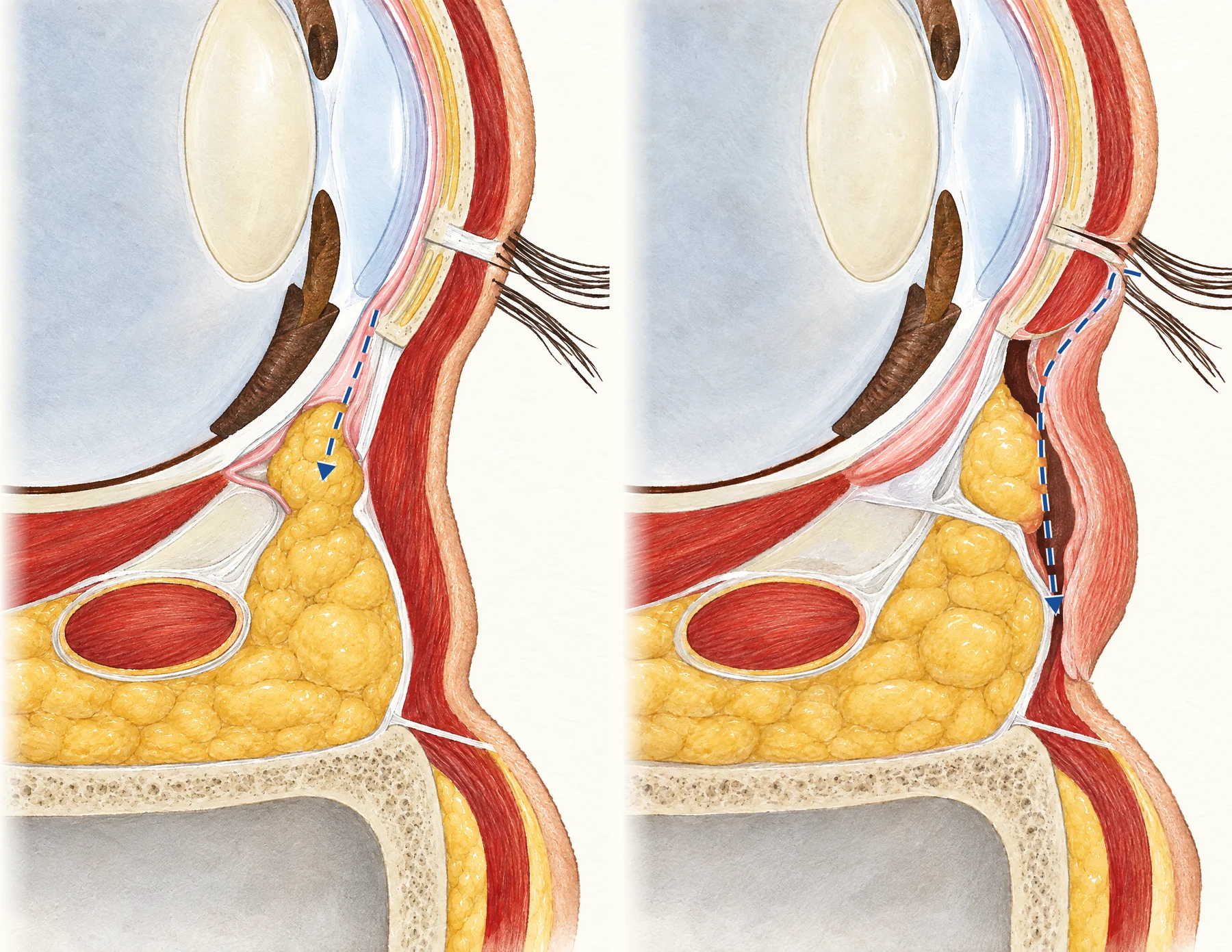
- Retrobulbar hemorrhage presents with pain, a bulging eye, and falling vision, usually within the first 24 hours. Of reported cases, about half recovered fully, about a quarter partly, and about 1 in 5 were left blind. Surgical decompression and shorter time to treatment each predicted a better outcome (PMID 29239798).
- Removing postoperative bandages and checking vision and eye prominence every 10 minutes for the first 2 hours was proposed after an early case of temporary blindness from retrobulbar hemorrhage (PMID 1200102).
- Bleeding behind both eyes in sequence caused temporary blindness in both eyes, reversed by immediate decompression in one reported case (PMID 3940099).
- Delayed bleeding around the eye, more than 48 hours after surgery, was linked to uncontrolled hypertension in reported cases that appeared 5 and 8 days after upper blepharoplasty (PMID 25797846).
- Double vision after inside-the-lid blepharoplasty involved the inferior rectus and inferior oblique muscles about equally. Some patients needed eye-muscle surgery, and most improved with observation alone (PMID 9734448).
- Cadaver dissection located the inferior oblique muscle origin relative to the bony orbital rim, giving surgeons a landmark to avoid it during fat removal (PMID 12360075).
- In a survey of oculoplastic surgeons, about 1 in 4 had seen at least one case of double vision lasting more than a week after lower blepharoplasty. The inferior oblique was involved in most cases, and the double vision resolved completely in about 3 of 4 (PMID 33246110).
- Thermal injury to the inferior rectus muscle from a carbon dioxide laser during inside-the-lid fat removal left a vertical eye misalignment at 6 months in one reported case, treated with muscle transposition (PMID 39360962).
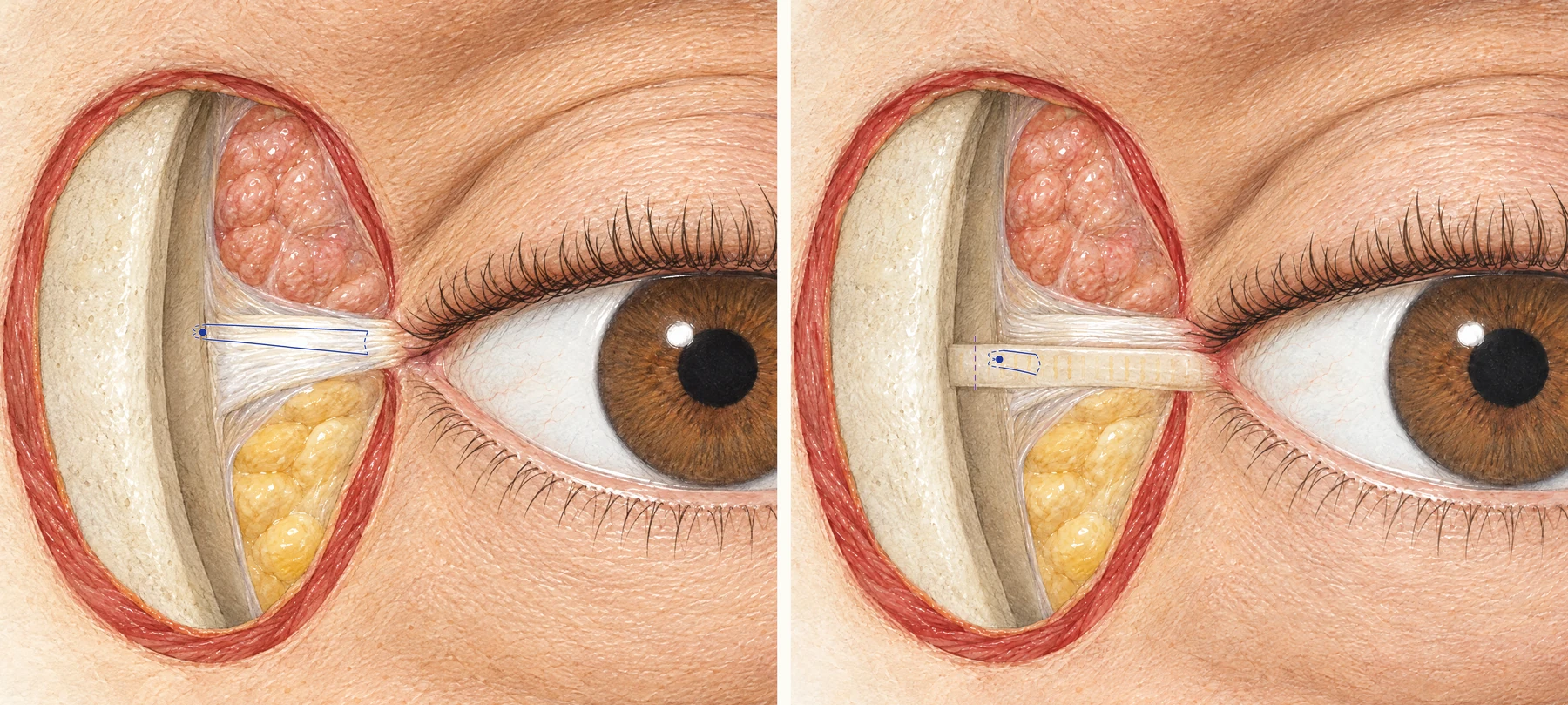
- A review of lid-suspension techniques to prevent ectropion (Frost sutures, periosteal anchoring, barbed sutures, forehead hitch) found them generally effective, though one trial found no benefit from Frost sutures and overall evidence quality was low (PMID 40907566).
Results and evidence
- A survey of American and British aesthetic surgeons found visual loss in about 1 in 20,000 blepharoplasties, and permanent loss in about 1 in 30,000. Hypertension was the most common risk factor (PMID 21239669).
- Among aesthetic eye surgery patients in an insurance-claim database, major complications occurred in about 1 in 250, most commonly hematoma at about 1 in 500 (PMID 29369102).
- In a national outcomes database of aesthetic surgery, pooled across procedures, hematoma, superficial wound complications, and reoperation each occurred in about 1% of patients or fewer (PMID 36728533).
- A 20-year literature review of lower blepharoplasty found reoperation in under 1% of patients, and scleral show, lid malposition, and ectropion each in well under 1% (PMID 30084870).
- A review of lower blepharoplasty safety reported no major complications causing eye or vision problems, with most functional and aesthetic problems resolving with conservative management or revision surgery (PMID 40995580).
- A review of upper blepharoplasty techniques found few complications reported overall and no meaningful differences between techniques in eye pressure, corneal thickness, or dry eye measures (PMID 37430010).
Risks and complications
- Skin-only excision avoids the added incomplete-closure risk of muscle excision in upper blepharoplasty, and satisfaction was no different (PMID 40152471).
- Dry eye symptoms and chemosis each affected about 1 in 4 patients in a 10-year single-surgeon series. Canthopexy during surgery raised chemosis risk, and incomplete lid closure after surgery raised dry eye risk (PMID 23329270).
- Male sex, preoperative eyelid laxity, and preoperative dry eye symptoms were each associated with more chemosis. Concurrent upper and lower blepharoplasty and a skin-muscle flap technique raised dry eye and chemosis rates further in the same series (PMID 23329270).
- Adding ptosis correction to upper blepharoplasty raised revision from about 4% to about 9% (PMID 38315110).
- Older age and a hemorrhage caused by trauma rather than surgery each predicted a worse visual outcome after retrobulbar hematoma (PMID 29239798).
- Incision tool (scalpel, radiofrequency, or CO2 laser) and suture material did not change the final scar in a 2026 evidence review; silicone-based products did reduce hypertrophic scarring (PMID 41193896).
- A silicone-based scar cream cut the need for steroid or 5-fluorouracil injection for hypertrophic or cicatricial scarring after upper blepharoplasty from about 4 in 10 eyelids to about 2 in 10 (PMID 31141848).
Recovery
- Symptoms of retrobulbar hemorrhage typically appear within the first 24 hours after surgery, with two reported peaks: from the operating room to 1 hour after surgery, and 6-12 hours after surgery (PMID 21239669).
- Lower-lid retraction requiring secondary surgery developed in about 1 in 7 patients in one review, with orbicularis suspension sutures reducing the risk (PMID 1892615).
- Cosmetic blepharoplasty was one of several identified causes of symptomatic nocturnal lagophthalmos, alongside alcohol use and facial palsy; all cases were relieved with non-surgical treatment (PMID 2076287).
- Iatrogenic dry eye disease after oculoplastic procedures including blepharoplasty is described as a distinct, under-recognized clinical entity requiring systematic preoperative ocular-surface assessment (PMID 42343584).
Combined procedures
- Blepharoplasty combined with a brow lift had the same major complication rate (about 1 in 250) as blepharoplasty alone (PMID 29369102).
- Blepharoplasty was the most common procedure added to facelift in a national facelift database, and combined procedures raised the overall odds of an adverse event (PMID 32459769).
- Forehead lift, midface lift, canthopexy, and canthoplasty performed alongside blepharoplasty were each analyzed for their effect on dry eye and chemosis; canthopexy specifically raised chemosis risk (PMID 23329270).
Current questions
- Database studies report low complication rates, under 1% for most events (PMID 36728533), while a single-surgeon series using patient-reported symptoms found dry eye and chemosis in over a quarter of patients (PMID 23329270); the gap likely reflects what is measured rather than what occurs.
- Evidence for ectropion-prevention suspension techniques remains low-quality, and comparative trials are still needed (PMID 40907566).
- Iatrogenic dry eye disease is described as an expanding, multidisciplinary problem that extends beyond blepharoplasty to other periocular and refractive procedures (PMID 42343584).
- Persistent double vision after lower blepharoplasty may be more common than the published literature suggests, based on a survey in which about 1 in 4 oculoplastic surgeons reported at least one case (PMID 33246110).
Terms
- Retrobulbar hemorrhage: bleeding behind the eye that can compress the optic nerve and cause vision loss (PMID 15599241).
- Orbital compartment syndrome: dangerously high pressure within the orbit, an emergency treated with lateral canthotomy (PMID 41191880).
- Lagophthalmos: incomplete closure of the eyelids (PMID 40152471).
- Ectropion: outward turning of the eyelid margin, away from the eye (PMID 1892615).
- Chemosis: swelling of the conjunctiva, the clear membrane over the white of the eye (PMID 23329270).
- Inferior oblique muscle: an eye-movement muscle that lies in the path of lower lid fat removal and can be injured, causing double vision (PMID 12360075).
- Diplopia: double vision, which after blepharoplasty usually comes from extraocular muscle injury (PMID 9734448).
- Insurance-claim and outcomes databases: registries used to track complication rates across many surgeons' patients (PMID 29369102), (PMID 36728533).
- Scleral show: visible white of the eye below the iris, from lower lid malposition (PMID 30084870).