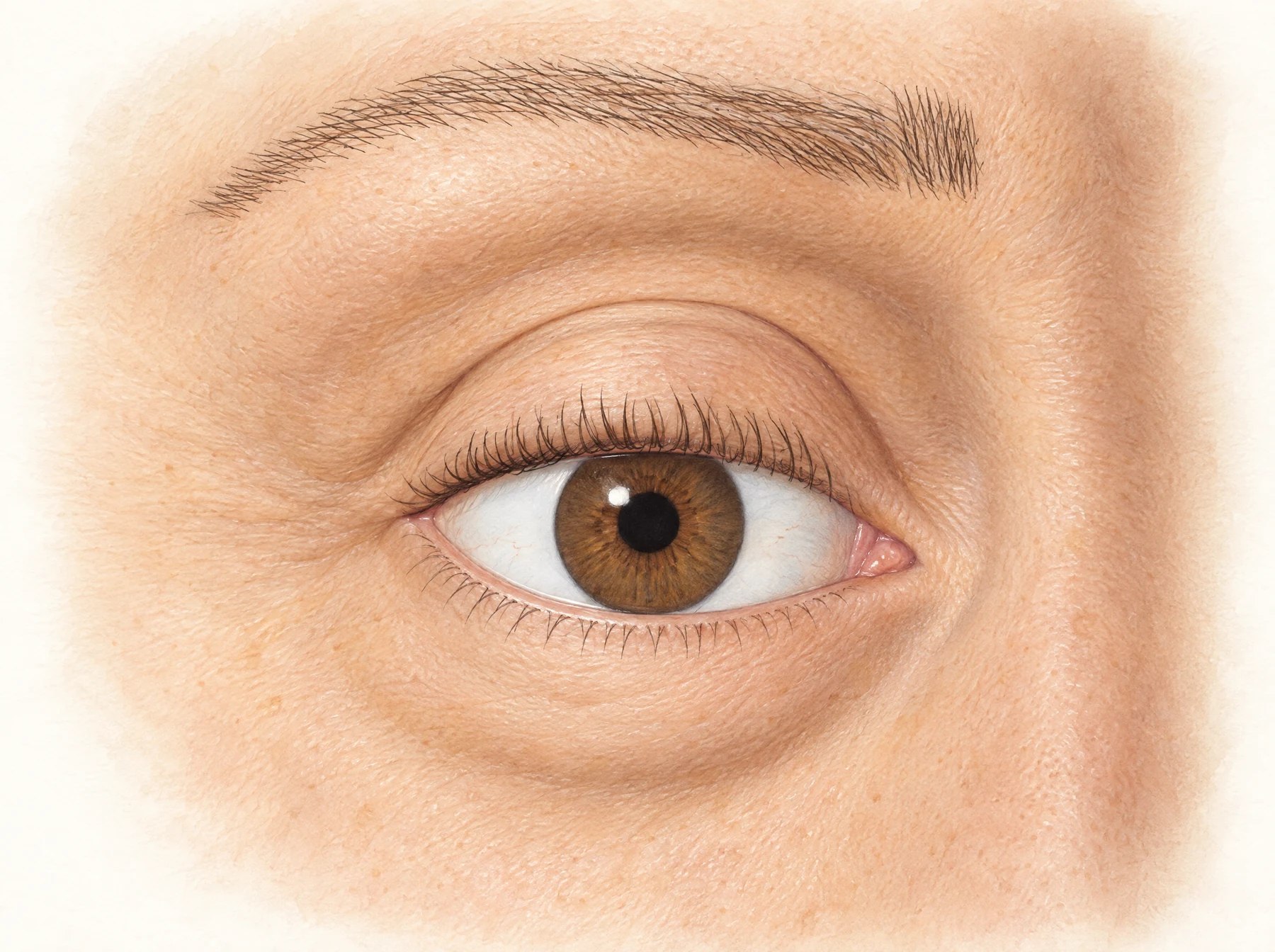
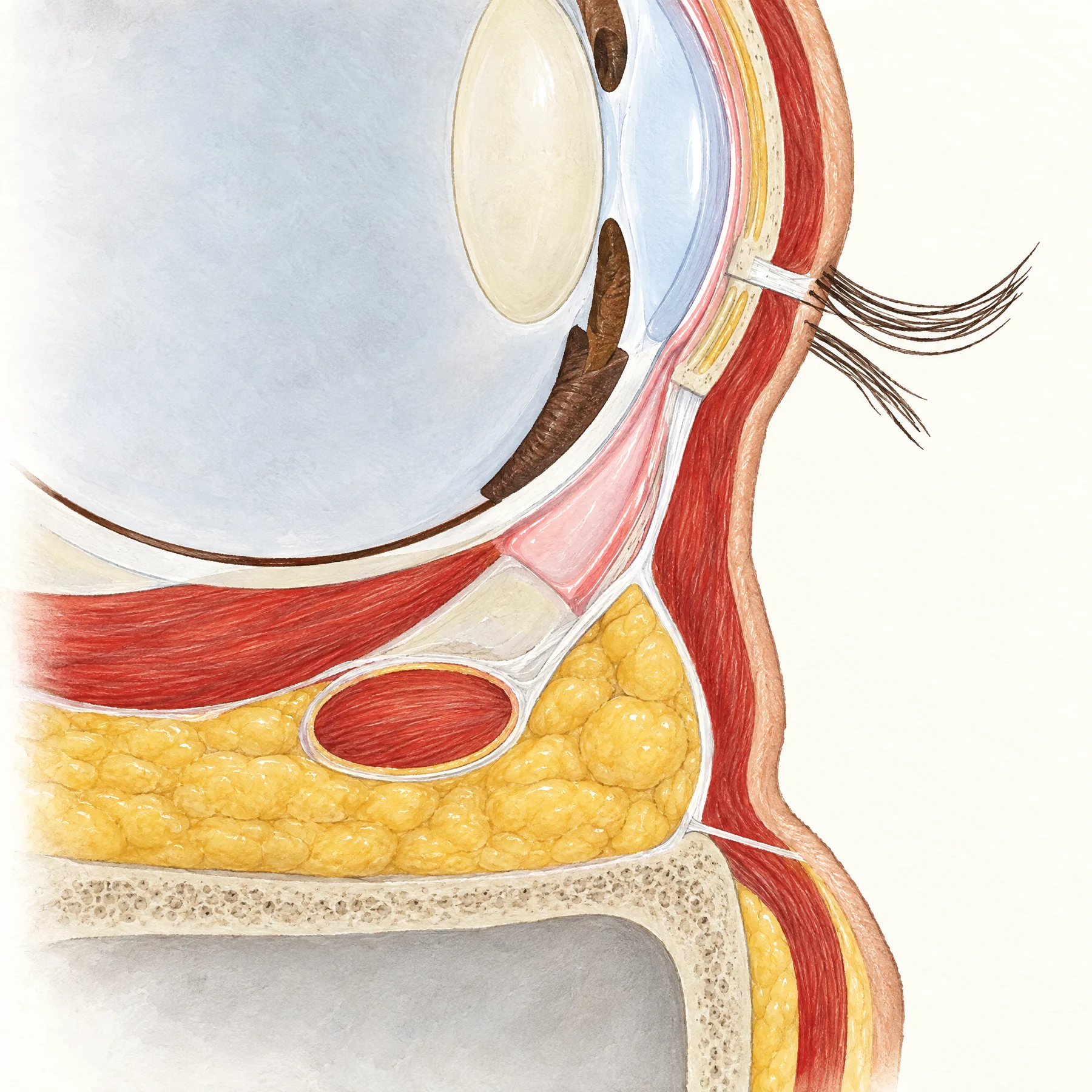
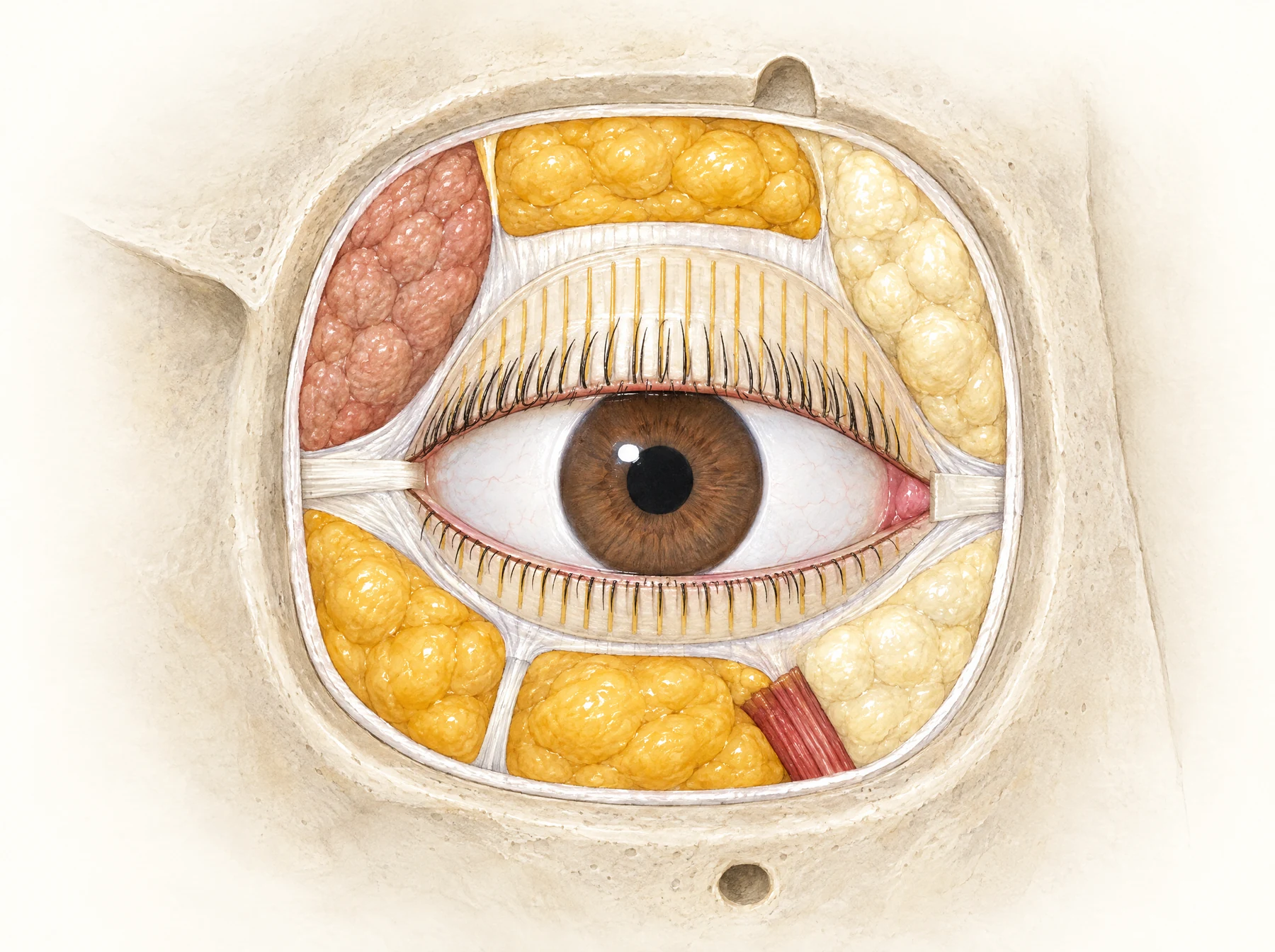
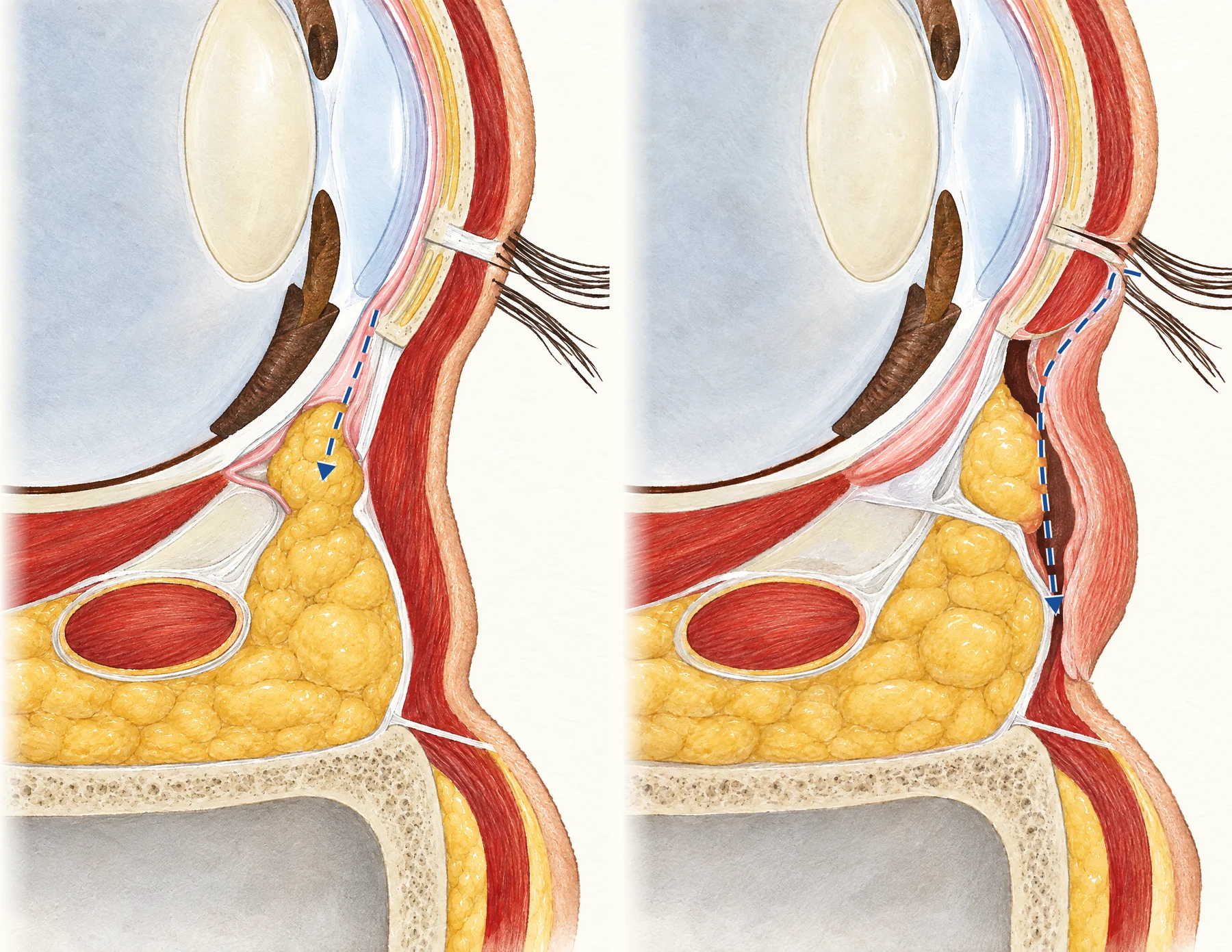
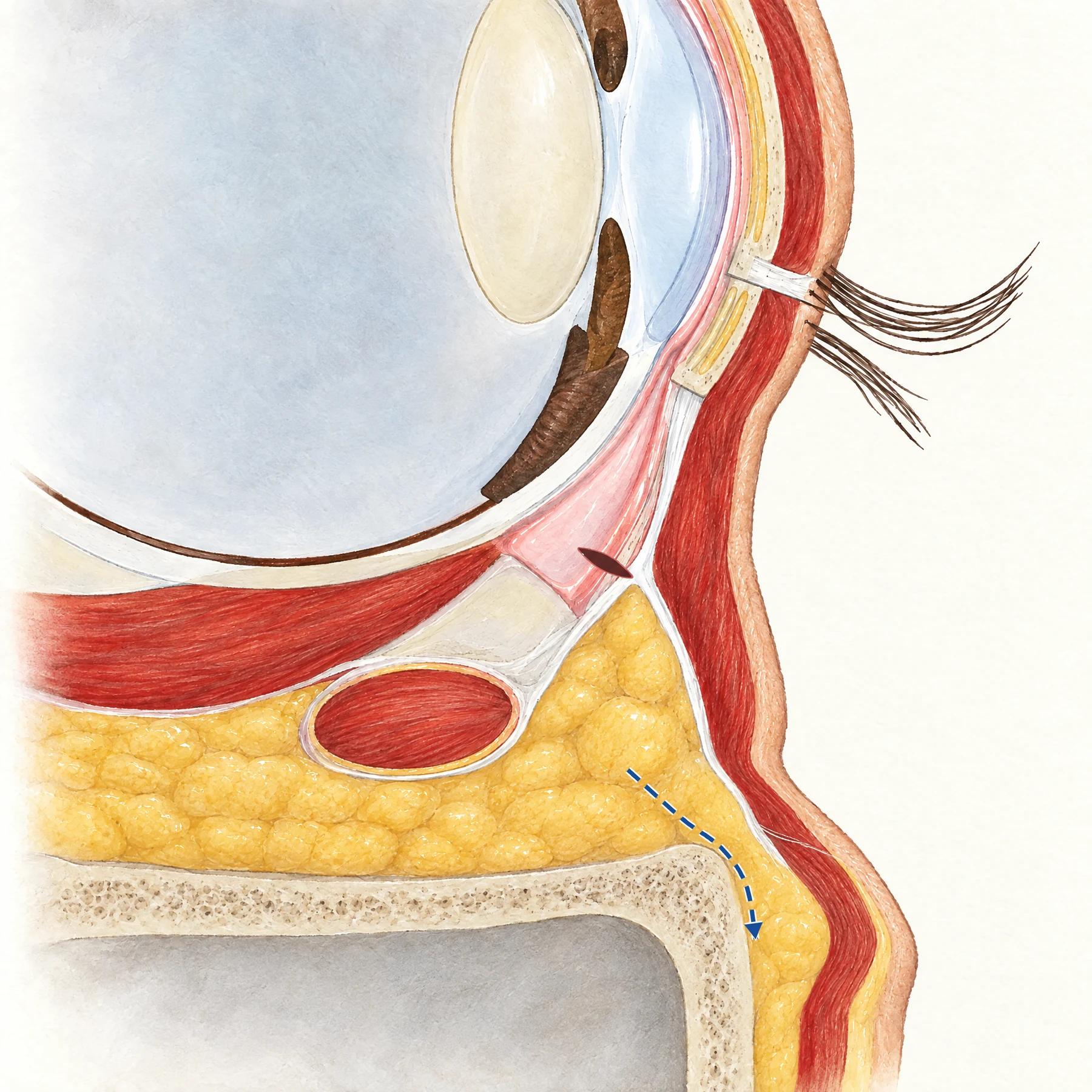
Causes: fat, fluid, festoons and the tear trough
- In patients seeking correction of eyelid bags, cheek descent and tear trough hollowing together explained about half of the problem and orbital fat prolapse the other half, with a hanging cheek festoon a smaller share; festoons and tear trough hollows were more common after age 50 (PMID 15809605).
- A tissue study of cadaver eyelids found a baggy eyelid starts with orbital fat pushing forward, followed in sequence by thinning of the orbital septum, the orbicularis oculi muscle and the skin; thinner skin went with a more severe bag (PMID 39760284). A published response argued the staging needs confirmation in living patients (PMID 41490335), and the original authors replied that the sequence remains their best current model (PMID 41490336).
- Gravity, not only volume loss, drives part of the appearance: when people with midface aging signs lay down, the tear trough, the fat bulge and cheek festoons all looked more youthful, and the photographs matched pictures of the same people taken 10 to 15 years earlier (PMID 24879881).
- Fat protrusion is not only an aging change: in East Asian adults aged 20 to 79, orbital fat already protruded in young patients and increased further with age, while the lower orbital rim stayed in place; a Caucasian comparison group instead showed the rim and cheek receding with age (PMID 41215813).
- Weakening of the lid's supporting ligaments lets the three orbital fat pads bulge forward against thinning skin and muscle; the lower lid has a less favorable complication profile for surgery than the upper lid (PMID 39585706).
- A festoon is a hanging fold of skin, orbicularis muscle and trapped fluid (PMID 635044). Malar mounds and malar edema are related, less mobile swelling over the cheekbone, bounded by the malar septum, a fascial barrier running from the orbital rim to cheek skin (PMID 19327681). Full anatomy and treatment are in Festoons and malar bags.
- The tear trough, the groove next to the nose below the inner lower lid, is a separate deformity from the bulging fat beside it (PMID 18047604). It is anchored by the tear trough ligament (PMID 22634656); anatomy plus surgical and filler treatment are in Tear trough and lid-cheek junction surgery.
Which bags surgery fixes
- Surgery removes or repositions bulging orbital fat and excess skin. It does not by itself fix fluid-based swelling: a festoon that persists after fat surgery, or malar edema from injected hyaluronic acid filler, which is dissolved with hyaluronidase before any lower eyelid surgery is considered. These need separate diagnosis and treatment (PMID 24431347); see Festoons and malar bags.
- Fat repositioning instead of removal is used when a bulge sits beside a hollow tear trough, so the same tissue fills both problems rather than leaving a hollow after the bulge is removed. In a large series the groove was eliminated in more than 8 in 10 patients, including patients with only a palpable, non-herniated fat pad (PMID 37220233); see Fat repositioning in lower blepharoplasty.
- Festoons from true orbicularis muscle laxity are treated by direct excision or an extended lower blepharoplasty with ligament release, not by fat surgery alone (PMID 39354229); see Festoons and malar bags.
- Patients whose main complaint is a hollow or dark circle rather than a bulge are often better treated with volume (fat grafting or filler) than with fat removal (PMID 34192769), (PMID 37220233); see Tear trough and lid-cheek junction surgery and Under-eye filler versus lower blepharoplasty.
Surgical approach: transconjunctival or skin-muscle
- Transconjunctival surgery removes or repositions fat through an incision inside the lid, leaving no visible skin scar, and suits bulging fat with little skin excess; the original series reported no lid retraction or ectropion (PMID 2771349). Full technique and outcome detail are in Transconjunctival blepharoplasty.
- Transcutaneous (skin-muscle) surgery uses an incision below the lashes and a skin-muscle flap, which also removes excess skin; when each approach was used on one lid of the same patient, the two were graded the same at 6 months (PMID 7568479).
- A skin pinch removes a fold of loose skin without undermining, often added to a transconjunctival fat step for patients with mild skin excess but no major bulge (PMID 18434828).
- In a survey of ophthalmic plastic surgeons, nearly all used the transconjunctival approach and lateral canthal suspension, and most used the transcutaneous approach and fat repositioning (PMID 28151825).
- Fat is handled by excision, by repositioning (moving it on its blood supply over the orbital rim), or by excising it and grafting it back (PMID 10697189), (PMID 7624408); technique comparisons, including subperiosteal against supraperiosteal planes, are in Fat repositioning in lower blepharoplasty.
Nonsurgical options
- Hyaluronic acid filler placed in the tear trough is a same-day, non-surgical option for volume loss without significant skin excess or fat bulge, and results last about 8 to 12 months; it is not a treatment for a true fat-based bulge (PMID 34192769). Technique, evidence and risk, including filler-related vision loss, are in Under-eye filler versus lower blepharoplasty.
- About 9 in 10 filler patients were satisfied, with swelling, bruising and occasional blue discoloration (Tyndall effect) as the main side effects other than blocked blood vessels (PMID 37684413); see Under-eye filler versus lower blepharoplasty.
- Intralesional tetracycline or doxycycline injection is used for festoons rather than fat bulges, intended to scar down and flatten the swelling without surgery (PMID 24841733); see Festoons and malar bags. Radiofrequency and other energy-based skin-tightening devices for mild cases are covered in Non-surgical eyelid tightening.
- Office-based direct excision of a festoon through a small incision (MIDFACE technique) is a lower-morbidity surgical alternative to a full lower blepharoplasty for patients whose main problem is a festoon rather than fat, with improvement sustained to 12 years (PMID 36877611); see Festoons and malar bags.
Results and evidence
- Reviews of published lower blepharoplasty results find that fewer than 1 in 100 patients need a repeat operation, and scleral show, lid malposition and ectropion are rarer still (PMID 30084870).
- A safety review found no major complications causing eye or visual disturbance; most functional and aesthetic problems resolved with conservative care or revision (PMID 40995580).
- Nearly all patients were satisfied after fat was removed and grafted back into the tear trough (PMID 37220233); the full series is in Fat repositioning in lower blepharoplasty.
- A lower-eyelid overview concludes that approach should follow whether skin excess, fat bulge or both are present, rather than one default technique for every patient (PMID 32971612). Outcome, satisfaction and revision detail by technique is in Lower blepharoplasty, Transconjunctival blepharoplasty, Fat repositioning in lower blepharoplasty, Festoons and malar bags and Under-eye filler versus lower blepharoplasty.
Risks and complications
- Conventional lower blepharoplasty with fat removal through the septum carries a reported lower lid malposition risk of up to about 1 in 5 (PMID 18434828).
- Fat grafting and repositioning for the tear trough or lid-cheek junction: about 1 in 9 patients had a complication, most often contour irregularity, undercorrection, swelling or bruising (PMID 37220233).
- Festoons and malar mounds are "notorious for persisting despite surgical treatment," a finding from the surgeon who first described them and still cited in current reviews, which is why a bulge, a festoon and a filler-related swelling are diagnosed separately before any single operation is chosen (PMID 24431347). Complication detail by approach, including orbital hemorrhage, strabismus, chemosis, scarring and filler vascular occlusion, is in Lower blepharoplasty, Blepharoplasty complications and Under-eye filler versus lower blepharoplasty.
Recovery
- Repositioned fat is fixed with a suture removed at 3 to 5 days; contour settles over 1 to 2 months (PMID 10697189).
- Office-based festoon excision (MIDFACE) has a minimally invasive recovery course compared with a full lower blepharoplasty (PMID 36877611); recovery timelines by technique are in Festoons and malar bags, Lower blepharoplasty, Transconjunctival blepharoplasty and Blepharoplasty recovery timeline.
Combined procedures
- Lower blepharoplasty is the most common procedure added to a facelift, and combined procedures raise the overall odds of an adverse event (Lower blepharoplasty). A midface lift is added when cheek descent, not just lid fat, contributes to the bag and tear trough appearance (Fat repositioning in lower blepharoplasty, Tear trough and lid-cheek junction surgery). Festoon excision is combined with transmalar lower blepharoplasty when festoons and fat herniation occur together, giving direct access to both in one operation (Festoons and malar bags).
Current questions
- Whether fat protrusion in young patients, documented by CT in East Asians from age 20, should be treated the same as age-related fat prolapse in older patients, or is a different, constitutional condition, is not settled (PMID 41215813).
- The staging sequence for baggy eyelid formation (fat protrusion first, then septum, muscle and skin thinning) was proposed from cadaver eyelids and is contested as needing confirmation in living patients (PMID 39760284), (PMID 41490335), (PMID 41490336).
- Gravity (tissue descent) against volume loss as the main driver of the bag-and-hollow appearance is open, with lying-down photographs favoring descent and other imaging studies favoring atrophy (PMID 24879881); see Tear trough and lid-cheek junction surgery.
- Transconjunctival or transcutaneous approach for fat preservation: both are reported safe, and a small side-by-side comparison found them equal (PMID 7568479), but the comparative evidence is too weak to name a best approach; see Lower blepharoplasty.
- Terminology for festoons, malar mounds and malar edema remains inconsistent across the literature, which complicates comparing studies of "eye bag" treatment; see Festoons and malar bags.
Terms
- Steatoblepharon: fat-related bulge of the lower eyelid, the main structural cause of an "eye bag" (PMID 39760284).
- Orbital fat prolapse (herniation): forward bulging of the fat pads behind the eye through a weakened septum (PMID 39585706).
- Tear trough: the groove at the inner lower lid next to the nose, distinct from the fat bulge beside it (PMID 18047604).
- Festoon: a hanging fold of skin, orbicularis muscle and fluid on the lower lid or cheek, from muscle laxity (PMID 635044).
- Malar edema / malar mound: fluid or soft-tissue swelling over the cheekbone, trapped by the malar septum (PMID 19327681).
- Transconjunctival approach: incision on the inner surface of the lower lid, with no external scar (PMID 2771349).
- Transcutaneous (skin-muscle) approach: incision below the lashes with a skin-muscle flap, used when skin must also be removed (PMID 7568479).
- Fat repositioning (transposition): moving orbital fat on its pedicle over the rim to fill a hollow instead of removing it (PMID 10697189).
- Skin pinch: removal of a fold of loose lower lid skin without undermining (PMID 18434828).
- Negative vector: a globe that projects forward of the cheek in profile, a risk factor for lid problems after fat removal; see Transconjunctival blepharoplasty.