



















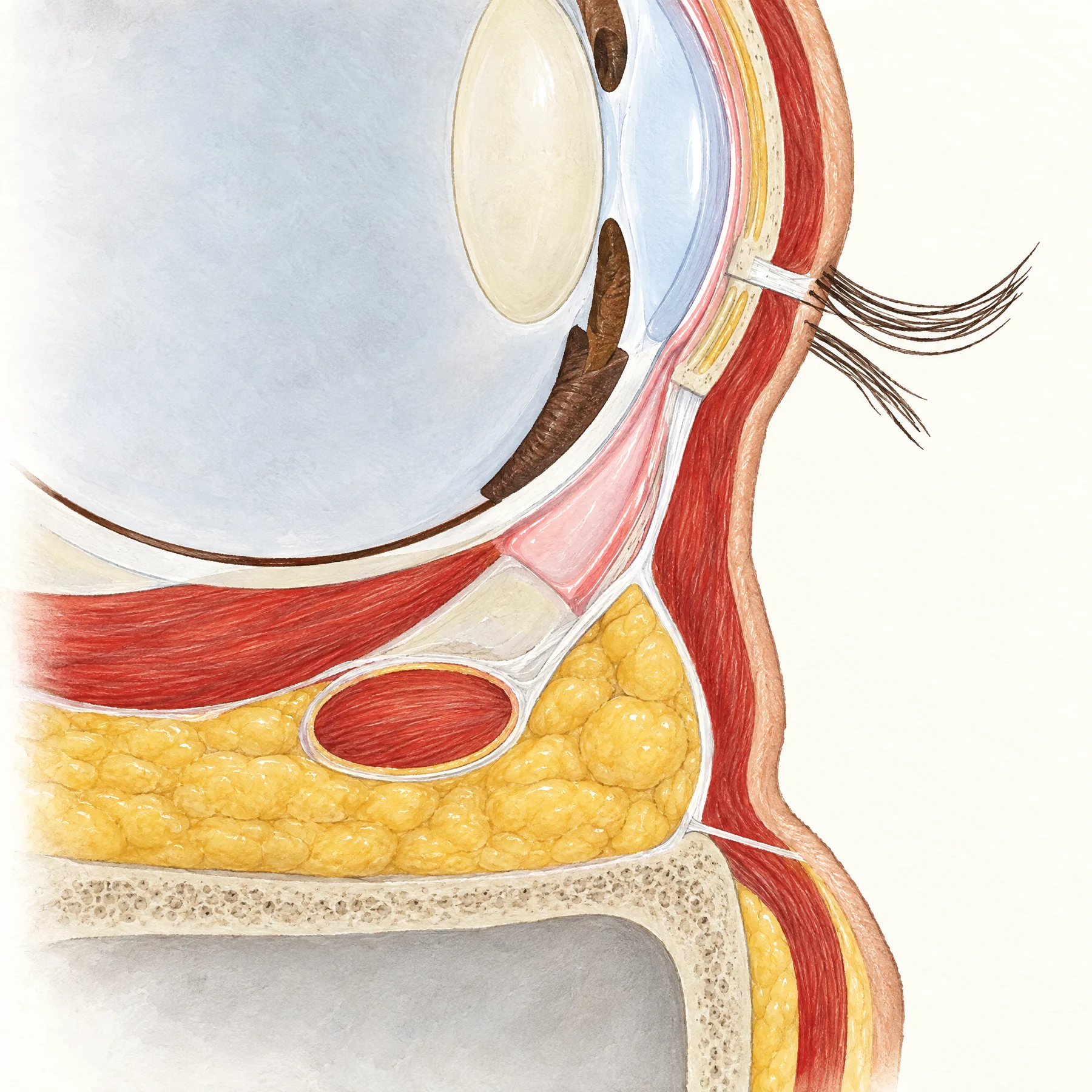
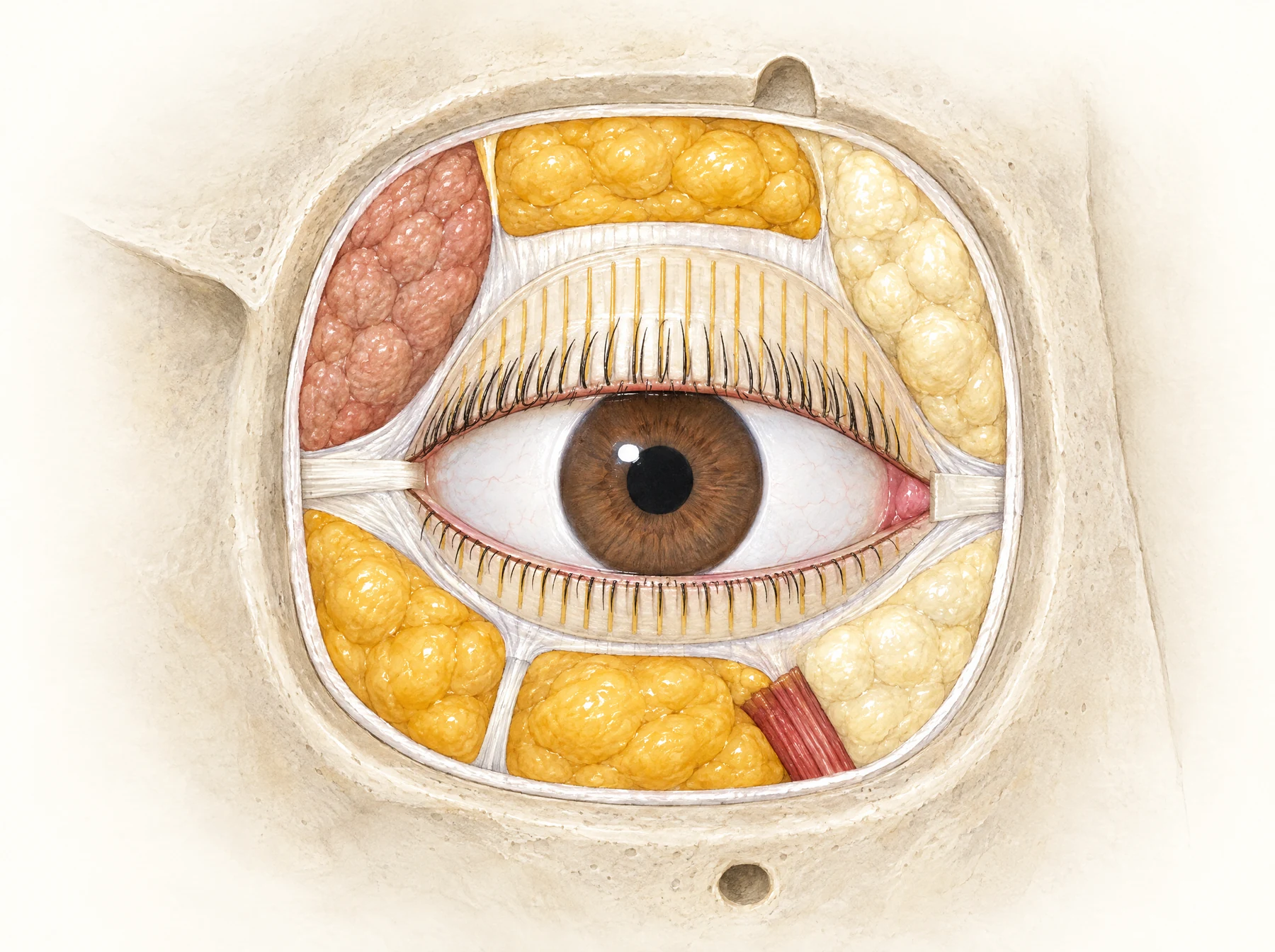
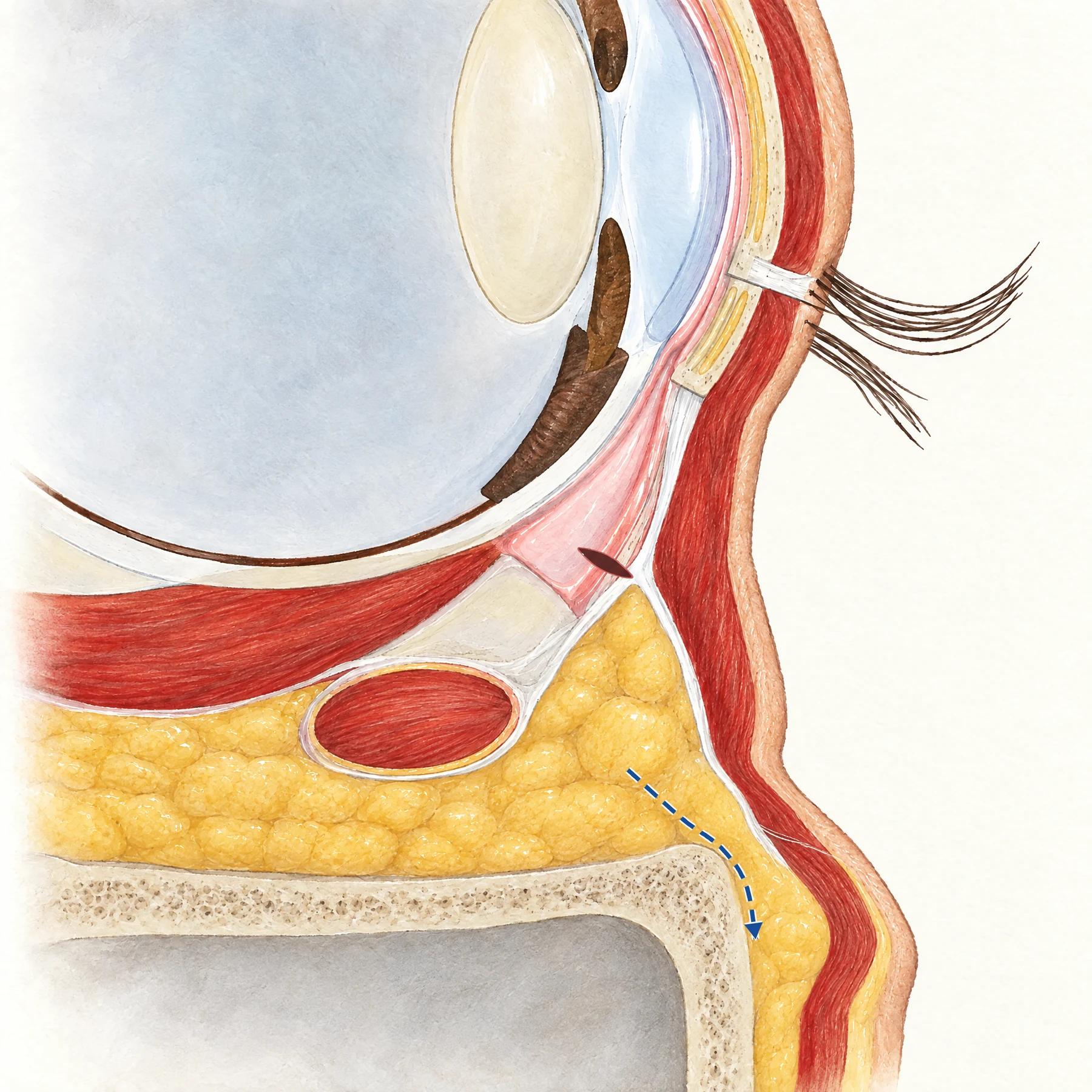
What it treats
- Removing lower lid fat through the septum alone can leave a concave, "operated" contour (PMID 7624408).
- Lower lid aging combines a fat bulge with a hollow tear trough just below it. Repositioning treats both with the same fat instead of removing the bulge and leaving the hollow (PMID 10697189).
- Fat repositioning is used for tear trough deformity with a palpable fat pad, including patients with minimal or no visible fat bulging. The deformity was eliminated in most patients, whether or not they had earlier lid surgery with fat removal (PMID 37220233).
- Tear trough anatomy and the ligament that tethers it are in Tear trough and lid-cheek junction. The transconjunctival incision is in Transconjunctival blepharoplasty.
How it is done
- Loeb described sliding the orbital fat pad over the rim, and grafting fat, to level lid depressions (PMID 7338007).
- Hamra released the arcus marginalis, the septal attachment at the orbital rim, and advanced lower lid fat over the rim during composite facelifts and isolated blepharoplasty (PMID 7624408).
- Hamra later added the septal reset, advancing the orbital septum itself over the rim for a firmer lid undersurface than fat transposition alone provides (PMID 15253208).
- Goldberg moved medial and central fat pedicles through a transconjunctival incision into a pocket on the cheekbone under the periosteum. Some fat resorbed unevenly over the following months (PMID 10697189).
- Comparing planes, fat placed under the periosteum (subperiosteal) was more precise, disturbed less normal anatomy and bled less. Placement on top of the periosteum (supraperiosteal) was faster but more traumatic, with more bruising, swelling and temporary contour irregularity. The final aesthetic result did not differ, and every patient in both groups was satisfied (PMID 23471339).
- Supraperiosteal fat repositioning with a midface lift in Asian patients was done through the inner lid (transforniceal) in a minority and through a skin-excision incision in most (PMID 38353810).
- Submuscular and preorbicularis planes were developed to address difficulties reported with the subperiosteal plane. Fat placed above the orbicularis muscle was followed for more than 3 years (PMID 33538121).
- An orbicularis oculi muscle overlap method combined with fat repositioning was developed for thin eyelids with a persistent tear trough after standard fat sliding or arcus release (PMID 24938691).
- Septal reinforcement with inverted-T or X-shaped plication, combined with fat preservation and septal repositioning below the arcus marginalis (PMID 29566215).
- Fat flap transposition stabilized with nasal alar base filling, in patients aged 22-49, fills the tear trough and the nasal alar base while preserving the fat pedicle's blood supply (PMID 39340682).
- Reconstructing the orbital fat flap extends pedicle length and preserves its blood supply, for more complete tear trough coverage where the standard pedicle is too short (PMID 39511024).
- Orbital septal fat release and preservation is used as a base for the orbitopalpebral sulcus rather than repositioned as a discrete pedicle (PMID 28180921, PMID 28337617).
- In an extended transconjunctival technique the fat pads are excised, the tear trough ligament and orbicularis retaining ligament are released, and the excised fat is grafted under the released ligament rather than repositioned on a pedicle (PMID 28746272). A larger series of the same approach with ligament release and free fat grafts followed patients for almost 2 years (PMID 41150997).
- Tear trough ligament release alone allows spontaneous repositioning of sub-orbicularis fat without a formal pedicle transfer (PMID 42247776).
- Midface rejuvenation can combine a preperiosteal midcheek lift, lower blepharoplasty with orbital fat used as a transposition flap, and autologous fat grafting (PMID 28684338).
Results and evidence
- Three-dimensional volume measurement showed a lasting gain in the tear trough and upper cheek about a year after surgery, with no meaningful difference between the two sides (PMID 26847158).
- Intraorbital fat repositioning with septal reset improved grade II and III tear trough deformity significantly more than autologous fat grafting. A small minority of eyes in each group showed no improvement (PMID 28008460).
- A minced free fat graft and a pedicle fat flap gave similar complication rates and satisfaction. Reoperation was about 6% with the graft and 12% with the flap, a difference not large enough to be reliable (PMID 37463504).
- In a randomized trial, traditional fat excision and fat transposition (both with canthopexy) both improved appearance on photographs, and self-esteem scores improved at 6 months (PMID 22124642).
- After septal plication, mild lid retraction or malposition, when it occurred, recovered without treatment within 1-2 weeks. There was no permanent malposition or ectropion (PMID 29566215).
- Fat flap with nasal alar base filling left about 9 in 10 patients with no visible deformity and most patients satisfied. Ultrasound showed no gap at the fat flap 6 months after surgery (PMID 39340682).
- Visible fat bulging is not required for benefit. Patients with severe or moderately severe tear trough complaints fell from about 86% before surgery to about 34% after, and lower eyelid satisfaction scores improved (PMID 37220233).
- The extended technique with ligament release needed revision in about 2 in 100 patients, with no chemosis, prolonged swelling, lower eyelid retraction or ectropion (PMID 28746272).
- The extended technique with free fat grafts left no scleral show. Fat necrosis occurred in about 3 in 100 patients and revision in about 1 in 100 (PMID 41150997).
- Ligament release alone gave excellent outcomes in most patients at every deformity grade, with no poor outcomes. Satisfaction trended lower with more severe deformity (PMID 42247776).
- Supraperiosteal repositioning with a midface lift left about 78% of patients extremely satisfied and nearly all the rest satisfied at 6 months. No facial numbness, paralysis, new double vision or granuloma was reported (PMID 38353810).
- A midface lift through a skin-muscle flap increased tear trough volume on 3D imaging whether the fat was left alone, repositioned or removed (PMID 36719989).
- A transconjunctival deep-plane midface lift had no significant complications over years of follow-up. Patients with heavy excess skin or festoons were advised traditional techniques instead (PMID 22859542).
- Fat placed above the orbicularis muscle kept its correction for more than 3 years, with no contour irregularity or long-term complication (PMID 33538121).
Risks and complications
- Pooled results for fat grafting or repositioning at the tear trough or lid-cheek junction: complications about 1 in 9, contour irregularity or undercorrection about 1 in 16, hematoma, swelling or bruising about 1 in 16, reoperation about 1 in 40 (PMID 39158343).
- Fat repositioning did not affect binocular vision. Vertical and horizontal eye movements worsened at 3 months and were no longer different from baseline by 6 months (PMID 34260464).
- After supraperiosteal repositioning through the skin route, lower lid ectropion needing a lateral tarsal strip occurred in under 1 in 100 patients, and revision for residual lateral fat in under 1 in 100 (PMID 38353810).
- After fat repositioning for a tear trough with a palpable fat pad, transient conjunctival bleeding, eyelid numbness and dry eye all resolved spontaneously. Undercorrection of the tear trough was the most common problem, in about 1 in 8 patients (PMID 37220233).
- The supraperiosteal plane caused more temporary bruising, swelling and contour irregularity than the subperiosteal plane in a single-surgeon comparison (PMID 23471339).
- A midcheek lift combined with fat-preserving blepharoplasty and fat grafting caused ectropion in a few patients, resolved with daily massage (PMID 28684338).
Recovery
- Repositioned fat is fixed with a suture removed at 3-5 days, and the contour settles over 1-2 months (PMID 10697189).
- After fat flap with nasal alar base filling, ultrasound at 6 months showed no obvious gap (PMID 39340682).
- After the extended ligament-release technique, revision was uncommon and swelling did not linger (PMID 28746272).
- The volume gain from repositioned fat was stable at about a year, with no meaningful loss between 10 and 16 months of follow-up (PMID 26847158).
With a facelift
- Hamra performed arcus marginalis release with fat preservation in every composite facelift, and in isolated blepharoplasty for patients without advanced facial aging (PMID 7624408).
- The septal reset was added to composite facelift after orbicularis repositioning and fat transposition (PMID 15253208).
- In a national facelift database, blepharoplasty was the most common added procedure, and combined procedures raised the odds of adverse events (PMID 32459769).
- The facelift approach can be chosen by midface ptosis grade, with transconjunctival blepharoplasty plus skin pinch or fat transposition as the lower lid options (PMID 33657627).
- A midcheek lift in the preperiosteal plane, combined with a fat transposition flap and autologous fat transfer, was used for concurrent midface and lower lid aging (PMID 28684338).
- Supraperiosteal fat repositioning is routinely combined with a midface lift, reaching the plane through the inner lid or through a skin incision (PMID 38353810).
Current questions
- Subperiosteal against supraperiosteal plane: the only direct single-surgeon comparison found no difference in final result, though the supraperiosteal plane caused more short-term bruising and irregularity (PMID 23471339).
- Pedicled transposition against free fat grafting: one comparison of minced graft and pedicle flap found equal outcomes (PMID 37463504). Another comparison of repositioning and fat injection favored pedicled repositioning for higher-grade deformity (PMID 28008460).
- Plane choice beyond subperiosteal and supraperiosteal now includes submuscular and preorbicularis placement, each proposed to solve problems reported with the others, with no head-to-head comparison identified (PMID 33538121).
- Whether visible fat bulging is required before repositioning: one series reports benefit with only a palpable, non-bulging fat pad (PMID 37220233).
- Transposing fat is reported as probably easier to control through the skin approach than through the inner lid, though a 2025 review found the comparative evidence too weak to be certain (PMID 41415593).
- Ligament release alone, without a formal fat pedicle, is proposed as a simpler alternative to fat transposition or septal manipulation, pending controlled trials (PMID 42247776).
Terms
- Fat repositioning (transposition): moving orbital fat on its blood-supplying pedicle over the orbital rim instead of excising it (PMID 7338007).
- Arcus marginalis: the attachment of the orbital septum to the bony orbital rim, released to allow fat to move over the rim (PMID 7624408).
- Septal reset: advancing the orbital septum itself, not just the fat, over the rim (PMID 15253208).
- Subperiosteal plane: a pocket for the fat pedicle created under the periosteum of the maxilla (PMID 10697189).
- Supraperiosteal plane: a pocket for the fat pedicle created above the periosteum, over the bone (PMID 23471339).
- Free fat graft: fat that is excised, then placed without a vascular pedicle, relying on revascularization (PMID 37463504).
- Tear trough ligament: the ligament tethering the lower lid to the bone at the tear trough, released in some repositioning techniques (PMID 28746272).
- Hirmand grade: a grading scale for tear trough deformity severity, from 0 (no visible deformity) upward (PMID 39340682).
- Orbicularis retaining ligament: the ligament tethering the lid-cheek junction laterally, released in extended techniques (PMID 28746272).