



















What it treats
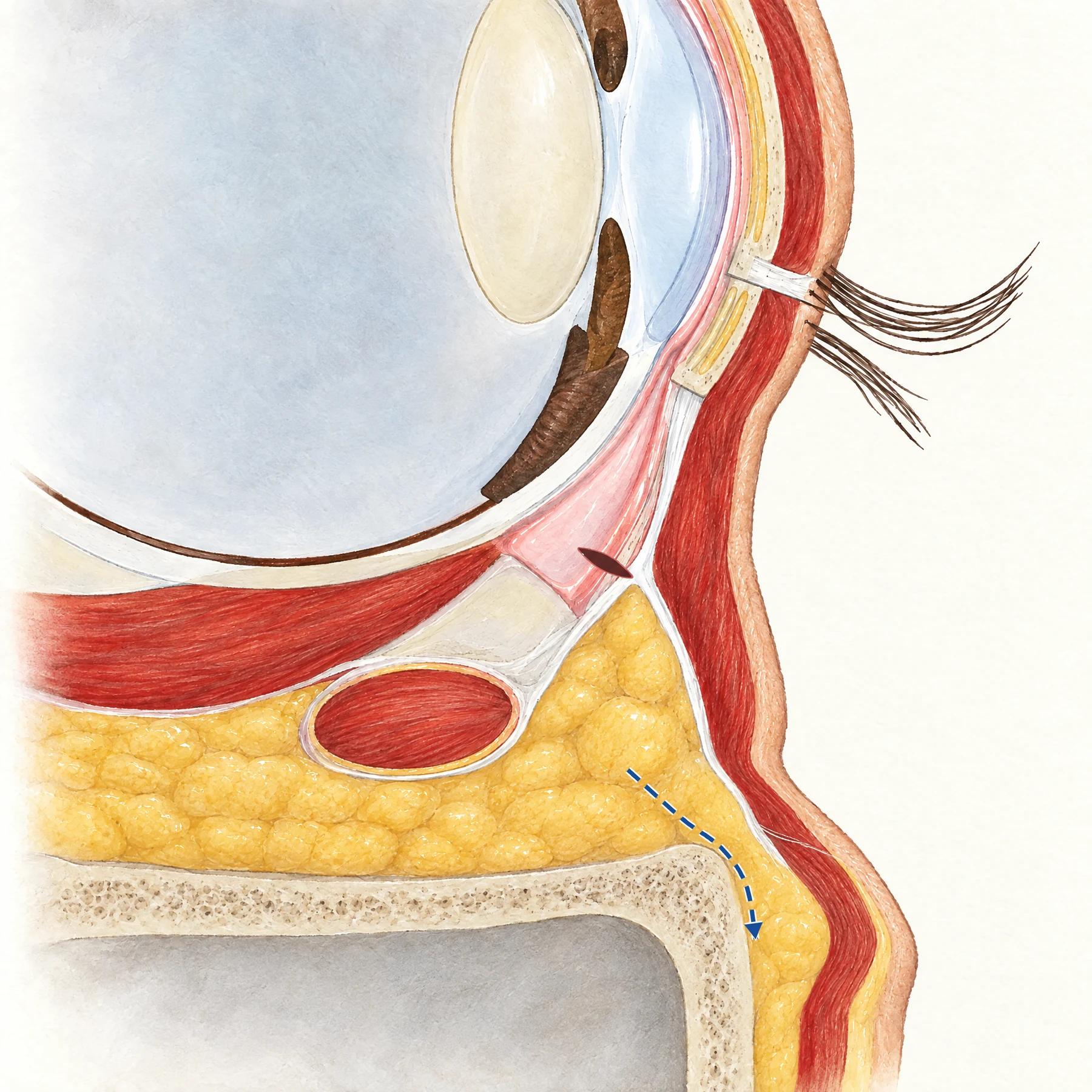
- Tear trough deformity (TTD) is a groove at the lower lid-cheek junction where the visible orbital rim is not covered by soft tissue (PMID 34012281).
- Causes are grouped as bone deficiency, fat prolapse or atrophy, and skin laxity; a published atrophy-bulging-laxity (ABL) system matches each cause to a treatment approach (PMID 32716132).
- TTD is described in the filler literature as the single most challenging facial area to treat with HA (PMID 34012281).
- Filler works best between ages 30 and 40, still helps to about 50, and is not recommended as the first choice after that (PMID 35478038).
- Filler and surgery are not always separate populations: many patients fall on a continuum where either approach is appropriate and the choice depends on individual risk tolerance (PMID 35386936).
How it is done
Filler technique
- HA gel is placed on the bone, deep to the orbicularis oculi muscle, in front of the infraorbital rim, by serial puncture or retrograde threading with a fine needle (PMID 34192769).
- Needle and cannula technique give no significant difference in outcomes or adverse events (PMID 35259144); needles carry more bruising (ecchymosis) and cannulas carry more edema (PMID 37424173).
- Pairing a firmer (higher G-prime) filler at the midface with a softer, less hydrophilic filler in the tear trough itself is reported to reduce the volume needed and prolong the result (PMID 39590588).
Surgical technique
- Fat repositioning blepharoplasty moves or grafts orbital fat over the rim instead of removing it; the transconjunctival approach suits patients with minimal skin excess, and the supraperiosteal plane allows a quicker procedure with no difference in final cosmetic outcome compared with other planes (PMID 39590588).
- Internal fixation of the repositioned fat lowers the risk of fat relapse and skin scarring but carries its own risk of suboptimal fat position (PMID 39590588).
- Midfacial volumization alongside, or in place of, direct tear-trough treatment is reported to improve overall infraorbital results in both filler and surgical planning (PMID 36998744).
Results and evidence
- Filler satisfaction is about 9 in 10 patients (PMID 37684413).
- In routine practice, most patients improved at the tear trough, about 84% were satisfied, and the effect was seen out to 12 months (PMID 40442496).
- In one retrospective study, improvement in infraorbital hollowing was sustained at 18 months, with no significant difference between the 6-, 12- and 18-month follow-ups, challenging the usual 6-12 month duration estimate (PMID 41446717).
- In a small 3D-imaging study, injected volume retention was about 70-80% at 30 days and fell to about 50-70% at 90 days (PMID 39670215).
- A composite non-cross-linked HA improved trough depression and the infraorbital depression, with only transient bruising, swelling and redness (PMID 38545776).
- In a randomized comparison, HA alone produced more Tyndall effect (blue discoloration) than HA combined with collagen or collagen alone (PMID 38299745).
- Direct comparison of the two approaches: fat repositioning gives long-lasting results at higher surgical risk; HA filler gives immediate, minimally invasive results that require periodic maintenance (PMID 39590588).
- Surgical comparator: across lower blepharoplasty, reoperation is under 1%, with scleral show, lid malposition and ectropion each well under 1% (PMID 30084870).
- Surgical fat grafting or repositioning comparator: total complications about 1 in 9, with reoperation about 1 in 40 (PMID 39158343).
Risks and complications
Filler, nonvascular
- Swelling and bruising each affect about 1 in 5 filler patients, redness about 1 in 14, lumps about 1 in 20 and blue discoloration (Tyndall effect) about 1 in 100 (PMID 37684413).
- Malar edema, a delayed complication distinct to the periocular area, was reported in about 1 in 9 patients in one review; about 9 in 10 adverse events overall were mild and self-resolved within a month (PMID 33546985).
- The physical basis of the "Tyndall effect" is disputed: HA gels are not the uniform, sub-wavelength spherical particles the true Tyndall effect requires, and skin's light-filtering properties make true subdermal blue-light scattering an unlikely mechanism; a vein-coloration-like optical effect is proposed instead (PMID 25192332).
Filler, vascular occlusion and blindness
- Reported cases of blindness are attributed to soft-tissue fillers of all types; hyaluronic acid accounts for a little over a quarter and autologous fat for nearly half (PMID 31321177).
- Among reported vascular complications of facial filler, about 3 in 5 ended in blindness, and about 7 in 10 of those patients had no improvement (PMID 31360292).
- Vision loss was the most common ocular complication of periocular HA injection, and nearly half of reported cases showed no improvement despite treatment (PMID 35091771).
- Patients with vision loss after facial HA injection had retinal or ophthalmic artery embolization, with recovery dependent on timing and type of subsequent treatment (PMID 30006992).
- Patients with ophthalmic artery occlusion after filler (HA and autologous fat) had no improvement in visual acuity, and some also had brain infarction (PMID 22835509).
- In a 2026 series of ophthalmic-cerebral embolic stroke after cosmetic facial injection, severe visual impairment improved in only about 1 in 5 patients by discharge, and earlier treatment was not associated with visual improvement (PMID 42588251).
- A scoping review of HA facial filler complications found tissue necrosis and tissue embolism among the reported severe complications, with some cases progressing to blindness or stroke (PMID 42525051).
Surgery
- Pooled surgical complication data: scleral show, ectropion and reoperation are each under 1% after lower blepharoplasty (PMID 30084870); fat grafting or repositioning complications are about 1 in 9, with reoperation about 1 in 40 (PMID 39158343).
- Vascular and nonvascular filler complication categories, including granuloma, migration and skin necrosis, are reviewed with prevention strategies keyed to anatomy and injection technique (PMID 33102629, PMID 33500603).
Recovery
- Filler: common treatment responses were mild or moderate and resolved within a month, and no severe adverse events were reported in the real-world study (PMID 40442496).
- Needle injection causes more bruising, cannula injection causes more edema; both are transient (PMID 37424173).
- Ocular complications after periocular HA injection nearly always have an immediate onset, which shapes the recovery and monitoring window (PMID 35091771).
- Supraperiosteal-plane fat repositioning surgery causes postoperative edema and temporary irregular contouring before settling to a final result equivalent to other surgical planes (PMID 39590588).
- When filler is misplaced, recovery can mean a second procedure: patients with filler-associated tear trough deformity needed corrective surgery with ligament release and fat transposition, and about 9 in 10 were satisfied with the corrective outcome (PMID 38727846).
Combined procedures
- Pairing a firmer filler at the midface cheek with a softer filler at the tear trough itself is used to blend the two zones and reduce the total filler volume needed (PMID 39590588).
- Combining collagen with HA reduced the rate of Tyndall discoloration compared with HA alone, while addressing collagen's shorter retention time (PMID 38299745).
- Midfacial volumization is used alongside infraorbital filler or surgery to address overlapping deformities such as malar mounds and festoons (PMID 36998744).
- Surgical correction (ligament release plus fat transposition) is used specifically to remove and treat filler that has produced a static or dynamic deformity (PMID 38727846).
Current questions
- Cost-effectiveness: the only identified economic comparison of injectable volumizers against surgical facial rejuvenation is a 2010 analysis of large-volume filler against rhytidectomy, which warned that repeat filler treatments can eventually exceed the cost of a single surgical procedure; no tear-trough-specific cost-effectiveness study was found (PMID 20665407).
- Duration is contested: a 2025 retrospective study found sustained improvement to 18 months (PMID 41446717), while a 2022 multicenter study found benefit dropping off after age 50 and recommended the usual 12-month follow-up window (PMID 35478038).
- Whether retrobulbar hyaluronidase reliably reverses filler-induced blindness is unresolved: two systematic reviews found visual improvement in only a minority of documented treated cases, and both concluded the evidence does not support the treatment as reliably effective (PMID 31880685, PMID 35787383).
- Whether the Tyndall effect is the correct physical explanation for blue-gray tear trough discoloration is disputed on optical grounds, with a vein-coloration mechanism proposed as more plausible (PMID 25192332).
- Rising reports of filler-associated tear trough deformity needing MRI workup and corrective surgery suggest a need for standardized volume and depth limits in this region (PMID 38727846).
- A 2024 narrative review frames the choice as patient-goal-dependent rather than settled by outcome data: fat repositioning surgery for patients wanting a long-term correction and willing to accept surgical risk, HA filler for patients preferring a non-invasive, maintainable, reversible treatment (PMID 39590588).
Terms
- Tear trough deformity: a groove at the lower eyelid-cheek junction where the orbital rim shows through unsupported skin (PMID 34012281).
- Infraorbital hollow: the broader area of under-eye volume loss that includes, but extends beyond, the tear trough (PMID 32716132).
- Tyndall effect: a light-scattering phenomenon proposed, and disputed on physical grounds, as the cause of blue-gray discoloration over HA filler (PMID 25192332).
- Hyaluronidase: an enzyme that dissolves hyaluronic acid, used to treat filler overcorrection, migration, or vascular occlusion (PMID 34188752).
- Vascular occlusion: blockage of a blood vessel by injected filler, which can cause skin necrosis or blindness (PMID 33102629).
- Retrobulbar hyaluronidase: hyaluronidase injected behind the eye in an attempt to reverse filler-induced vision loss, of uncertain effectiveness (PMID 31880685).
- G-prime (G'): a measure of a filler's firmness or elasticity that guides where and how much is used (PMID 39590588).
- MIHAS: the Merz Infraorbital Hollow Assessment Scale, used to grade under-eye hollowing severity (PMID 41446717).
- GAIS: the Global Aesthetic Improvement Scale, a clinician- or patient-rated outcome measure (PMID 40442496).
- Fat repositioning: a surgical technique that moves lower-eyelid fat over the orbital rim to fill the tear trough instead of removing it (PMID 39590588).