Causes: skin, brow, or fat
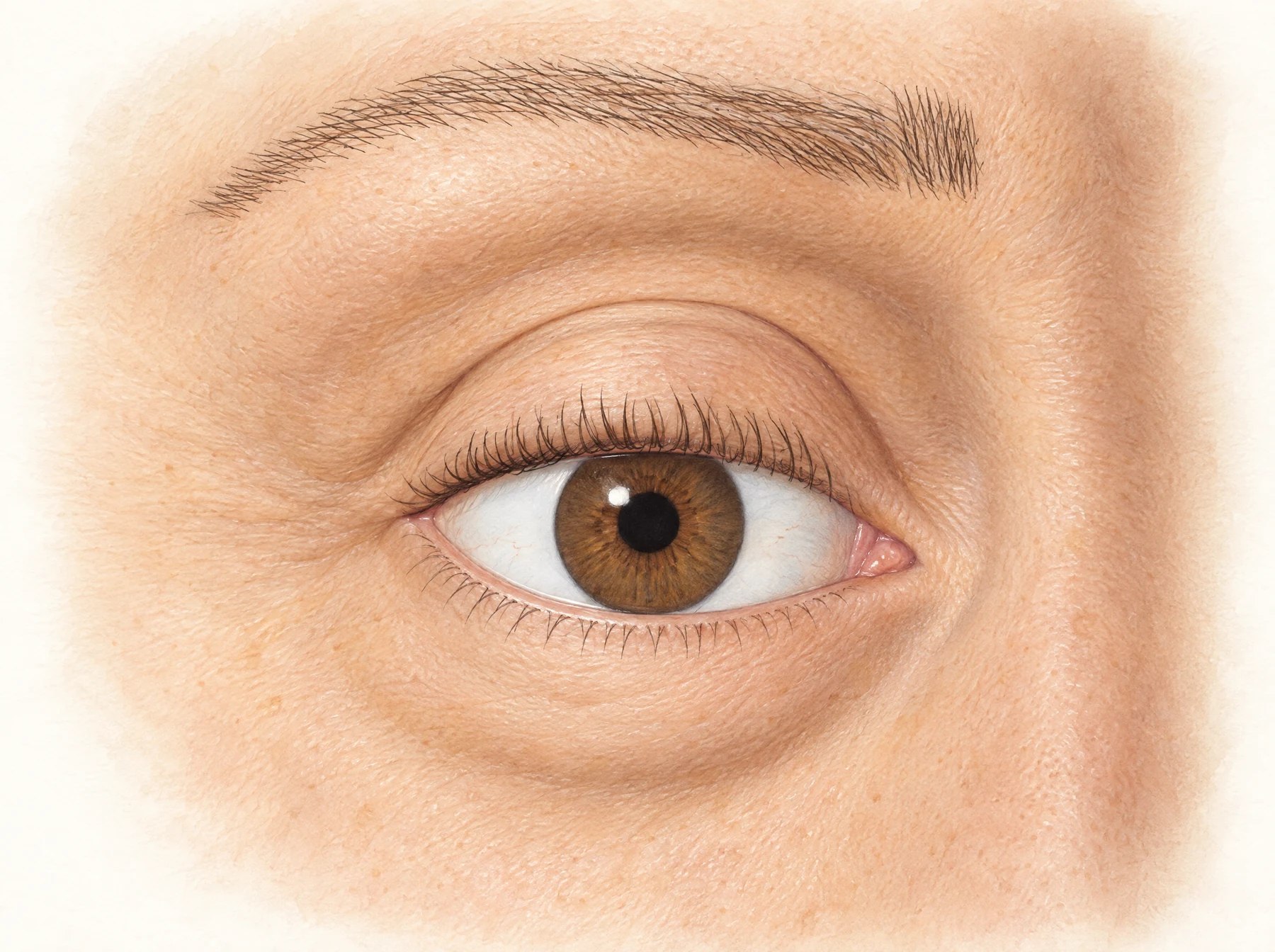
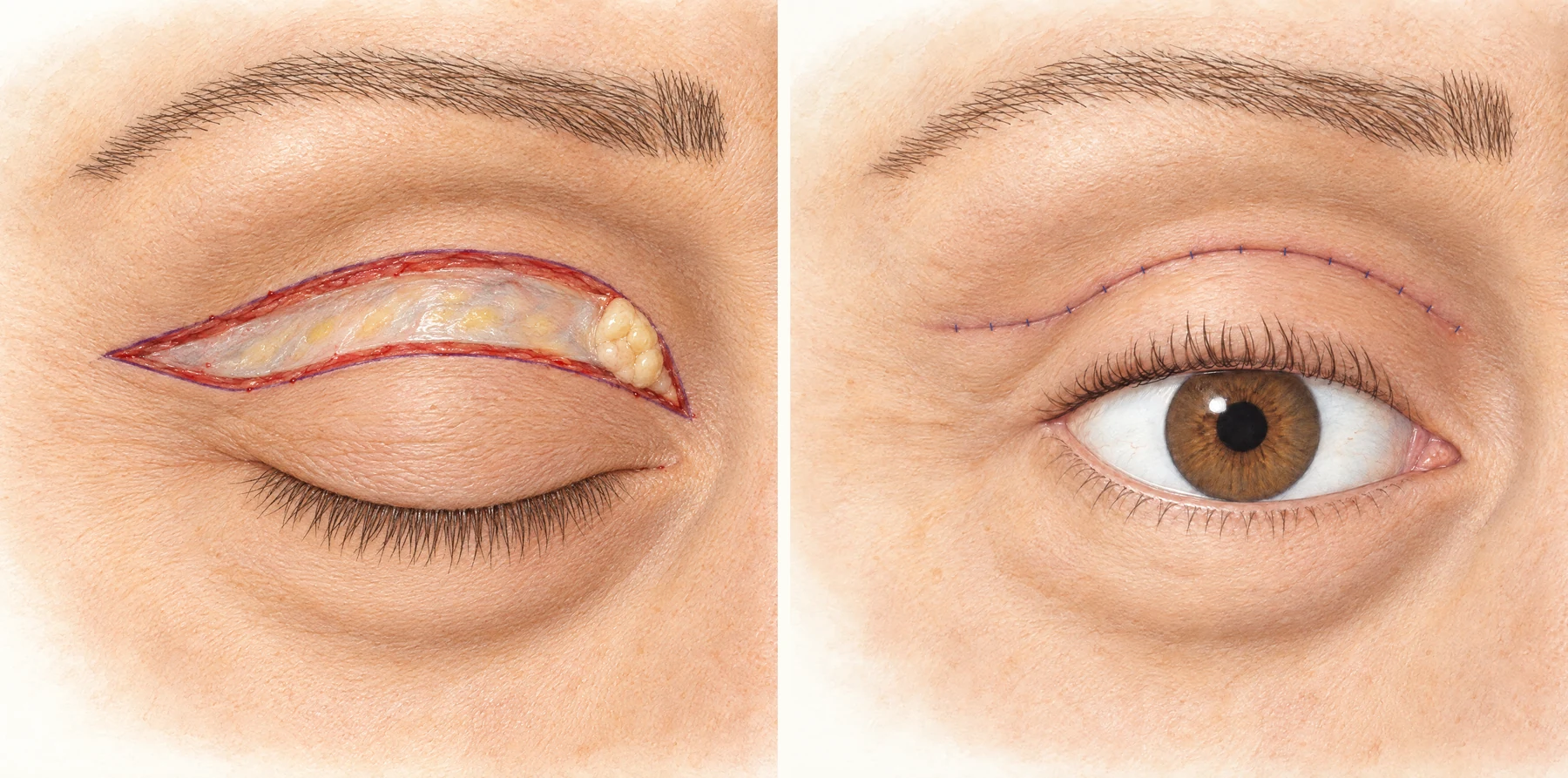
- Dermatochalasis is lax, redundant upper eyelid skin. It is treated by removing the excess skin, covered in Upper blepharoplasty (PMID 42236867).
- Lateral hooding, hooding concentrated over the outer third of the eye, often reflects brow position rather than lid skin alone. The lateral brow has no forehead-muscle support and slides down over the temple earlier and further than the inner brow (PMID 8643714).
- A low lateral brow can mimic or add to lid hooding. Brows sit slightly higher in women aged 50-60 than in women aged 20-30, and the difference shows mainly at the inner and middle brow, which is the argument for lifting the outer brow specifically rather than the whole brow evenly (PMID 19935315).
- Hooding is told apart from true ptosis (a low lid margin) and pseudoptosis by four measurements: palpebral fissure height, marginal reflex distance, lid crease position and levator function. They are covered in Droopy eyelids (PMID 35058403).
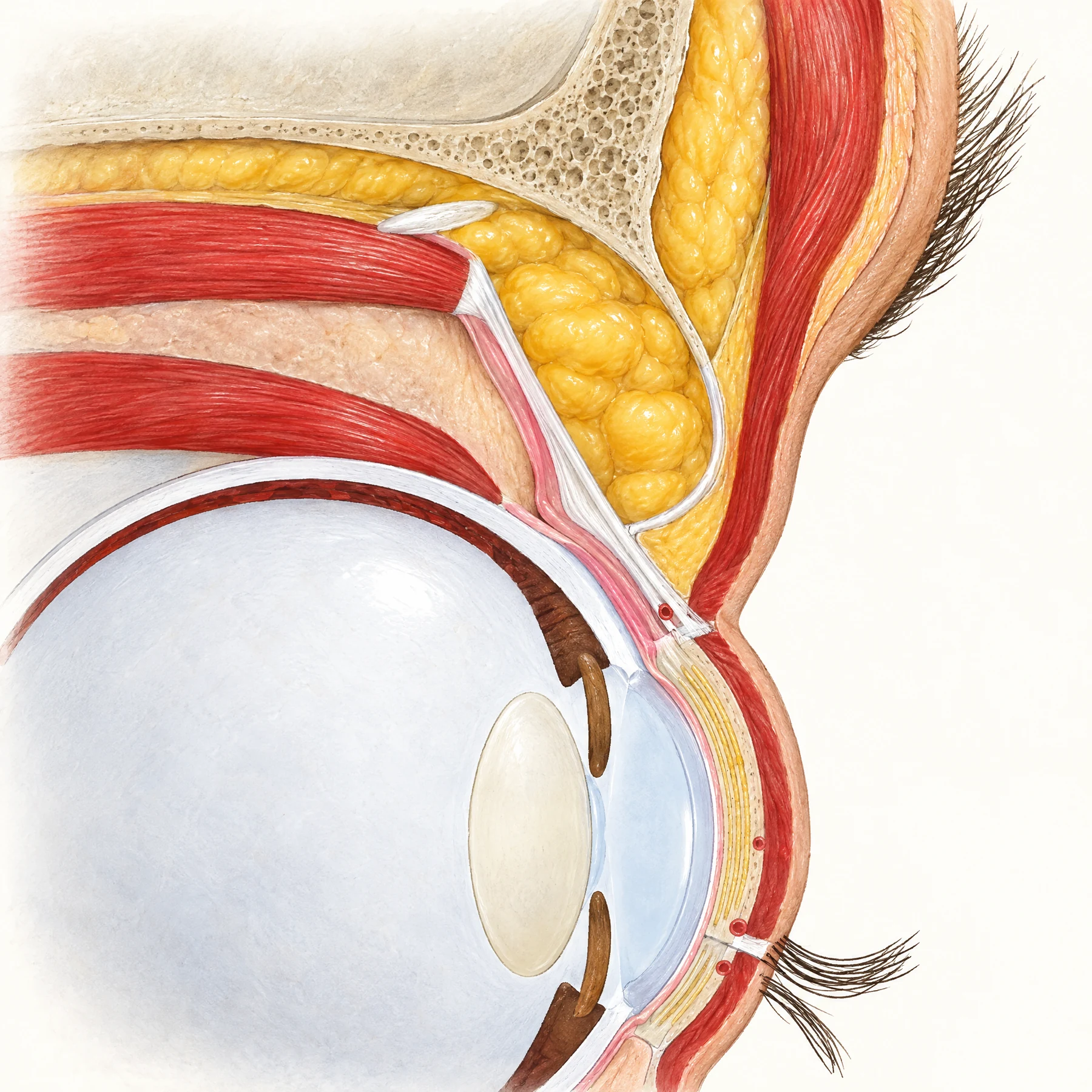
- Fat and muscle bulk under the brow add to hooding. Retro-orbicularis oculi fat (ROOF) under the lateral brow thickens the lid in many patients, and surgeons remove it along with skin when the lid is bulky (PMID 34949571).
- Patients on glucagon-like peptide-1 receptor agonists (GLP-1RAs, used for weight loss and diabetes) are more likely to develop brow ptosis and dermatochalasis than similar patients not on them, attributed to loss of brow and lid fat (PMID 41251628). Over 10 years they also have higher rates of upper eyelid blepharoplasty, ptosis repair and brow ptosis repair, roughly 1.8 times those of matched patients with type 2 diabetes (PMID 41945654).
- Visual field testing alone does not capture the full burden of dermatochalasis, which matters for patients whose main complaint is hooding rather than measured field loss. See Functional blepharoplasty and visual fields (PMID 42693598).
How surgeons assess it
- Photographs taken before and after upper blepharoplasty show that correcting lid skin alone accentuates the tendency of the eyebrow to drop, more in the lateral brow and on both sides. This is why brow position is checked before relying on skin excision alone (PMID 22571187).
- One algorithm measures lid-to-brow distance before and after simulated skin removal (a pinch test) and sorts patients by how much the forehead muscle (frontalis) is compensating for hooding. Habitual frontalis use predicts whether skin excision alone will reveal a lower brow afterward (PMID 37940703).
- Pretarsal show (the visible skin between lashes and crease) before surgery predicts how much a skin-only excision will help. Eyes with complete pretarsal show improved less with conventional excision than eyes with a smaller pretarsal height (PMID 33234951).
- Forehead lines are a sign the frontalis is compensating for a drooping lid or brow. Older patients with horizontal forehead lines more often have ptosis than those without lines (PMID 30030561).
- Photo-based (telemedicine) assessment of eyelid and brow position agrees well with an in-person exam for brow ptosis and moderately to substantially for dermatochalasis. Agreement on dermatochalasis falls when overhanging skin hides the lid margin (PMID 35030149).
Treatment: upper blepharoplasty, brow lift, or both
- Skin-predominant hooding with a stable brow is treated with standard upper blepharoplasty: skin with or without a strip of orbicularis muscle and some fat. Technique and outcomes are in Upper blepharoplasty (PMID 42236867).
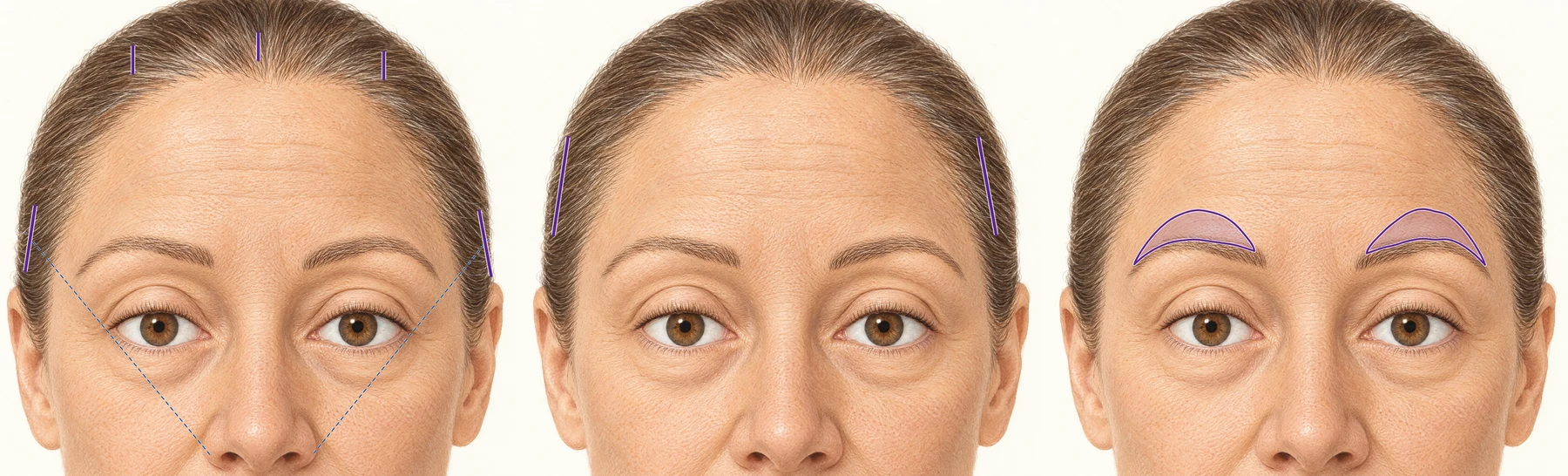
- Brow-predominant hooding, particularly lateral hooding with a stable lid, is treated with a brow lift. A 2025 review covers evaluating brow position and hairline, and choosing among coronal, pretrichial, endoscopic, temporal, direct and mid-forehead approaches (PMID 40603240). Temporal (lateral) brow lift is in Temporal and lateral brow lift. The shorter options are in Browpexy and direct brow lift.
- In a randomized trial of women having upper blepharoplasty, an internal browpexy raised the lateral brow by about 2 mm at 6 months. A temporal brow lift in the same trial did not change lateral brow position (PMID 28975711).
- When the brow is stable and hooding comes from skin redundancy alone, a specific incision shape ("bird beak") redistributes the descended skin without a brow procedure (PMID 42233882).
- Subbrow (infrabrow) blepharoplasty removes skin immediately below the eyebrow rather than within the lid crease. First described for Asian patients, it was later adapted for Caucasians with moderate to severe dermatochalasis and lateral hooding, with all patients satisfied and only transient scar redness (PMID 33620928).
- Subbrow excision is combined with other steps in the same operation to treat the fat or muscle component: lateral fat repositioning (PMID 38896863), orbicularis and suborbicularis fat fixation (PMID 39945844), orbicularis folding (PMID 35570053), medial fat transposition (PMID 40879736), and en bloc orbicularis and ROOF removal plus fixation (PMID 42716981).
- For severe skin laxity, a skin-orbicularis repositioning modification is added to infrabrow excision to avoid the wrinkles and contour deformities reported after conventional infrabrow excision (PMID 42260146).
- For patients older than 60, extended upper blepharoplasty combined with subbrow skin removal is more stable than extended blepharoplasty alone. Patients who kept their subbrow skin developed recurrent excess skin at 1 year, and those who had it removed did not (PMID 37410575).
- A composite-flap technique re-suspends the orbicularis oculi muscle, orbicularis retaining ligament and ROOF as one unit to the lateral orbital thickening (a firm fascial structure at the orbital rim), rather than removing skin alone (PMID 42380312).
- Nonsurgical skin-tightening devices are an option for patients who want to avoid an incision. See Non-surgical eyelid tightening.
Results and evidence
- Composite flap suspension flattened lateral hooding markedly and increased lateral canthal tilt by about 5 degrees, with brow position unchanged and high patient satisfaction at 12 months (PMID 42380312).
- Modified subbrow excision for severe laxity improved lid-to-brow heights at the pupil, inner cornea and outer corner of the eye, with no hypertrophic scar or sunken lid reported (PMID 38598138).
- Orbicularis and suborbicularis fat fixation corrected brow descent by about 3 to 4 mm, nearly all patients were satisfied, and there was no serious complication (PMID 39945844).
- Infrabrow excision with lateral fat repositioning gave good outcomes at 3 months, with no wound separation, incomplete lid closure, visible scarring or sensory change (PMID 38896863).
- Infrabrow excision with lateral periorbital undermining lengthened the distance from the outer corner of the eye to the lid crease by about 2 mm, with no significant complications (PMID 39704510).
- Infra-brow volume contouring left patients uniformly satisfied. Swelling resolved within 1-3 months, scars were not unaesthetic, and transient numbness resolved in 3-5 months (PMID 42716981).
- Sub-brow lift with orbicularis folding gave a more pleasing brow-to-eye ratio and higher satisfaction than a traditional incision (PMID 35570053).
- Medial fat pad transposition during subbrow lift improved bulging near the nose and central fullness, and most patients rated the result much or markedly improved (PMID 40879736).
Risks and complications
- Removing lid skin without addressing a low brow can let the brow descend further. Pooled data found brow height fell about 1.5 mm after upper eyelid surgery generally and under 1 mm after simple blepharoplasty, with skin excision itself not changing brow height in isolation (PMID 36890345).
- After ptosis surgery, measurable brow descent occurred in about 6 in 10 patients, more often in men and in eyes that had more skin removed (PMID 39879807).
- Adding a brow lift to blepharoplasty does not raise major complication rates. Major complications were about 4 in 1,000 whether or not a brow lift was combined with blepharoplasty (PMID 29369102).
- Transient sensory change (numbness or paresthesia) after subbrow or infra-brow excision resolved within 3-5 months with no permanent deficit in one series (PMID 42716981). In another series brow numbness was rare and resolved within a week (PMID 34949571).
- Full complication rates for upper blepharoplasty and for each brow lift technique (hematoma, nerve weakness, asymmetry, scar) are in Upper blepharoplasty, Temporal and lateral brow lift and Browpexy and direct brow lift.
Recovery
- Swelling after infra-brow volume contouring resolved within 1 to 3 months (PMID 42716981).
- After subbrow blepharoplasty in Caucasians, scar redness was uncommon and improved over a 12-month follow-up (PMID 33620928).
- Recovery timelines for standard upper blepharoplasty and for brow lift techniques are in Blepharoplasty recovery timeline, Upper blepharoplasty and Temporal and lateral brow lift.
Combined procedures
- Brow lift and upper blepharoplasty are frequently combined. Ptosis repair is sometimes needed as well when a low lid margin, not just excess skin, contributes to the heavy appearance. See Blepharoptosis repair and Droopy eyelids.
- An internal browpexy placed through the same incision as upper blepharoplasty adds lateral brow lift without a separate scar. Outcome data are in Browpexy and direct brow lift (PMID 28975711).
- Fat loss in the brow and lid from GLP-1 receptor agonist therapy is associated with higher rates of blepharoplasty, ptosis repair and brow ptosis repair being sought together (PMID 41945654).
Current questions
- No validated hooding-specific or dermatochalasis-specific symptom questionnaire exists. Visual field testing alone is reported to miss the broader burden patients describe (PMID 42693598).
- Which patients benefit from subbrow or infra-brow excision instead of standard upper blepharoplasty or a separate brow lift is not settled by controlled trials. The published series so far are retrospective and from single centers (PMID 33620928, PMID 38598138, PMID 42380312).
- Predicting which patients will develop further brow descent after skin-only blepharoplasty is imprecise. One algorithm sorted patients into three risk groups by compensatory frontalis use but could not predict the lid-brow distance change for an individual (PMID 37940703).
- The link between GLP-1 receptor agonist therapy and fat loss around the eye, brow ptosis and dermatochalasis is new as of 2026 and rests on retrospective database studies rather than prospective follow-up (PMID 41251628, PMID 41945654).
- Photo-based assessment of hooding is reliable for brow ptosis but less reliable for dermatochalasis when the lid margin is obscured, which limits remote triage for the patients whose hooding is most severe (PMID 35030149).
Terms
- Dermatochalasis: excess, lax upper eyelid skin (PMID 42236867).
- Lateral hooding: skin overhanging the outer third of the upper eyelid, often from a low lateral brow (PMID 8643714).
- Brow ptosis: a lowered eyebrow that can mimic or add to eyelid hooding (PMID 19935315).
- Pseudoptosis: a droopy appearance without true ptosis, for example from brow descent or skin excess alone (PMID 35058403).
- Subbrow (infrabrow) blepharoplasty: skin excision just below the eyebrow instead of within the eyelid crease (PMID 33620928).
- ROOF (retro-orbicularis oculi fat): a fat pad under the lateral brow that can add bulk to hooding (PMID 34949571).
- Pinch test: manually lifting excess lid or brow skin to simulate the result of excision before surgery (PMID 37940703).
- Pretarsal show: the visible lid skin between the lashes and the eyelid crease (PMID 33234951).
- Frontalis compensation: raising the brow with the forehead muscle to lift hooded or ptotic lids, often visible as forehead lines (PMID 30030561).
- Internal (transblepharoplasty) browpexy: stitches placed through the blepharoplasty incision to hold up the outer brow (PMID 28975711).