



















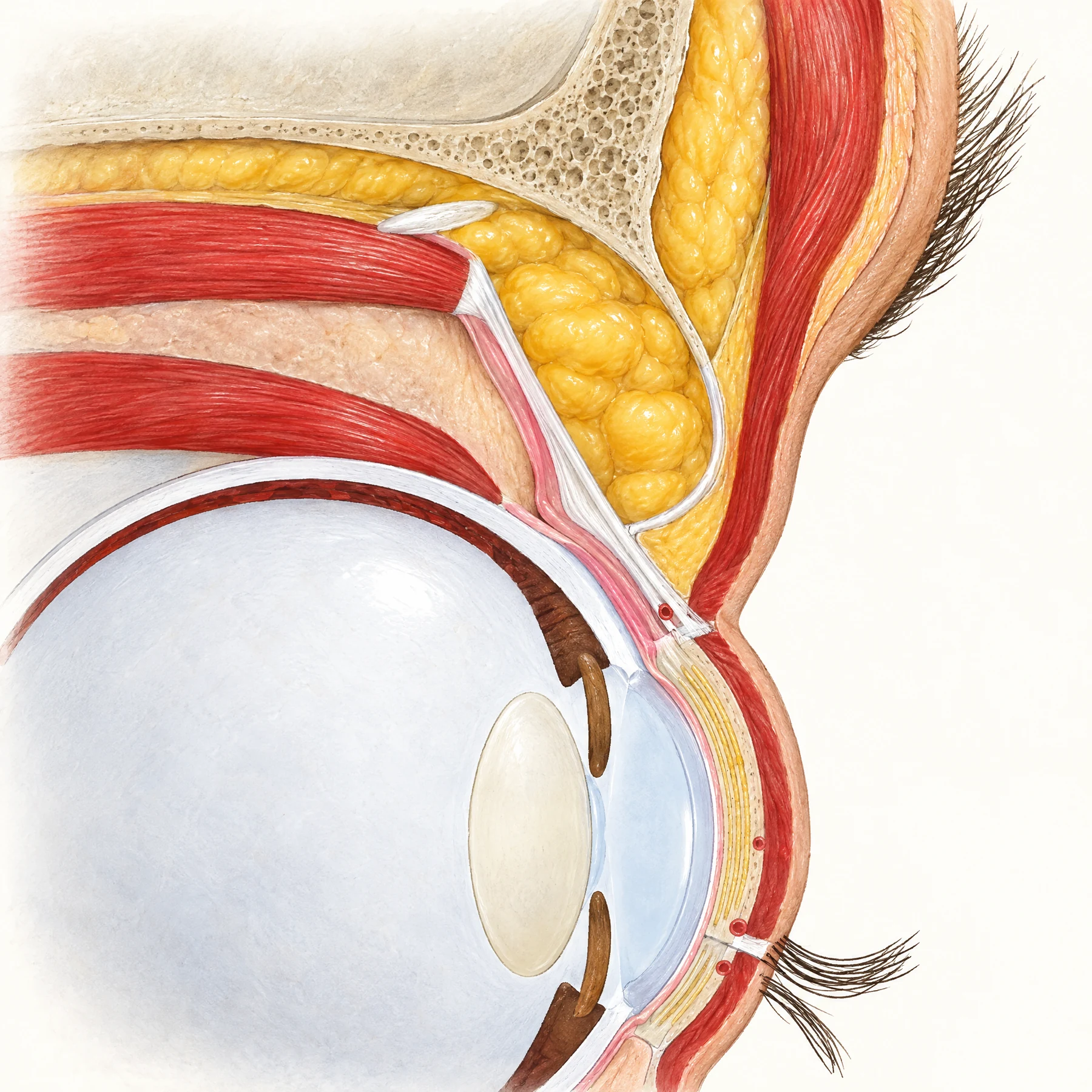
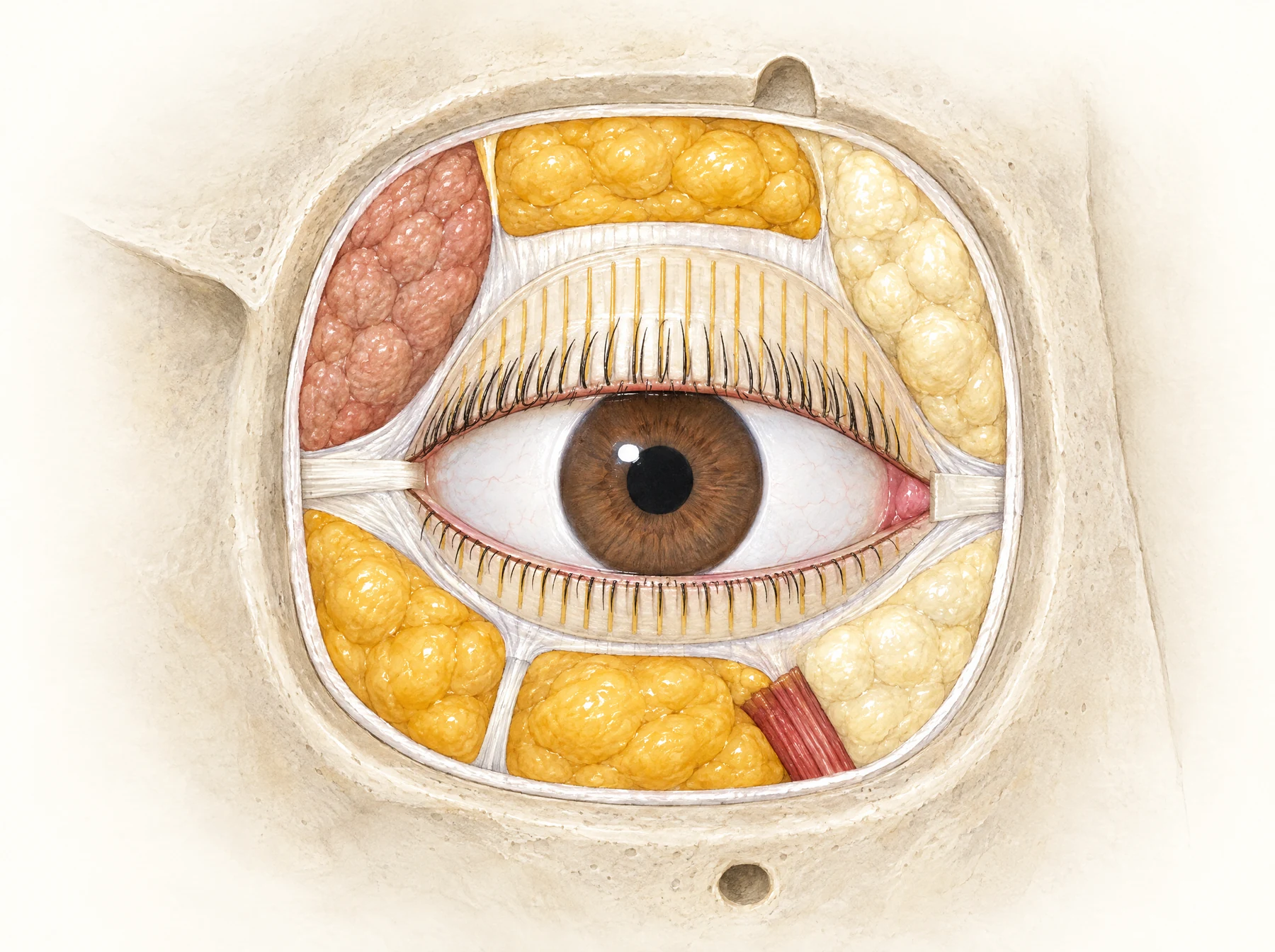
What it treats
- The condition was first described as superior sulcus deformity, corrected with an alloplastic implant in orbital reconstruction (PMID 7447778).
- Traditional blepharoplasty often excised skin, muscle and excessive fat, leaving a long-term hollow orbit and a harsh, operated appearance. Current methods favor limited, conservative resection (PMID 15536308).
- After upper blepharoplasty, a white-line disinsertion of the levator aponeurosis can bind into the septal scar left by fat removal, producing post-upper blepharoplasty syndrome: ptosis, hollow sulcus, high or absent crease, eyelash ptosis and compensatory brow elevation. It was found in many of the eyelids studied and in none of the ptosis-surgery control eyelids (PMID 31802837).
- Facelift technique can also cause hollow eyes. Unopposed lateral tissue advancement and lower eyelid fat removal during facelift and blepharoplasty were identified as frequent causes, correctable with orbicularis repositioning and arcus marginalis release (PMID 9774028).
- Aging upper periorbits fall into two patterns: soft tissue ptosis needing excision, or volume depletion with bony resorption producing sunken, hollow, skeletonized orbits that need volume added rather than removed (PMID 21046102).
- A CT study of total orbital fat volume in Asian patients found fat volume increased until about age 60 and decreased after, a pattern proposed to explain age-related change in eyelid fat prominence (PMID 21042175).
- Hollows are classified by pattern. A photographic analysis of women graded an inner shadow (A-pattern) and a complete extension of the hollow (C-pattern) (PMID 28753160). A separate case series classified upper eyelid volume deficiency as medial A-shaped hollow, generalized hollow, postblepharoplasty volume loss, or hooding with subbrow deflation (PMID 19935245).
- Deep superior sulcus can progress to sunken superior sulcus syndrome: deep sulcus, incomplete lid closure and corneal exposure damage from posterior retraction of skin, orbicularis and septum after orbital fat atrophy (PMID 24614548). A milder presentation causes soft contact lens displacement and wear intolerance (PMID 30555974).
How it is done
Autologous fat grafting and fat repositioning
- Structural fat transplantation for the upper eyelid complex, performed since 1986, was an early description of volume restoration for aging or iatrogenic deformity (PMID 11134987). A free fascia-fat composite graft, taken from the mons pubis, preauricular or temporal area, was used for sunken or multiply folded upper eyelids after Asian blepharoplasty (PMID 11176595).
- The lumbrical fat graft was described as a simple replacement for lost upper eyelid fat (PMID 11932621). Orbital fat anatomic repositioning combined with a fat graft applied to the retro-orbicularis oculi fat (ROOF), graded by sunken depth into 4 stages, was described for Asian eyelids (PMID 20835821).
- Fat grafting alone or combined with orbicularis oculi muscle imbrication (volumetric upper blepharoplasty) places small volumes, under 1 cc in the deep plane and a few cc in the superficial plane, and drew published discussion over patient selection (PMID 28753160), (PMID 29068899), (PMID 29068883). Dermis fat grafting has also been used for superior sulcus volumetric rejuvenation (PMID 26019236).
- Transposition of an orbital fat fascia flap, preserving its vascular pedicle, was based on cadaver anatomy and histology (PMID 37535089). Orbital fat pad repositioning combined with orbicularis oculi muscle flap folding is another described combination (PMID 36727782).
- The "pendulum movement" of orbital fat and ROOF (POR technique) was developed for revision upper blepharoplasty after over-resection, retraction or atrophy of the nasal and central fat pads (PMID 38315230).
- Combined double-eyelid surgery, orbital fat pad repositioning and autologous fat transplantation has been used for severe, grade 3-4 sunken upper eyelids (PMID 38752130), and orbital fat repositioning alone for milder sunken eyelids in young Asian adults (PMID 25804503).
- Combined orbital fat repositioning with supplemental microfragmented autologous fat grafting, assessed by high-resolution ultrasonography, has been studied for moderate hollowing (PMID 41939494). Fat grafting through a supraorbital approach into the ROOF layer has been used for post-blepharoplasty depression (PMID 42303763).
- An endoscopic ROOF transposition technique, through minimal scalp incisions, has been combined with concurrent endoscopic midface and temporal lift (PMID 41628599).
- A medial-pedicled preseptal orbicularis oculi muscle flap, a non-fat alternative, has been used for superior orbital sulcus hollowness (PMID 42332315). A central preaponeurotic fat advancement pedicle has been used during upper blepharoplasty to correct volume asymmetry between the two sulci (PMID 39718136).
Hyaluronic acid and other filler
- Serial puncture injection of hyaluronic acid gel at the superior orbital rim was used for upper eyelid filling and contouring (PMID 19935245), and reviewed as a nonsurgical option for volume deflation of the periorbital area (PMID 28255285).
- Hyaluronic acid gel injected into the superior sulcus was used to treat incomplete lid closure in sunken superior sulcus syndrome (PMID 24614548), and to improve contact lens wear intolerance from deep sunken superior sulcus in a case report (PMID 30555974).
- Deep supraperiosteal hyaluronic acid injection by blunt cannula, 0.2-0.4 mL per eyelid, has been studied for supraorbital hollowing (PMID 41850033). Hyaluronic acid and poly-L-lactic acid (PLLA) have been compared for upper-eyelid hollowing, HA in a single session and PLLA over 3 sessions 4 weeks apart (PMID 41799414).
Results and evidence
- Volumetric upper blepharoplasty (fat grafting with or without orbicularis imbrication) corrected the inverted eyelid ratios and turned every concave lateral contour convex, regardless of approach (PMID 28753160).
- Orbital fat repositioning with ROOF fat grafting gave satisfactory results in most patients. A few needed additional surgery for a translocated fat lump or undercorrection (PMID 20835821).
- With an orbital fat fascia flap, the sunken depth improved from about 6 mm to about 2 mm by 9-18 months, and one patient needed additional granular fat transplantation (PMID 37535089).
- Orbital fat pad repositioning with orbicularis folding reduced sunken depth from about 3 mm to about 1.5 mm at about a year, with no major complications (PMID 36727782).
- After the POR technique, nearly all patients had an improved aesthetic rating and were satisfied (PMID 38315230).
- Combined fat repositioning and transplantation for severe (grade 3-4) sunken eyelids left about 9 in 10 patients satisfied at 1 year, with recurrence in about 6 in 100 and complications in about 5 in 100 (PMID 38752130). Orbital fat repositioning alone in young Asian adults left about 3 in 4 satisfied at 1 year, with relapse in about 1 in 10 and complications in about 1 in 12 (PMID 25804503).
- Combined orbital fat repositioning and microfragmented fat grafting corrected hollowing of about 6 mm with about 1 mL of grafted fat. Ultrasonography confirmed improvement that was stable from 3 to 6 months, and nearly all patients were satisfied (PMID 41939494).
- Fat grafting via a supraorbital approach left about 8 in 10 patients "very much improved" at 6 months and most of the rest "much improved" on the Global Aesthetic Improvement Scale (GAIS). Mild recurrent hollowing occurred in about 1 in 8, most of whom had secondary grafting (PMID 42303763).
- Endoscopic ROOF transposition gave stable improvement in eyelid contour and lateral orbital fullness at 12 months (PMID 41628599). A preseptal orbicularis oculi flap and conventional blepharoplasty scored no differently on patient-reported FACE-Q scores (PMID 42332315).
- A long-term review of micro-fat grafting over 15 years found bad outcomes in a small minority of patients, and a handful judged "ugly," across follow-up ranging from months to many years (PMID 32944851).
- Hyaluronic acid gel filling improved appearance on photographs in most patients and nearly all were satisfied at about 13 months. About 1 in 5 requested additional filler, and patients whose problem was hooding still needed blepharoplasty or ptosis surgery (PMID 19935245).
- Hyaluronic acid gel improved incomplete lid closure by about 70% in sunken superior sulcus syndrome (PMID 24614548).
- Supraperiosteal hyaluronic acid at 6 months left about 9 in 10 patients rating the result "very good" or "exceptional" (PMID 41850033).
- Hyaluronic acid outperformed PLLA on hollow area and sulcus curvature through 6 months, but PLLA showed greater improvement by 9 months (PMID 41799414).
- A systematic review of hyaluronic acid after blepharoplasty found volume retention persisted beyond 12 months in most cases. Lipofilling as an adjuvant had a lower complication rate (about 1 in 8) than isolated blepharoplasty (about 1 in 5) (PMID 40648944).
Risks and complications
- Ptosis after autologous fat injection into the upper eyelid was reported in a small number of cases. Removal of the grafted fat, with or without levator aponeurosis advancement, was required in all (PMID 26229134).
- Granulomatous inflammation with foreign body reaction and fat necrosis developed in the upper eyelid after an autologous fat injection in the forehead, from migration of the injected fat, in a single case (PMID 30615002).
- After periumbilical fat implantation into the upper eyelid, most patients had a swollen appearance, an unsmooth double-eyelid line and adhesion. After corrective surgery two-thirds had an excellent result, and only the eyes with the most severe damage had a poor outcome (PMID 37430215).
- With the preseptal orbicularis oculi flap, transient numbness above the brow was common and resolved within a few months, with no flap necrosis. The conventional blepharoplasty comparison group had medial canthal scarring, some needing revision (PMID 42332315).
- A first reported case of chronic upper eyelid edema from temporal hyaluronic acid filler injected 2 years earlier required surgical, not hyaluronidase, resolution because the diagnosis was delayed (PMID 41959944).
- In the systematic review of post-blepharoplasty hyaluronic acid, lipofilling carried a lower complication rate than blepharoplasty alone, and hyaluronidase resolved recalcitrant edema in about half to all treated cases (PMID 40648944).
Recovery
- After endoscopic ROOF transposition, early edema and bruising resolved within 1 week, with stable results through 12 months (PMID 41628599).
- After supraperiosteal hyaluronic acid injection, transient bruising and edema, each in about 1 in 4 patients, resolved without intervention (PMID 41850033).
- After combined orbital fat repositioning and fat grafting, ultrasonography showed outcomes stabilized by 3 months, with no further significant change to 6 months (PMID 41939494).
- After hyaluronic acid gel for sunken superior sulcus syndrome, complications were limited to bruising and temporary uneven contour (PMID 24614548).
With a facelift
- Hollow eyes are described as a frequent facelift sequela, corrected with orbicularis repositioning and arcus marginalis release performed as part of the facelift itself (PMID 9774028).
- In the endoscopic ROOF transposition series, nearly all patients had a concurrent endoscopic midface and temporal lift, and a few had a forehead lift in the same operation (PMID 41628599).
Current questions
- Fat grafting versus filler: one group considers structural fat grafting more invasive, with greater morbidity and downtime, and favors HA filler as the preferred nonsurgical option (PMID 21046102). Published correspondence on a major fat-grafting series shows continued debate over patient selection (PMID 29068899), (PMID 29068883).
- HA against PLLA: one comparative cohort found HA faster-acting through 6 months but PLLA more effective by 9 months, without a resolved recommendation for which to prefer over time (PMID 41799414).
- Late-onset filler complications, presenting years after injection and far from the injection site, remain poorly understood and likely underdiagnosed (PMID 41959944).
- Donor fat source: periumbilical fat grafting carries a distinct complication profile from orbital or standard autologous fat, with swelling and adhesion in most of one series (PMID 37430215).
- Non-fat alternatives: the preseptal orbicularis oculi flap scored similarly to conventional blepharoplasty, but in a small, selected group (PMID 42332315).
- Long-term durability: a 15-year fat-graft review found most outcomes good but still catalogued poor results years after treatment (PMID 32944851).
Terms
- Superior sulcus (deformity): the deepened groove between the upper eyelid crease and the orbital rim when volume is lost (PMID 7447778).
- Sunken superior sulcus syndrome (SSSS): deep superior sulcus with lagophthalmos and exposure keratopathy from orbital fat atrophy (PMID 24614548).
- Retro-orbicularis oculi fat (ROOF): the fat layer beneath the orbicularis oculi muscle, a common fat-graft recipient site for upper lid hollowing (PMID 20835821).
- A-pattern / A-shaped hollow: an inner (medial) shadow pattern of upper eyelid hollowing, as distinguished from a complete, full-width hollow (PMID 28753160), (PMID 19935245).
- Volumetric blepharoplasty: upper blepharoplasty that adds or preserves volume, typically with fat grafting, rather than only excising tissue (PMID 28753160).
- Lumbrical fat graft: a specific autologous fat graft technique described for replacing lost upper eyelid fat (PMID 11932621).
- Fascia-fat / dermis-fat graft: composite grafts combining fat with fascia or dermis for added structural support and survival (PMID 11176595).
- Preaponeurotic fat: the central upper eyelid fat pad, which can be advanced on a pedicle to correct volume asymmetry (PMID 39718136).
- Poly-L-lactic acid (PLLA): a biostimulatory injectable filler compared with hyaluronic acid for upper-eyelid hollowing (PMID 41799414).
- GAIS: the Global Aesthetic Improvement Scale, a clinician- and patient-rated outcome measure (PMID 41850033).
- Lagophthalmos: incomplete eyelid closure, a functional consequence of severe upper eyelid hollowing (PMID 24614548).