



















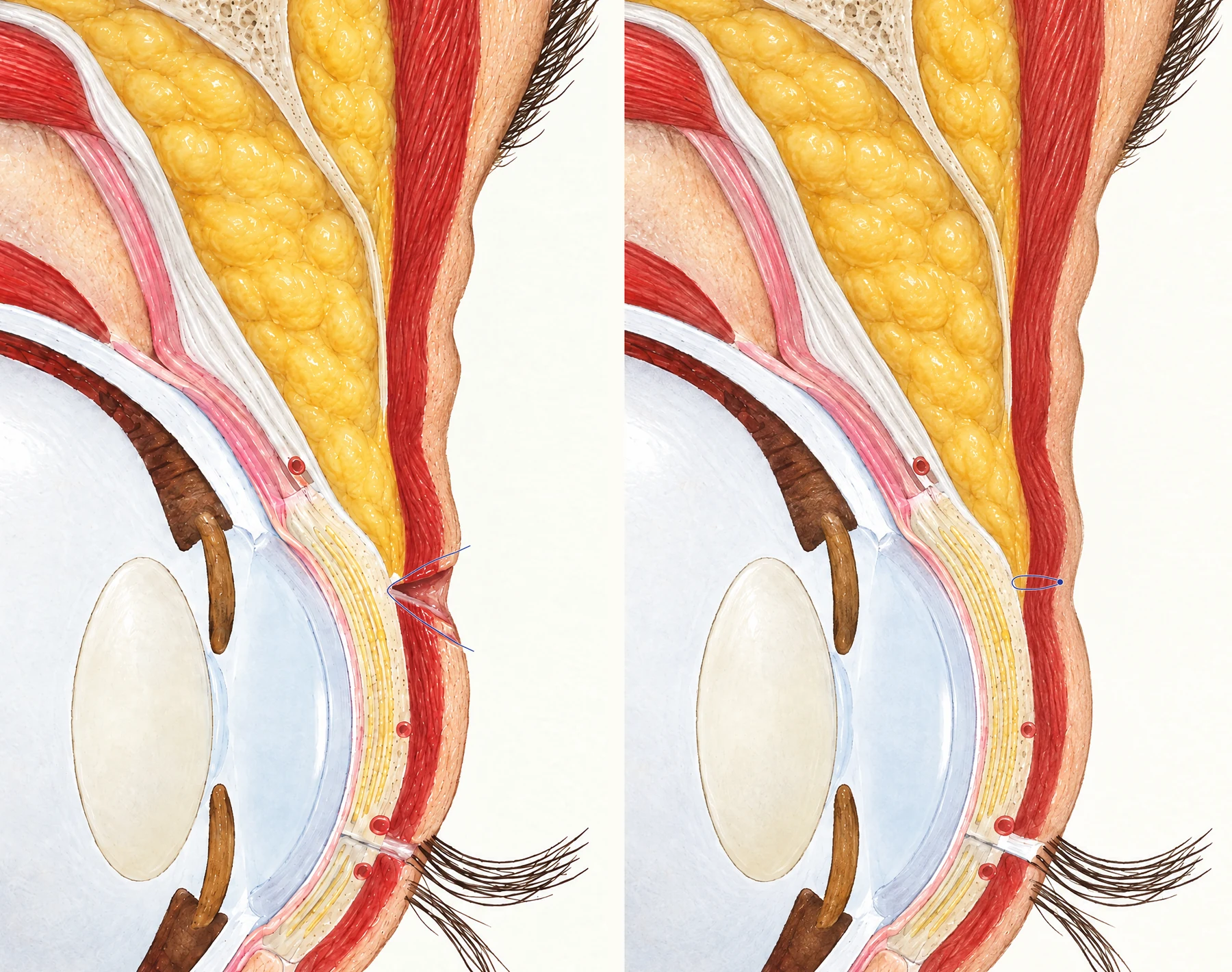
Dermatochalasis: what it treats
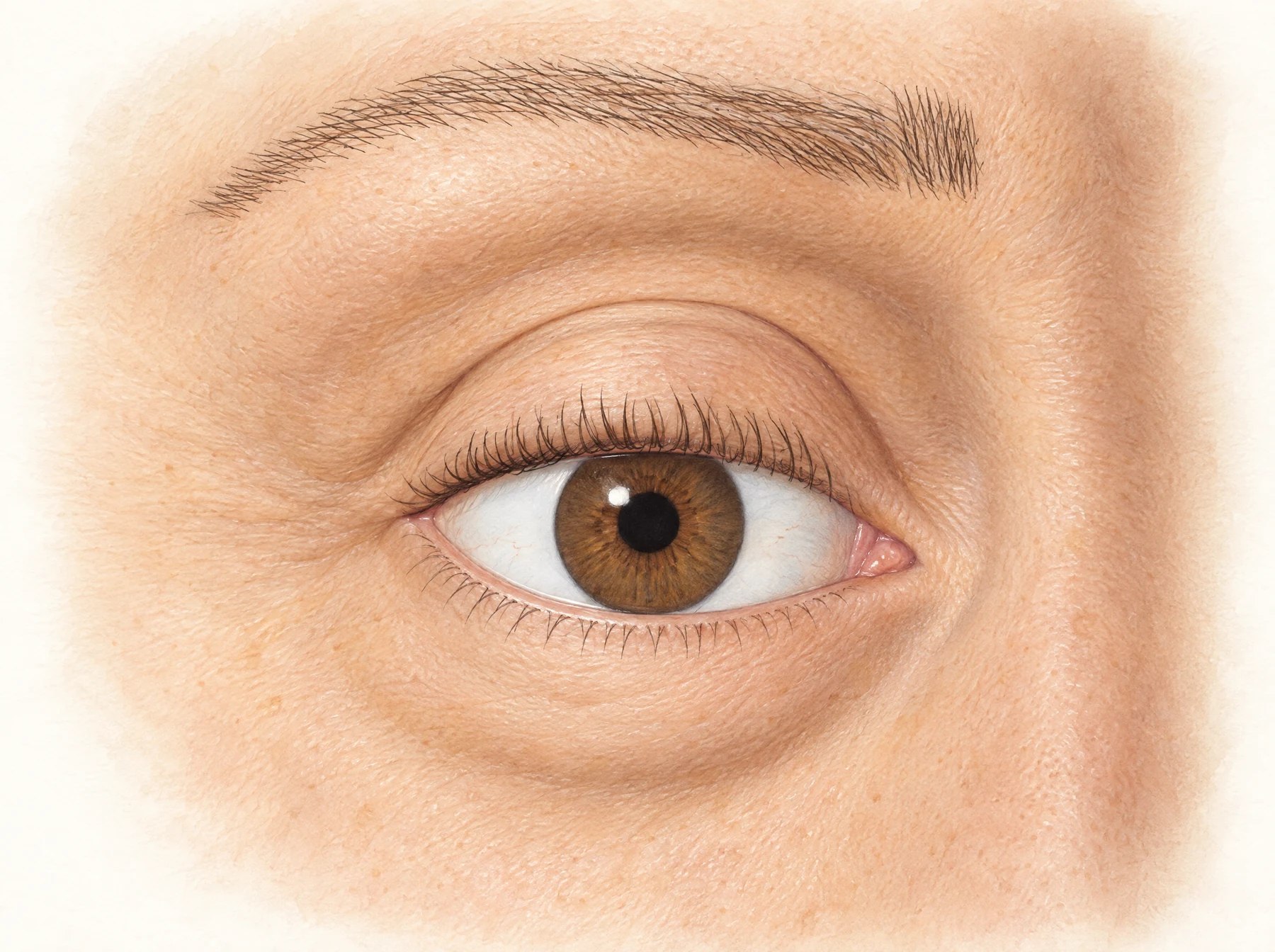
- Dermatochalasis is excess eyelid skin; it can occur with orbital fat prolapse, lacrimal gland prolapse and involutional ptosis; upper blepharoplasty is among the most common cosmetic operations in the United States (PMID 42236867).
- Blepharoplasty for herniated orbital fat was described on an anatomical basis in 1951 (PMID 14864073).
- Older technique removed skin, muscle and a large amount of fat and left some patients with a hollow orbit; current methods remove less tissue (PMID 15536308).
- Pretarsal show: most eyes have complete pretarsal show before surgery; this group improved less after conventional excision (PMID 33234951).
- Superior visual field: skin excision enlarged the upper visual field several-fold at 3 months, and the preoperative field predicted the gain better than lid height (PMID 35086303).
- Visual quality: contrast sensitivity rose and astigmatism fell after surgery; visual acuity did not change (PMID 36788649).
- Visual field testing alone does not capture the whole burden of dermatochalasis; no validated dermatochalasis-specific symptom questionnaire exists (PMID 42693598).
- Hidden ptosis: a survey of Aesthetic Society surgeons concluded that mild to moderate ptosis and different upper lid aging patterns are underrecognized (PMID 33346340).
How it is done
Skin, muscle and fat
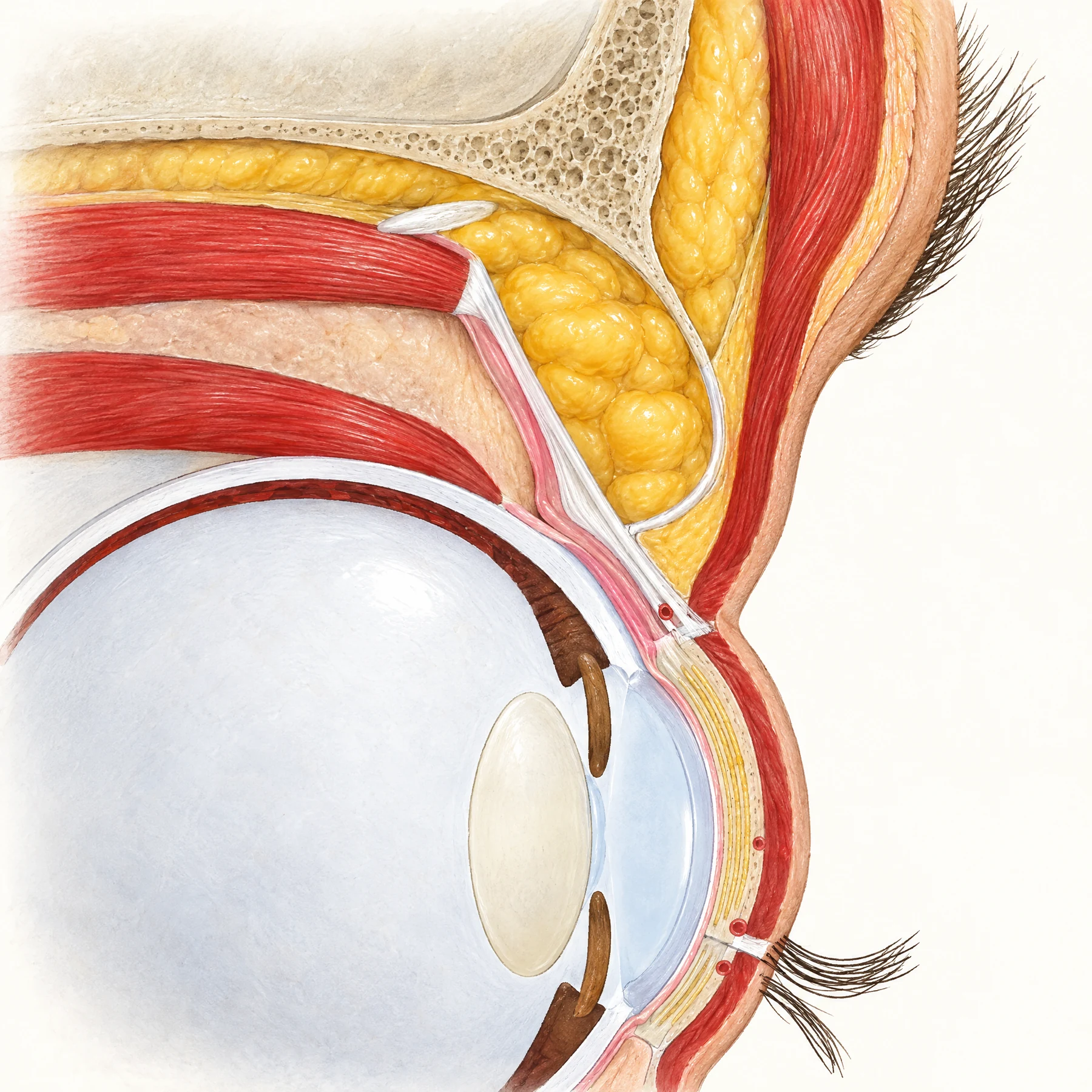
- Skin-only excision leaves the orbicularis oculi muscle in place; skin-muscle excision removes a strip of preseptal orbicularis with the skin (PMID 33538853).
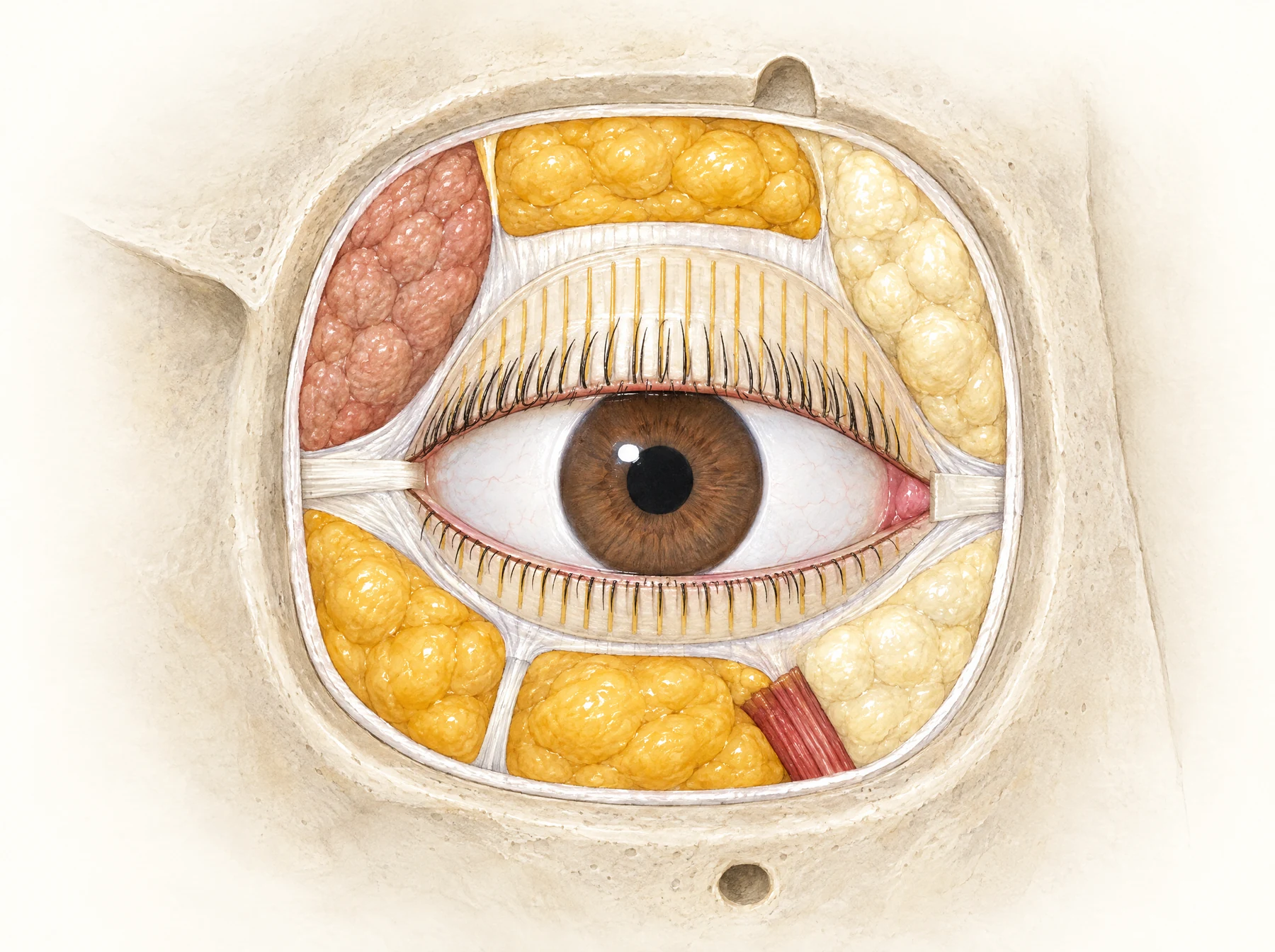
- Fat can be removed from the central (preaponeurotic) and nasal pads (PMID 39856176), preserved, or moved: one technique anchors the nasal fat pad centrally to fill the upper lid (PMID 39421583).
- Volumetric upper blepharoplasty: fat grafting to the hollow upper lid, usually combined with orbicularis imbrication (PMID 28753160).
- Surgeons with long experience or high case volume preserved volume more often and more often added fat grafting, brow lift and ptosis repair (PMID 33346340).
Skin excision shape and closure
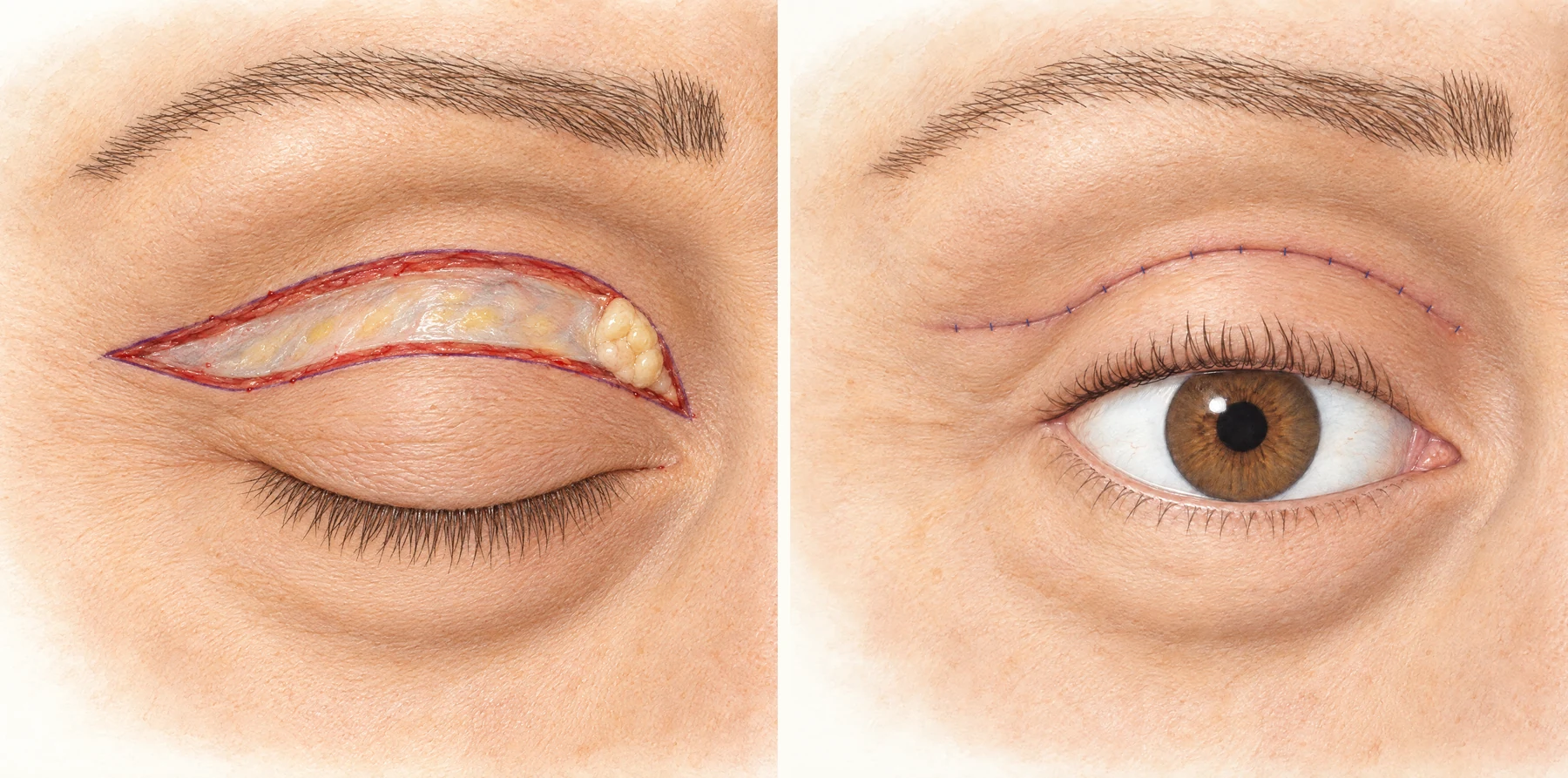
- A laterally extended excision gave slightly more and more even pretarsal show than a traditional ellipse; the ellipse group had more lateral brow descent (PMID 36205656).
- Intradermal and continuous nylon sutures gave equal scar quality at 6 months, and most patients rated the result much or very much improved (PMID 42118953).
- Scalpel, radiofrequency and CO2 laser incisions gave no difference in final scar; absorbable and nonabsorbable sutures healed alike (PMID 41193896).
Anesthesia
- Adding tranexamic acid to lidocaine with epinephrine increased intraoperative blood loss, with no difference in swelling or bruising at day 7 (PMID 38789809).
Results and evidence
Muscle excision or skin only
- Across randomized trials, dry eye symptoms fell after surgery; dry eye did not differ between skin-muscle and skin-only excision; incomplete eye closure (lagophthalmos) was more frequent with muscle excision; satisfaction did not differ (PMID 40152471).
- A systematic review found no long-term aesthetic difference; muscle excision gave more early swelling, bruising, pain, dry eye and lagophthalmos, which resolved within weeks (PMID 33538853).
- In a left-right randomized trial, the muscle-excised side had more symptoms and a worse appearance at day 7, with no difference at days 30 and 90 (PMID 21224748).
- In a randomized trial at 12 months, skin-only and skin-muscle scored the same for upper lids, brows, face and satisfaction; the "eyes in general" score was higher after skin-only (PMID 35219565).
- A retrospective series found slightly more complications and higher satisfaction when skin, muscle and fat were all excised than with skin only (PMID 39856176).
Dry eye and function
- Subjective dry eye complaints fell by 12 months with either technique; objective tear measures did not change (PMID 34612583).
- Dry eye symptom scores fell at 1 month and 1 year with orbicularis-sparing and orbicularis-excising technique alike (PMID 37354267).
- The American Academy of Ophthalmology review found most studies showed no subjective dry eye worsening, and reported benefits in visual function, headache and daily life (PMID 40913605).
- Headache scores fell and brow height decreased after blepharoplasty, with no difference between techniques (PMID 36674313).
Satisfaction
- Photographs scored by independent reviewers showed a clear rise in cosmetic score after surgery (PMID 33234951).
- Upper eyelid appraisal and satisfaction with eyes improved on FACE-Q; preoperative severity did not predict satisfaction (PMID 39037480).
- Nasal fat preservation raised the FACE-Q upper eyelid score, with no fat necrosis and volume held at about 1 year (PMID 39421583).
Brow position
- Brow height fell about 1.5 mm after upper eyelid surgery overall and about 0.7 mm after simple blepharoplasty; skin excision itself did not affect brow height (PMID 36890345).
Risks and complications
- Orbital hemorrhage after cosmetic eyelid surgery occurs in about 1 in 2,000 cases; permanent visual loss from it occurs in about 1 in 22,000; most hemorrhages began within 3 hours of surgery (PMID 15599241).
- A review of blindness after blepharoplasty found retrobulbar hemorrhage in most cases, and the final event was usually retinal or optic nerve ischemia (PMID 3516289).
- Major complications occurred in about 4 in 1,000 aesthetic eye surgery patients; hematoma, the most common, in about 2 in 1,000 (PMID 29369102).
- Wound dehiscence occurred in about 1 in 70 eyelids at a mean 9 days; male sex and fast-absorbing gut suture were independent risk factors (PMID 32852369).
- Patients on aspirin, warfarin or apixaban had no significantly higher complication rate than patients not on them, and no major bleeding (PMID 42236867).
- Revision was needed in about 1 in 26 patients after blepharoplasty alone against about 1 in 11 when ptosis correction was added (PMID 38315110).
- New dry eye lasting 3 months or longer occurred in under 1% of upper blepharoplasties and all resolved (PMID 38315110).
- Post-upper blepharoplasty syndrome (ptosis, hollow sulcus, high crease): the levator aponeurosis was disinserted and bound into septal scar left by fat removal (PMID 31802837).
- Complication timeline: corneal abrasion and retrobulbar hemorrhage in week 1; lid malposition, exposure and tearing in weeks 1-6; contour change, asymmetry and scarring later (PMID 20195127).
Recovery
- Bleeding risk is highest in the first 3 hours and falls after 24 hours, though hemorrhage can occur several days later (PMID 15599241).
- Ice packs had no effect on swelling, redness or hematoma, and gave slightly less pain on day 1 (PMID 25626811).
- Arnica ointment 10% made no difference from placebo in swelling, bruising, pain or satisfaction (PMID 27348641).
- Oral bromelain for 2 weeks lowered swelling scores on days 3, 7 and 11 and bruising on day 3 only (PMID 42728656).
- Return to work was shorter after skin-only surgery than after skin, muscle and fat excision (PMID 39856176).
- Silicone products reduced hypertrophic scarring; cold compresses, compressive dressings and over-the-counter scar products showed minimal benefit (PMID 41193896).
Combined procedures
- Blepharoplasty was the most common procedure added to facelift; combined procedures raised the odds of adverse events (PMID 32459769).
- Blepharoplasty combined with brow lift had the same major complication rate as blepharoplasty alone (PMID 29369102).
- Brow lift was added in about 3 in 10 and ptosis correction in 1 in 5 upper blepharoplasties in one series (PMID 38315110).
- Brow lift and blepharoplasty overview, including upper lid blepharoplasty with supratarsal fixation (PMID 20595828).
Upper and lower together
- One review of aesthetic surgery of the forehead and eye area presents upper lid blepharoplasty with supratarsal fixation and lower lid blepharoplasty with tear trough correction (PMID 20595828).
- Complications after upper or lower lid surgery follow one timeline, from orbital hemorrhage in the first week to lid malposition and scarring later (PMID 20195127); lower lid technique is in Lower blepharoplasty.
Current questions
- Muscle excision: pooled randomized data show more lagophthalmos and no aesthetic gain (PMID 40152471); a 2025 retrospective series reported higher satisfaction when muscle and fat were removed (PMID 39856176).
- Volume preservation against fat excision: experienced surgeons preserve more volume (PMID 33346340); the nasal fat preservation series is small with about 1 year of follow-up (PMID 39421583).
- Complete pretarsal show: the authors advise considering fat grafting or ptosis repair instead of skin excision alone (PMID 33234951).
- Continuing blood thinners through surgery: one 2026 cohort found no major bleeding (PMID 42236867).
- Functional criteria: a 2026 review proposes adding a symptom score to visual field testing for funding decisions (PMID 42693598).
- Recovery adjuncts: bromelain reduced swelling in a 2026 trial (PMID 42728656); tranexamic acid in the local anesthetic increased bleeding in a 2024 trial (PMID 38789809).
Terms
- Dermatochalasis: excess, lax eyelid skin (PMID 42236867).
- Orbicularis oculi: the muscle that closes the eyelids; a strip is sometimes removed with the skin (PMID 33538853).
- Preaponeurotic and nasal fat pads: the two fat compartments of the upper lid (PMID 39856176).
- Pretarsal show: the visible lid skin between lashes and crease (PMID 33234951).
- MRD1: distance from the corneal light reflex to the upper lid margin, a measure of lid height (PMID 35086303).
- Lagophthalmos: incomplete eyelid closure (PMID 40152471).
- Orbital (retrobulbar) hemorrhage: bleeding behind the eye that can compress the optic nerve (PMID 15599241).
- Levator aponeurosis: the tendon that lifts the upper lid (PMID 31802837).
- FACE-Q: a validated patient questionnaire for facial aesthetic outcomes (PMID 35219565).
- Volumetric blepharoplasty: eyelid surgery that adds or keeps volume, for example with fat grafting (PMID 28753160).