


















Home / Procedures / Upper eyelid / Blepharoplasty by age

Blepharoplasty by age

Eyelid surgery is done from the 30s into the 80s. What the surgery treats, the technique chosen and the risks all change by decade, from fat bulging without extra skin in healthy adults in their 30s to severe droop with weak lifting muscle in patients in their 80s. Blepharoplasty is projected to rank among the three most requested cosmetic procedures in the United States by 2030 as the patient population ages.

Medical illustrations

Labelled. The numbers match the key.

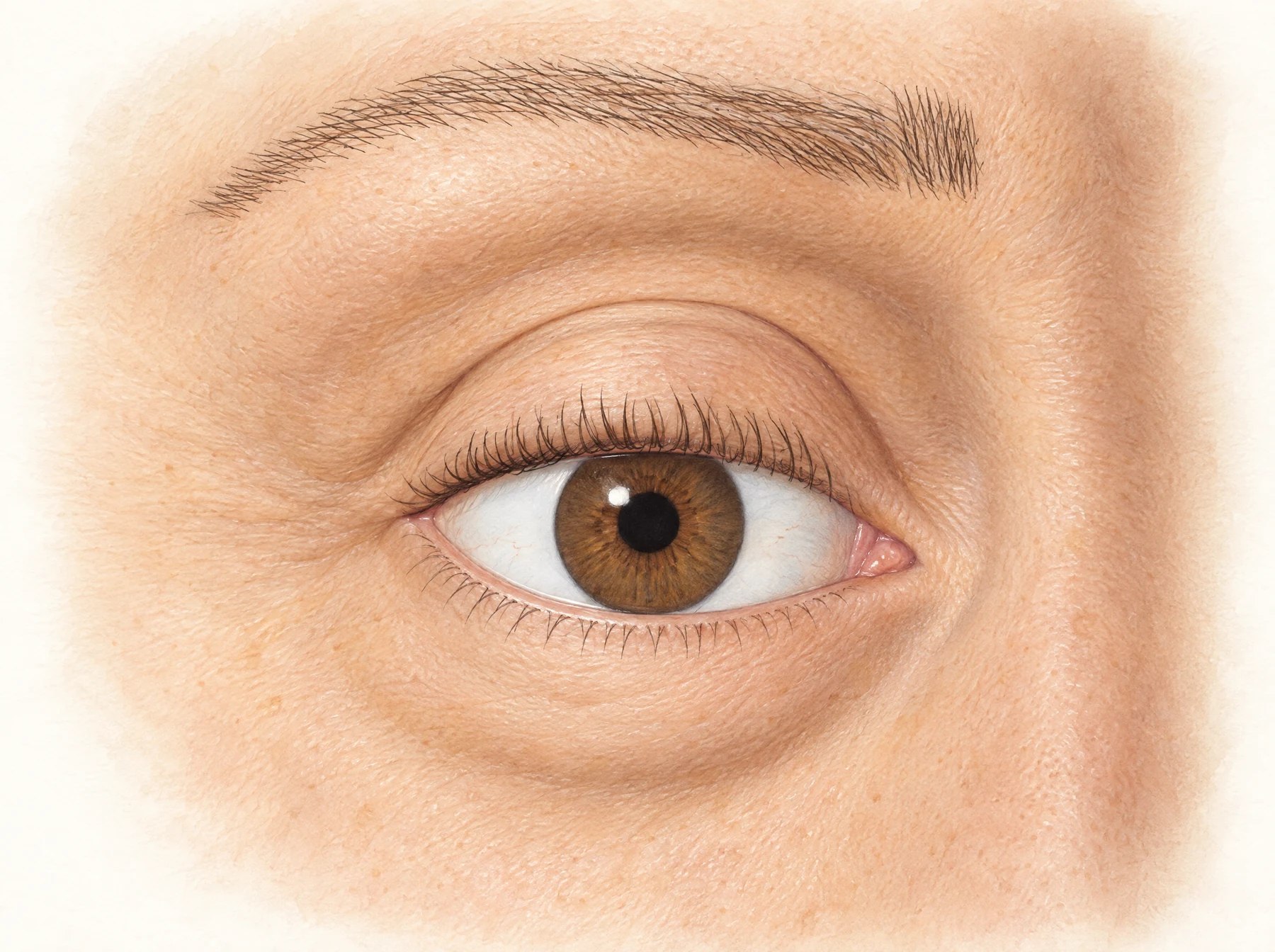
Medical illustration of the right eye region of a woman about 55 seen from the front: eyebrow, upper eyelid crease with mild hooding of the outer fold, lid margins and lashes, the inner corner with the caruncle, the slightly higher outer corner, lower lid fullness, tear trough and lid-cheek junction.

Eyelid surface landmarks

The right eye of a woman in her mid-fifties, showing the brow, the upper lid crease and fold, the corners of the eye, the tear trough and the lid-cheek junction.

  1. Eyebrow
  2. Upper eyelid crease
  3. Upper eyelid skin fold
  4. Upper eyelid margin and lashes
  5. Lateral canthus
  6. Medial canthus
  7. Caruncle
  8. Lower eyelid margin
  9. Lower eyelid
  10. Tear trough
  11. Lid-cheek junction
  12. Cheek
  13. Iris
  14. Pupil
  15. Sclera

Anatomy checked against StatPearls. Anatomy, Head and Neck: Eyelid, StatPearls. Blepharoplasty, StatPearls. Blepharoplasty, Lower Lid, Canthal Support, Wong CH et al. The tear trough ligament: anatomical basis for the tear trough deformity. Plast Reconstr Surg 2012, Muzaffar AR et al. Surgical anatomy of the ligamentous attachments of the lower lid and lateral canthus. Plast Reconstr Surg 2002.

Every eyelid illustration

See the work

Surgeons whose own sites show upper blepharoplasty: before-and-after photographs first. Choose your state for the surgeons near you.

Surgeons by stateAlabamaAlaskaArizonaArkansasCaliforniaColoradoConnecticutDelawareDistrict of ColumbiaFloridaGeorgiaHawaiiIdahoIllinoisIndianaIowaKansasKentuckyLouisianaMaineMarylandMassachusettsMichiganMinnesotaMississippiMissouriMontanaNebraskaNevadaNew HampshireNew JerseyNew MexicoNew YorkNorth CarolinaNorth DakotaOhioOklahomaOregonPennsylvaniaRhode IslandSouth CarolinaSouth DakotaTennesseeTexasUtahVermontVirginiaWashingtonWest VirginiaWisconsinWyoming

Oculoplastic surgeon
Austin, Texas
See the before and after
Oculoplastic surgeon
Tampa, Florida
See the before and after
Oculoplastic surgeon
Providence, Rhode Island
See the before and after
Plastic surgeon
Houston, Texas
See the before and after
Facial plastic surgeon
Aliso Viejo, California
See the before and after
Plastic surgeon
Tysons Corner, Virginia
See the before and after
Plastic surgeon
Los Angeles, California
See the before and after
Oculoplastic surgeon
Bellaire, Texas
See the before and after
Plastic surgeon
Meridian, Idaho
See the before and after
Plastic surgeon
New York, New York
See the before and after
Plastic surgeon
Beverly Hills, California
See the before and after
Oculoplastic surgeon
Scottsdale, Arizona
See the before and after

What upper blepharoplasty costs

Self-pay prices, and what insurance pays when the operation is covered.

Published prices
$5,000

Most practices that publish a price for it charge between $3,850 and $6,000.

Average surgeon fee
$3,359

From the American Society of Plastic Surgeons, before anesthesia and the operating room.

When insurance covers it
$778

Medicare's average payment to the surgeon (Upper blepharoplasty, skin weighting down the lid, CPT 15823). The surgery center is paid separately; you pay your deductible and coinsurance.

What eyelid surgery costs, in full · Prices in your state are on your state's page.

  • Between 40 and 60, excess upper-eyelid skin, bulging fat, a lower lid-cheek junction and upper-lid droop all become more common. Over half of people already had excess upper-eyelid skin at 40, and about two thirds at 60 (PMID 30320720).
  • Drooping of the outer brow becomes significant only after about age 61; people under 60 differ little from each other (PMID 30746916).
  • Eyelid tissue with excess skin has more lymphatic vessels, wider lymph channels, fewer elastic fibers and more inflammatory cells than normal eyelid tissue (PMID 21211847).
  • Eyelid aging (excess skin, droop, outward or inward turning lids) is attributed to loss of elastic fibers and overactive elastin-degrading enzymes, possibly from local ischemia, inflammation or chronic mechanical stress (PMID 26466237).
  • In younger patients, lower-lid fat bulging without meaningful skin excess is common. The inside-the-lid approach, which removes fat with no skin incision, is described as suited to this group, while patients needing skin removed are treated through the skin (PMID 32971612).
  • Mild to moderate ptosis (droopy upper lid) is underrecognized among blepharoplasty patients of all ages, not only older ones (PMID 33346340).

How it is done: technique by age

  • Standard technique is described in upper blepharoplasty and lower blepharoplasty. Younger patients with fat bulging and no skin excess are the group for whom the inside-the-lid approach, with no skin incision, is described (PMID 32971612).
  • Double-eyelid surgery with buried stitches creates a crease without cutting skin and is common in East Asia. Within a year, the eyelid was redone or the stitch removed in about 1 in 6 patients aged 45 and older, against about 1 in 14 aged 18 to 39. Older age independently raised the risk, and most cases were dissatisfaction with eyelid shape, not crease loss or infection (PMID 41838082).
  • In another buried-stitch series, redoing the surgery for loosened stitches was most common under age 20 (about 4 in 10) and least common in the 30s (about 1 in 8). Patients 60 and older showed no clear difference from the others (PMID 41171312).
  • For severe droop with poor or absent lifting-muscle function in patients aged 83 to 87, a forehead-muscle sling normally used for congenital ptosis improved eyelid position and visual field in every patient reported. Most had stable correction, and one overcorrected, could not fully close the eye and had revision surgery (PMID 41627255).

Results and evidence

  • In older patients having upper blepharoplasty (average age in the 70s), brow height did not change significantly after surgery, whether or not fat was removed (PMID 26505314).
  • Pooled across studies, the brow drops about 1.5 mm after upper eyelid surgery overall and under 1 mm after blepharoplasty alone. Results were not broken out by age; full figures are in upper blepharoplasty (PMID 36890345).
  • A 2025 American Academy of Ophthalmology review of quality-of-life outcomes after upper blepharoplasty and ptosis surgery did not break its findings out by age; the full findings are in upper blepharoplasty (PMID 40913605).
  • A series of severe eye complications after cosmetic surgery, mostly in younger women, included delayed optic nerve injury and corneal damage after eyelid surgery and a corneal chemical burn from iodophor entering the eye. It reflects younger cosmetic patients more than the older patients typical of dermatochalasis surgery (PMID 41125814).

Risks and complications: risk in older patients

  • A strict protocol keeping systolic blood pressure under 120 mmHg after facelift with blepharoplasty produced no hematomas. A history of hypertension went with higher preoperative pressure, and age over 65 showed a borderline link in women. More than 1 in 3 patients in this combined-procedure group had some complication (PMID 38714536).
  • Patients on aspirin, blood thinners or both who continued them through oculoplastic surgery (average age about 70) had no major bleeding. One minor bleed after upper-lid blepharoplasty, in a patient on aspirin and rivaroxaban, resolved on its own, and bleeding rates matched patients off the drugs (PMID 41672423).
  • Upper blepharoplasty patients on blood thinners had about 6% minor complications, not clearly different from patients off them, and none had major bleeding; full figures are in upper blepharoplasty (PMID 42236867).
  • Patients with rheumatoid arthritis, lupus or scleroderma had blepharoplasty complication rates no different from matched patients without these diseases (PMID 39353284).
  • In oculoplastic patients aged 18 to 92, bleeding went with a higher bleeding-history questionnaire score, aspirin use in eyelid surgery, diabetes, kidney disease, general anesthesia and longer surgery. Local anesthesia, anticoagulant use and high blood pressure were not significant factors (PMID 40695569).
  • Obstructive sleep apnea, more common with age and weight, went with a higher failure rate for ptosis repair: about 1 in 5 against about 1 in 8 without it. It raised the need for revision even after adjusting for age and sex (PMID 37995148).

Recovery

  • In the buried-stitch double-eyelid study, redo events in older patients rose sharply between 30 and 90 days after surgery, while in younger patients they built up steadily over the year (PMID 41838082). Recovery time by age has not been compared for standard excisional blepharoplasty; recovery for all ages is in upper blepharoplasty.

Combined procedures

  • Ptosis correction and brow lift are added to upper blepharoplasty often enough to move revision rates. Revision was about 9% when ptosis correction was added, against about 4% for blepharoplasty alone, and results were not reported by age. Combined-procedure evidence is in upper blepharoplasty, browpexy and direct brow lift and blepharoptosis repair (PMID 38315110).
  • Severe senile ptosis with poor lifting-muscle function has been treated with a forehead-muscle sling in patients in their 80s (PMID 41627255).

Current questions

  • Whether buried-stitch crease surgery lasts well enough for older patients: one study found about twice the redo rate in older patients (PMID 41838082), while another found the highest redo rate under age 20 (PMID 41171312).
  • Whether the forehead-muscle sling should be used more often for severe ptosis in patients in their 80s with poor lifting-muscle function, based so far on a very small case report (PMID 41627255).
  • Whether age itself, apart from the blood-thinner use, diabetes and general anesthesia that go with it, is an independent bleeding risk in oculoplastic surgery; a 2025 pilot study spanning ages 18 to 92 did not find age independently significant (PMID 40695569).
  • Whether conditions more common with age, such as sleep apnea, should change ptosis-repair counseling or technique, given the link to revision (PMID 37995148).

Terms

  • Dermatochalasis: excess, lax eyelid skin that becomes more common with age (PMID 30320720).
  • Involutional ptosis: age-related eyelid droop from a stretched or disinserted levator aponeurosis (PMID 26466237).
  • Senile ptosis: severe involutional ptosis with poor or absent levator function, seen in the oldest patients (PMID 41627255).
  • Elastolysis: breakdown of elastic fibers in eyelid tissue, seen in dermatochalasis (PMID 21211847).
  • Familial fat herniation: prominent lower-eyelid fat pads without skin excess, seen in younger patients and treated by the transconjunctival approach (PMID 32971612).
  • Transconjunctival approach: fat surgery through an incision on the inner eyelid, with no skin incision (PMID 32971612).
  • Buried-suture double-eyelid surgery: a non-incisional technique that creates an eyelid crease with sutures rather than skin excision (PMID 41838082).
  • Frontalis muscle flap suspension: a technique that uses the forehead muscle to lift a ptotic eyelid when the levator muscle itself has little or no function (PMID 41627255).

Blepharoplasty by age questions

What age is right for blepharoplasty?

Patients in their 30s with bulging lower-lid fat and little loose skin are the group for the inside-the-lid approach (PMID 32971612). Loose upper-lid skin, fat bulging and lid droop all become more common between 40 and 60 (PMID 30320720). The outer brow drops measurably only after about 61 (PMID 30746916). Patients aged 83 to 87 with severe droop have had a forehead-muscle sling (PMID 41627255).

Does eyelid surgery make you look younger?

Face-reading software estimated patients as 3.2 years younger after blepharoplasty than before it (PMID 40167099). The study used before-and-after photos of 94 patients with an average age of 52 (PMID 40167099). The change did not differ by sex, true age or procedure type (PMID 40167099). Patients who looked older than their age before surgery looked about 5 years younger afterward (PMID 40167099).

Do hooded eyes get worse with age?

In one study of eyelid aging, more than half of 40-year-olds already had loose upper-lid skin (PMID 30320720). By 60 the share was about two thirds (PMID 30320720). The outer brow starts to fall after about 61 (PMID 30746916). Eyelid skin loses elastic fibers with age (PMID 26466237). Hooded lids are covered in Hooded eyelids.

Is blepharoplasty safe for older patients?

In oculoplastic patients aged 18 to 92, age was not an independent bleeding risk (PMID 40695569). Diabetes, kidney disease, general anesthesia and longer surgery were (PMID 40695569). Patients averaging about 70 who stayed on aspirin or blood thinners had no major bleeding (PMID 41672423). Patients in their 80s with severe droop had better lid position and visual field after a forehead-muscle sling (PMID 41627255).

Can you have blepharoplasty in your 20s or 30s?

Younger patients often have bulging lower-lid fat without loose skin (PMID 32971612). That pattern is treated through the inside of the lid, with no skin cut (PMID 32971612). Mild upper-lid droop is missed in blepharoplasty patients of every age (PMID 33346340). In buried-stitch double eyelid surgery, patients under 20 had the highest redo rate, about 4 in 10 (PMID 41171312).

Papers cited on this page

Newest first.

2026
Frontalis Muscle Flap Suspension for Severe Senile Ptosis: Key Considerations and Surgical Techniques
Kim J, Kim Y, Rha EY, Shin J · J Craniofac Surg · PMID 41627255
2026
Assessing the Safety of Eyelid Surgery in Patients on Antithrombotic Therapy: Empirical Evidence Supporting Favourable Outcomes
Giacuzzo C, Wanas AM, Tan LT, Ghazi-Nouri S · Klin Monbl Augenheilkd · PMID 41672423
2025
An Analysis of Severe Ophthalmologic Complications Following Plastic and Cosmetic Procedures: Insights and Experience Sharing
Quan X, Peng P, Yin Y, Xue P, Fan X, Xia W, et al. · Aesthetic Plast Surg · PMID 41125814
2025
Risk factors for bleeding and perioperative bleeding complications in oculoplastic surgery: a prospective pilot study
Christensen NA, Feltgen N, Horn M, Naxer S, van Oterendorp C, Koscielny J, et al. · Br J Ophthalmol · PMID 40695569
2025
Using Facial Recognition Software to Quantify Perceived Age Reduction in Patients Undergoing Blepharoplasty
Khong J, Davis AJ, Wei O, Cooney CM, Broderick KP · Ann Plast Surg · PMID 40167099
2024
The Role of Blood Pressure Control in Prevention of Hematoma After Blepharoplasty
Ash M, Shauly O, Swan C, Menon A, Schafer C, Nahai F · Aesthetic Plast Surg · PMID 38714536
2024
Impact of connective tissue diseases on complications following aesthetic surgery: A matched cohort study
Abbas F, Khalaf R, Reyes J, Fodor R, Perozzo F, Obeid R, et al. · J Plast Reconstr Aesthet Surg · PMID 39353284
2024
Obstructive Sleep Apnea Associated With Increased Failure Rate of Ptosis Repair
Nirmalan A, Tran MT, Tailor P, Hodge D, Bradley EA, Wagner LH, et al. · Ophthalmic Plast Reconstr Surg · PMID 37995148
2024
Eyelid and Brow Rejuvenation: Technical Pearls and Outcomes of Upper Blepharoplasty with or without Ptosis Correction and Brow Lift
Falcon Rodriguez L, Kuruoglu D, Salinas CA, Liu A, Wagner LH, Bradley EA, et al. · Plast Reconstr Surg · PMID 38315110
2020
Lower eyelid blepharoplasty: An overview
Bhattacharjee K, Ghosh S, Ugradar S, Azhdam AM · Indian J Ophthalmol · PMID 32971612
2019
Study on the Aging Dynamics of the Periorbital Region: From Observation to Knowledge of Physiopathology
De Biasio F, Miotti G, Zingaretti N, Castriotta L, Parodi PC · Ophthalmic Plast Reconstr Surg · PMID 30320720
2015
Eyelid aging: pathophysiology and clinical management
Damasceno RW, Avgitidou G, Belfort R, Dantas PE, Holbach LM, Heindl LM · Arq Bras Oftalmol · PMID 26466237
2015
Eyebrow Position Following Upper Blepharoplasty
Dar SA, Rubinstein TJ, Perry JD · Orbit · PMID 26505314
2011
Histologic assessment of dermatochalasis: elastolysis and lymphostasis are fundamental and interrelated findings
Nagi KS, Carlson JA, Wladis EJ · Ophthalmology · Randomized Controlled Trial · PMID 21211847