



















What it treats
- Furnas separated true festoons, caused by orbicularis oculi muscle laxity, from malar mounds and bags, which involve skin, fat and interstitial edema (PMID 635044), (PMID 8485946).
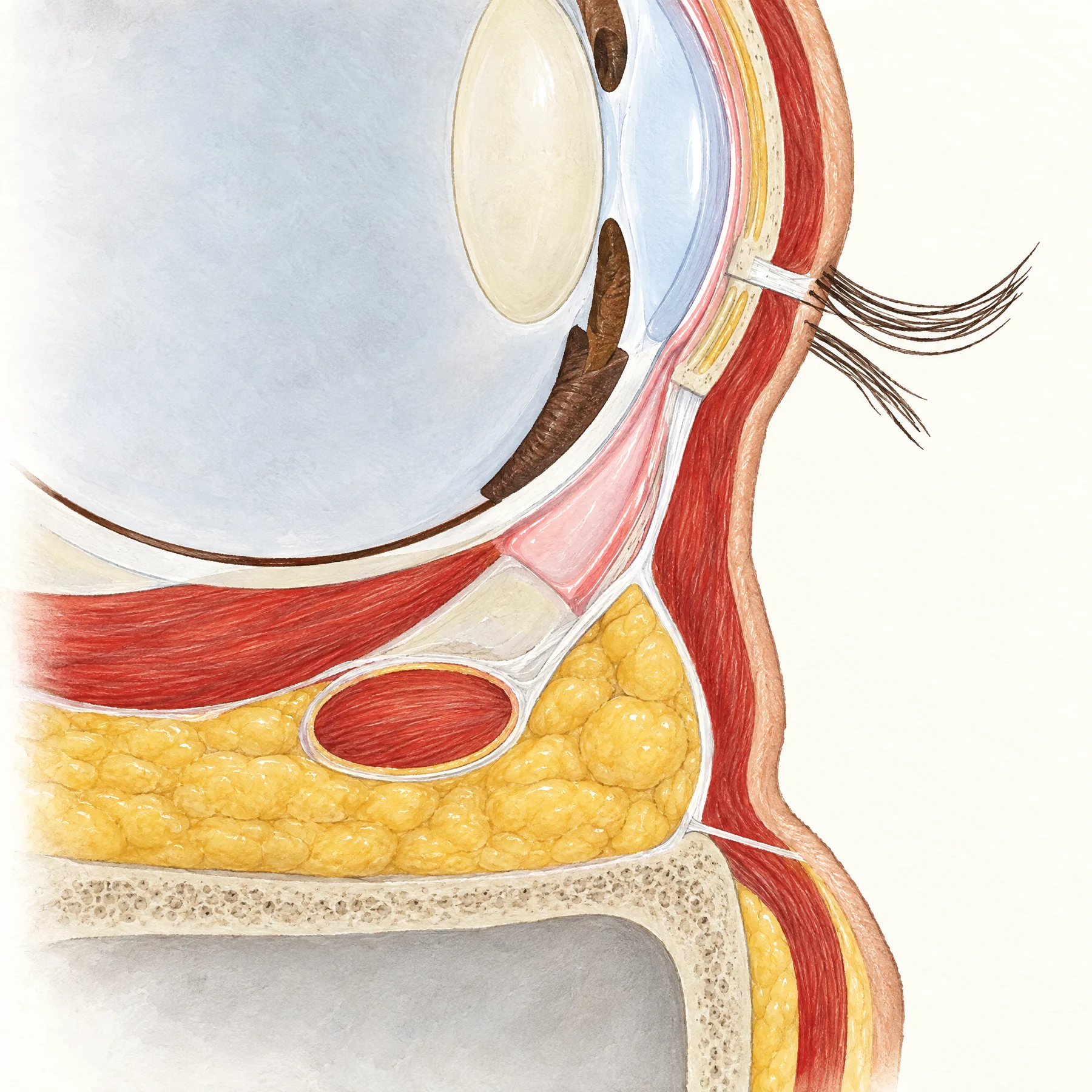
- The malar septum runs from the orbital rim periosteum to cheek skin 2.5-3 cm below the outer corner of the eye. It traps edema and hemoglobin pigment above its insertion and defines the lower boundary of malar mounds, malar edema and festoons (PMID 19327681). The same fascia traps fluid at the site where a black eye forms after trauma (PMID 9579587).
- The prezygomatic space, a glide plane over the cheekbone bounded by the orbicularis retaining ligament above and zygomatic ligaments below, lets the orbicularis move independently of the cheek and explains the shape of malar mounds (PMID 12172155). Dissection also identified a tear trough muscle fiber and other connective tissue bands anchoring the orbicularis oculi directly to skin under the eye (PMID 38036923).
- Orbicularis and ligament anatomy varies by ancestry, with a thicker orbicularis oculi reported in African populations and thinner fat pads in Europeans (PMID 40668178).
- Extended blepharoplasty was first described for infraorbital, or malar, bags seen in up to 1 in 10 blepharoplasty candidates (PMID 2036181). Among patients seeking correction of eyelid bags, cheek festoon was a smaller contributor than cheek descent with tear trough and orbital fat prolapse, and festoon and tear trough were significantly more common after age 50 (PMID 15809605).
- Festoons can be precipitated by botulinum toxin injected under the eye in a patient whose orbicularis was already weakened by prior lower lid surgery, reported as a single case (PMID 12752529).
- Congenital festoons, present since childhood, were described in a small minority of patients treated for festoons or malar mounds over 10 years (PMID 29671023).
- Patients in one festoon surgery series named genetics, pets, prior hyaluronic acid filler, neurotoxin injection, facial surgery, alcohol use, allergies and sun exposure as possible contributing factors, each cited by roughly half or more (PMID 36877611).
- Infraorbital hollows, above the orbital rim, overlap in appearance with malar mounds, festoons and dark circles but are a separate deformity needing differentiation (PMID 36998744), an approach also framed as mapping alternating elevations and hollows of the lower eyelid and cheek (PMID 27398004).
How it is done
Filler-related and fluid causes
- Hyaluronic acid filler placed in the tear trough can cause malar edema that presents up to 7 years after injection. Hyaluronidase resolved it completely in a reported case (PMID 28837381).
- Recurrent eyelid edema after hyaluronic acid was treated with serial hyaluronidase and fractionated radiofrequency microneedling, with carbon dioxide laser added in some patients. All resolved with no recurrence over at least 2 years (PMID 38828092). A review of the same complication describes the same treatment ladder: corticosteroids, hyaluronidase, then radiofrequency microneedling or surgery once the filler has dissolved (PMID 39395232).
- For filler-related contour problems around the eyes, hyaluronidase dissolved the filler in one session in most patients and two sessions in the rest. Mild edema persisted in a few patients despite no visible filler (PMID 30298348).
Direct excision
- Furnas's original technique excised the redundant orbicularis oculi muscle and supported the remaining muscle with periosteal and muscular sutures (PMID 635044). Later series applied direct skin excision to the malar festoon as part of facial rejuvenation surgery (PMID 7598032), with lower lid tightening (PMID 22690920), and under the umbrella term malar bags for malar edema, mounds and festoons (PMID 39354229).
- Mini-incision direct festoon access, cauterization and excision (MIDFACE) uses a 1-cm office-based incision instead of wide flap dissection (PMID 36877611). Another technique uses an infraorbital curvilinear incision at the base of the lowest festoon, with the orbital septum left intact and no fat manipulation (PMID 40327813).
Extended lower blepharoplasty and midface lift
- Extended blepharoplasty carries the skin-muscle flap dissection of standard lower blepharoplasty below the infraorbital rim, usually with a lid-shortening procedure (PMID 2036181). Direct transcutaneous lower blepharoplasty through an infraorbital incision has been extended to tear trough deformity, suborbicularis oculi fat and festoons in high-grade lower eyelid deformity (PMID 39104922).
- Extended lower blepharoplasty with subcutaneous and sub-orbicularis dissection plus canthoplasty removes larger amounts of skin than standard technique allows (PMID 41198888). Combined festoon excision with transmalar lower blepharoplasty gives direct access to the inferior orbital fat pads when festoons and fat herniation coexist (PMID 42130916).
- A surgical protocol of subciliary skin-muscle flap, release of the orbicularis retaining and zygomaticocutaneous ligaments, midface lift, canthopexy and orbicularis muscle suspension is used for both acquired and congenital festoons (PMID 37256298), (PMID 29671023).
Laser, energy-based and injection treatment
- Fractional microneedle bipolar radiofrequency combined with a medium-depth 15% TCA peel has been used alongside blepharoplasty (PMID 32985067). Radiofrequency microneedling alone was evaluated by blinded photographic review (PMID 41092094). Microfocused ultrasound with visualization (MFU-V) tightens skin from several depths (PMID 40763772). A thermomechanical device (Tixel) delivers topical tetracycline 1% through the skin (PMID 38605495).
- Intralesional tetracycline 2% injection was the first reported sclerotherapy for lower eyelid festoons (PMID 24841733). Intralesional doxycycline has also been used (PMID 30882591). Tetracycline injection has been combined with the pinch technique and canthopexy 3 months later for severe festoons (PMID 35156019).
Results and evidence
- MIDFACE direct excision had no major complications. Photographs graded by three physicians showed sustained improvement in festoon score up to 12 years after surgery, incision scars were undetectable on photographs, and patient satisfaction averaged 9.5 out of 10 (PMID 36877611).
- Infraorbital curvilinear direct excision removed a mean 15 mm of skin with no lagophthalmos, corneal staining or eyelid retraction. Minor complications were uncommon and recurrence was about 4 in 100 at 11 months (PMID 40327813).
- Direct excision of malar bags, and direct excision with lower lid tightening, each reported no major complications and high satisfaction (PMID 39354229), (PMID 22690920).
- Subciliary flap with ligament release, midface lift, canthopexy and muscle suspension was used in patients with acquired festoons, many after a failed earlier correction. Persistent malar edema beyond 6 weeks occurred in about 1 in 6 patients and mostly resolved with a steroid taper and hydrochlorothiazide. Few needed reoperation (PMID 37256298).
- Extended transcutaneous lower blepharoplasty for high-grade deformity left all patients satisfied with good scar quality (PMID 39104922). A series removing 6-16 mm of skin reported low complications and a satisfactory outcome (PMID 41198888).
- Radiofrequency microneedling lowered the festoon score significantly by both surgeon and layperson grading, with better undereye skin quality and less fat bulge reported in a large share of cases (PMID 41092094).
- Tixel plus topical tetracycline improved masked-reviewer grading, and self-reported disturbance fell sharply. Most patients reported moderate to significant improvement, and 9 in 10 reported improvement lasting at least 4 months (PMID 38605495).
- Intralesional tetracycline 2% lowered the mean festoon grade with no cutaneous ischemia or necrosis (PMID 24841733). Doxycycline sclerotherapy lowered the mean grade from about 2.5 to 0.9 at about 5 months (PMID 30882591).
- At a mean 3.6 years after tetracycline injection, about 6 in 10 patients reported improvement (most of them within 2 months) and about two-thirds would repeat the treatment. Men were more likely than women to consider repeating it (PMID 33234952).
- MFU-V and combined radiofrequency microneedling with a 15% TCA peel each reported visible improvement with no complications at follow-up (PMID 40763772), (PMID 32985067).
Risks and complications
- Furnas described festoons and malar mounds as notorious for persisting despite surgical treatment (PMID 8485946).
- Every patient with congenital festoons had residual puffiness needing further surgery or off-label deoxycholic acid injection, against about 1 in 20 patients with acquired festoons (PMID 29671023).
- In the larger surgical series, malar edema lasting beyond 6 weeks occurred in about 1 in 6 patients, 2 needed reoperation, and 1 developed transient lid retraction after a prior facelift with facial nerve injury (PMID 37256298).
- Botulinum toxin injected under the eye can precipitate festoon formation when the orbicularis oculi has already been weakened by earlier lower lid surgery (PMID 12752529).
- Hyaluronic acid filler-related malar edema can present years after injection. Proposed mechanisms include the impermeable malar septum trapping fluid, disrupted eyelid lymphatics, and immune reaction to hyaluronic acid fragments (PMID 38828092). After hyaluronidase before lower blepharoplasty for filler-related problems, a few patients had prolonged postoperative edema, resolving by 6 months in most (PMID 30298348).
- After infraorbital curvilinear excision, minor complications were uncommon and recurrence was about 4 in 100 (PMID 40327813).
- With tetracycline or doxycycline sclerotherapy, no cutaneous ischemia or necrosis was reported. Pain, bruising and swelling were the complications recorded, in up to about 1 in 6 patients on long-term follow-up (PMID 24841733), (PMID 30882591), (PMID 33234952).
Recovery
- MIDFACE is performed through a 1-cm office-based incision with a minimally invasive recovery course (PMID 36877611).
- Tixel with topical tetracycline was given about every 5 weeks for about 5 sessions, with improvement beginning about 11 days after the first treatment (PMID 38605495).
- After tetracycline injection, most patients who improved noticed the change within 2 months (PMID 33234952).
- After direct infraorbital excision, results were durable at about 11 months with no lagophthalmos or eyelid retraction (PMID 40327813).
With a facelift
- Malar bags are a recognized challenge within blepharoplasty patients, and treatment reviews build midface lift and ligament release into the surgical algorithm rather than treating festoons separately (PMID 24431347), (PMID 31051517).
- Both Asaadi series combine subciliary lower blepharoplasty, midface lift, canthopexy and orbicularis muscle suspension in one operation (PMID 37256298), (PMID 29671023). Combined festoon excision with transmalar lower blepharoplasty addresses concurrent orbital fat herniation (PMID 42130916). More than half the patients in the extended transcutaneous series also had upper blepharoplasty in the same operation (PMID 39104922).
- Extended lower blepharoplasty adds deep and superficial canthoplasty for support when large amounts of skin are excised (PMID 41198888).
- When periocular filler has caused malar edema, hyaluronidase dissolution is completed before lower blepharoplasty with fat repositioning and skin resurfacing (PMID 30298348).
Current questions
- Terminology is unsettled: reviews still note inconsistent use of the terms malar mound, malar edema and festoon (PMID 39354229), (PMID 42165449), (PMID 40105778).
- No single dominant technique has emerged. A systematic review proposed an updated algorithm but noted management remains individualized (PMID 31051517), and a later review concluded no nonsurgical treatment yet meets the ideal of minimal invasiveness with predictable improvement (PMID 33906762).
- Direct excision and extended lower blepharoplasty series report high satisfaction and low complications, but the published series are small and mostly retrospective (PMID 36877611), (PMID 37256298).
- Energy-based devices show measurable improvement in small series but remain useful mainly for mild to moderate festoons (PMID 41092094), (PMID 40763772).
- Hyaluronic acid filler is an increasingly recognized cause of malar edema, but its exact pathophysiology is still under study (PMID 38828092), (PMID 39395232).
- Congenital festoons were first described as a distinct entity in 2018. Whether their pathophysiology and recurrence risk differ from acquired festoons is not established (PMID 29671023).
Terms
- Festoon: a hanging fold of skin, orbicularis oculi muscle and fluid on the lower eyelid or cheek, caused by muscle laxity (PMID 635044).
- Malar mound: puffiness over the cheekbone in the prezygomatic space, often congenital (PMID 24431347).
- Malar edema: fluid accumulation over the malar eminence, trapped by the malar septum (PMID 19327681).
- Malar bags: umbrella term for festoons, malar mounds and malar edema as one spectrum (PMID 39354229).
- Malar septum: the fascial barrier from the orbital rim to cheek skin that traps edema and defines the lower border of festoons (PMID 19327681).
- Orbicularis retaining ligament (ORL): ligament bounding the prezygomatic space above (PMID 12172155).
- Zygomaticocutaneous ligament (ZCL): ligament released with the ORL during midface lift for malar mounds (PMID 37256298).
- Prezygomatic space: the glide plane over the zygoma where malar mounds form (PMID 12172155).
- Steatoblepharon: fat-related lower eyelid bulge, distinct from but often co-present with festoons (PMID 41092094).
- Sclerotherapy: intralesional tetracycline or doxycycline injection intended to scar down and flatten a festoon (PMID 24841733).
- MIDFACE: mini-incision direct festoon access, cauterization and excision, an office-based technique (PMID 36877611).
- MFU-V: microfocused ultrasound with visualization, a non-invasive skin-tightening device (PMID 40763772).