
What it treats
- Patients are dissatisfied after double eyelid surgery for scar, a low or high fold, a shallow or deep fold, triple folds, pretarsal fullness, ptosis, and asymmetry (PMID 26306087).
- Asymmetry was the leading complaint after both primary and revision double eyelid surgery; revision patients complained more often of an asymmetric crease shape specifically, rather than just height (PMID 39998431).
- A prior "European-style double eyelid" operation can leave a complex deformity combining a high fold, upper-lid depression, multiple folds and scarring, needing more than one correction at once (PMID 30456638).
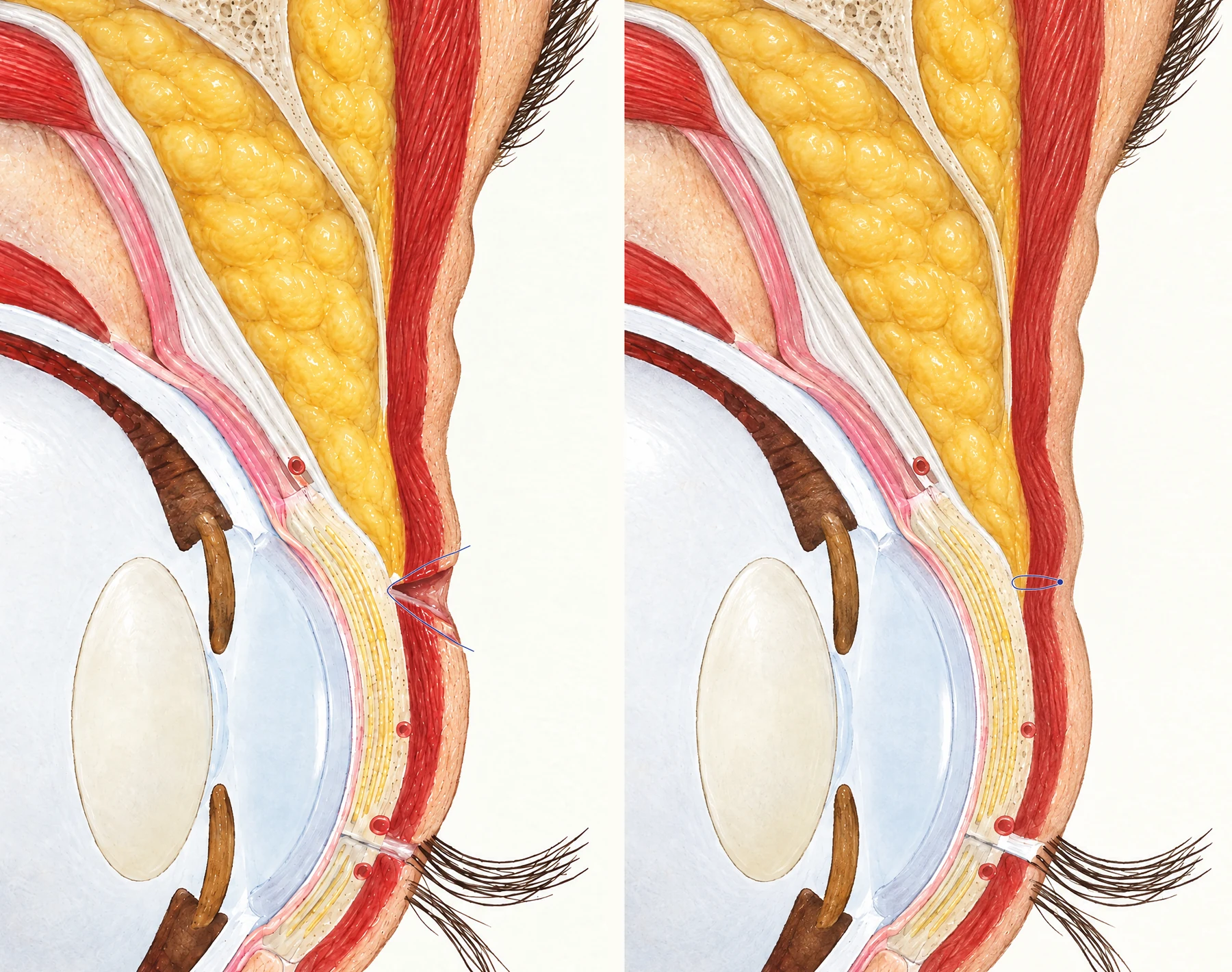
- Three mechanisms recur across the four problems this page covers: scar adhesion between skin and the levator or orbicularis (high crease and multiple folds), loss of fixation between skin and the deep lid structures (crease loss), and depletion of orbital septal fat during the first surgery (the sunken look) (PMID 34331094), (PMID 42315793). Primary technique and crease-loss risk by age are covered in double eyelid surgery, and fat grafting for hollow lids in general in hollow upper eyelid and fat grafting.
How it is done
Multiple creases
- Unwanted extra lines form from adhesions after inappropriate manipulation during the first surgery or a secondary operation; correction dissects and releases the scar tissue, then augments the preorbital area with orbicularis muscle or orbital fat to prevent the skin and levator from readhering (PMID 21364433).
- An older technique for multilaminated septal structures from a prior operation slits the scar transversely, removes the layered septal tissue, and spreads the extruded preaponeurotic fat into the cleared space to prevent the adhesion from re-forming (PMID 11083574).
- Fat grafting can recontour a sunken lid with multiple folds and reportedly forms a new single crease as a side effect, using microautologous fat transplantation delivered in small, consistent parcels (PMID 26678103).
- Grafting free orbital fat into the postorbicularis space during the original blepharoplasty, in patients with thin eyelid tissue judged at risk, is proposed to prevent multiple folds and sunken eyelids before they occur (PMID 32028370).
Crease too high
- Correction generally releases the scar adhesion between skin and the levator aponeurosis, repositions or adds orbital fat to refill the gliding zone, and re-fixes the skin at a lower, more natural point; the fixation tissue used (orbicularis, tarsus, fascia) and the fat source vary by technique (PMID 30245018), (PMID 36913561), (PMID 37027031).
- A tarsus-orbicularis fixation combined with orbital fat repositioning, using lower-eyelid fat for grafting when needed, treated high folds (PMID 36042546).
- Preserving the skin below the original high crease while reconstructing the subcutaneous orbital fascia beneath it, rather than re-excising skin, was used in eyes with little eyelid skin and thick orbital fascia (PMID 38513342).
- A three-plane dissection above the incision line, combined with preaponeurotic fat flap repositioning or autologous fat grafting to block scar readhesion, treated high folds (PMID 40550894).
- Cadaveric dissection of the orbital fat fascia flap's blood supply informed a technique that preserves the flap's vascular pedicle to reconstruct the gliding zone (PMID 41286171).
Loss of crease (disappearing fold)
- A buried-suture crease that has loosened or disappeared is treated first by removing the suture; outcomes differ by removal technique, and a full skin incision succeeded far more often than a small incision for suture-related complications (PMID 27622107).
- A biomimetic revision for a disappearing crease sutures the pretarsal fascia, orbicularis oculi muscle and dermis together at the lower incision edge, aiming for more secure internal fixation than the original suture or incision gave (PMID 40446845).
- "Sausage phenomenon," a depressed groove with persistent pretarsal swelling after incisional surgery, is addressed by releasing the pretarsal orbicularis muscle and fixing a flap of its outer fascia to the aponeurosis (PMID 37991537).
- Reconstructing the orbital septum and its fusion point to the levator aponeurosis or tarsal plate is used across all three fold problems (high crease, multiple creases, and disappearance), on the reasoning that the fusion point, not just the skin incision, determines fold stability (PMID 34331094).
Sunken lid
- Among patients with a sunken upper eyelid, more than 8 in 10 had prior upper-lid surgery; the leading cause was absolute or relative deficiency of orbital septal fat, generally from excessive fat removal during the earlier blepharoplasty (PMID 42315793). General mechanisms and fat-grafting technique for a hollow upper eyelid, including in patients with no prior surgery, are in hollow upper eyelid and fat grafting.
- The pendulum technique repositions orbital fat and retro-orbicularis oculi fat together to correct sunken-lid deformity specifically after a prior Asian upper blepharoplasty (PMID 38315230).
Scar and depression
- A turnover orbicularis-septum composite flap, inverted downward over a depressed incisional scar, addresses the tissue deficit directly rather than only resurfacing the scar (PMID 38349356).
- An elevated cephalad orbital septum flap used at the time of the original, primary surgery is reported to lower the rate of incisional depression, framing depression as preventable at the first operation rather than only correctable afterward (PMID 42623493).
With epicanthoplasty
- An unmatched epicanthal fold can make an otherwise acceptable double eyelid look unsatisfactory; a four-point epicanthoplasty redesign was used specifically to revise blepharoplasty outcomes where the medial canthal area did not harmonize with the crease (PMID 40691656).
Results and evidence
- Multiple folds released and augmented with soft tissue resolved completely in more than 9 in 10 patients; the rest recurred and were corrected by reoperation, all in patients who had already had one or more prior secondary operations, where adhesions were most severe (PMID 21364433).
- High-fold correction by pretarsal orbicularis flap was satisfactory in about 8 in 10 patients, with few needing further revision (PMID 30245018).
- High-fold correction by retro-orbicularis oculi fat (ROOF) transposition satisfied about 9 in 10 patients, with no infection or levator dysfunction (PMID 36913561).
- An individualized free-style design satisfied about 9 in 10 patients, with partial or complete crease loss in fewer than 3 in 100 (PMID 37027031).
- Tarsus-orbicularis fixation with fat repositioning lowered the mean crease height from about 10 mm to 7 mm and left about 9 in 10 patients fully satisfied (PMID 36042546).
- Subcutaneous fascia reconstruction under preserved skin lowered the crease height from about 10 mm to 6 mm, with surgeon-patient agreement on a good result in about 9 in 10 and no recurrence of the original high crease (PMID 38513342).
- Three-plane dissection with fat repositioning or grafting lowered crease height from about 11 mm to 7 mm, with overall satisfaction of about 9 in 10; prior blepharoplasty history, concomitant ptosis, and concomitant eyelid depression each predicted lower satisfaction (PMID 40550894).
- A vascularized orbital fat fascia flap satisfied more than 9 in 10 patients; a few needed secondary revision for a unilateral sunken upper eyelid (PMID 41286171).
- Biomimetic fixation for a disappearing crease left no crease disappearance during follow-up, and nearly all patients were satisfied (PMID 40446845).
- Suture removal for suture-related complications succeeded in more than 1 in 3 eyelids with a full skin incision, against fewer than 1 in 20 with a small incision (PMID 27622107).
- Orbital septum and fusion-point reconstruction for high, multiple and disappeared creases gave a good outcome in nearly all patients; recurrence of disappearance and asymmetry were rare (PMID 34331094).
- OFOOM-orbicularis-aponeurosis fixation for sausage-phenomenon revision raised patient-rated appearance satisfaction substantially; about 1 in 11 needed a second revision (PMID 37991537).
- A turnover orbicularis-septum flap for depressed scars left about 2 in 3 patients fully satisfied and about 1 in 15 unsatisfied, mostly from a recurrent shallow or disappeared fold or from asymmetry (PMID 38349356).
- A septoaponeurotic fixation technique used across a very large series of primary and revision Asian upper blepharoplasties reported high satisfaction (about 19 in 20) and fold loss or asymmetry in under 2 in 100 (PMID 41942643).
Risks and complications
- Depressed scarring after incisional double eyelid surgery is common enough to drive its own revision literature; about 1 in 15 patients remained unsatisfied after the revision itself, most often because the fold stayed shallow or disappeared again (PMID 38349356).
- Even with a technique designed to prevent incisional depression, fair or poor scars occurred in about 2 in 100 primary-surgery patients and partial or complete fold disappearance in about 1 in 100 by 6 months (PMID 42623493).
- Reoperation on a reoperation is harder: about 1 in 5 revisions in one surgeon's series followed an already-failed revision, and fully excellent outcomes across all revisions were about 6 in 10 (PMID 15457048).
- Continuous buried sutures led to reoperation less often over 4 years than two-point sutures (about 1 in 7 against 1 in 4), mostly for suture loosening; how reoperation risk varies by age and suture pattern is covered in double eyelid surgery (PMID 40571750).
- Undercorrected ptosis found at the time of crease revision accounted for some "unsatisfied" outcomes even when the crease itself was successfully repositioned, in more than one series (PMID 36042546), (PMID 38513342).
Recovery
- Revision results were mostly reported at 6 months, with a smaller number of patients followed to 1-2 years and some to 4 years (PMID 30245018), (PMID 37027031).
- Releasing scar adhesions is part of multiple-fold correction (PMID 21364433); general swelling and healing timelines are in blepharoplasty recovery timeline.
Current questions
- No head-to-head comparison of the many high-crease fixation techniques (orbicularis, tarsus, orbital fat fascia flap, septum reconstruction) exists in the same patients; each is reported as a single-arm or single-center series (PMID 36042546), (PMID 38513342), (PMID 40550894), (PMID 41286171).
- Whether fat grafting prevents multiple folds and sunken eyelids, as opposed to only treating them once present, rests on one small series without a comparison group (PMID 32028370).
- Prevention versus cure: an elevated orbital septum flap used at the original surgery reports lower depression rates than earlier revision series, but the preventive and corrective approaches have not been compared directly (PMID 42623493).
- The largest outcomes series comes from a single technique at a single institution; whether its low fold-loss and asymmetry rate holds for other surgeons using the same fixation principle is untested (PMID 41942643).
- Patient-reported complaint patterns differ between primary and revision surgery (asymmetric crease shape is more specifically a revision complaint), suggesting revision patients may be judging results against a different standard than first-time patients, which outcome scales do not currently separate (PMID 39998431).
Terms
- High crease (high fold): a double eyelid crease positioned higher than intended, the most common reason for double-eyelid revision (PMID 26306087).
- Multiple folds: more than one crease line above the lash line, caused by scar adhesion between the skin and the levator or orbicularis muscle (PMID 21364433).
- Crease loss (fold disappearance): fading or loss of the surgically created crease, treated by removing a loosened suture or re-fixing the skin to the deeper lid structures (PMID 27622107).
- Sunken (hollow) upper eyelid: a concave upper-lid contour, most often from excessive orbital fat removal at the original surgery (PMID 42315793).
- Sausage phenomenon: a depressed incisional groove with a bulging pretarsal segment above it, named for its appearance (PMID 37991537).
- Gliding zone: the plane between the orbital septum and the levator aponeurosis where the preaponeurotic fat sits; its disruption or reconstruction governs several revision techniques (PMID 41286171).
- Orbital septum fusion point: the point where the orbital septum joins the levator aponeurosis or tarsal plate, which several techniques target directly to stabilize the crease (PMID 34331094).
- Retro-orbicularis oculi fat (ROOF): a fat layer beneath the orbicularis oculi muscle, used as a graft or transposition source to fill a high or sunken lid (PMID 36913561).
- Preaponeurotic fat flap: the central upper-lid fat compartment, repositioned or used as a vascularized flap in several revision techniques (PMID 40550894).
- Supratarsal depression: a sunken appearance just above the tarsal plate, one of the recurring complaints after a failed revision (PMID 15457048).