When both are needed
- Involutional ptosis, from aponeurosis dehiscence or disinsertion, commonly occurs at the same time as dermatochalasis; the presence of ptosis should be checked before any upper-lid blepharoplasty (PMID 7111498).
- About 1 in 7 people considering blepharoplasty had undiagnosed ptosis, most of it mild, and it was far more common in people with uneven eyebrows (PMID 37694225).
- More than half of patients seen for facial rejuvenation had ptosis, detailed separately in blepharoptosis repair (PMID 32356151).
- Of patients presenting for excess eyelid skin, up to about 1 in 5 needed ptosis correction added to the blepharoplasty (PMID 38315110).
- A survey of Aesthetic Society members found ptosis and varied upper-lid aging patterns are underrecognized in blepharoplasty patients; nearly all surgeons who repair ptosis use levator advancement or plication as their main technique (PMID 33346340).
- Dermatochalasis and ptosis require separate evaluation in the same patient, since skin excess can hide a low lid margin and vice versa (PMID 3045728).
- Early reports of the combined operation advised that when ptosis is present, it should be corrected at the same time as the blepharoplasty rather than staged (PMID 8485935).
How it is done
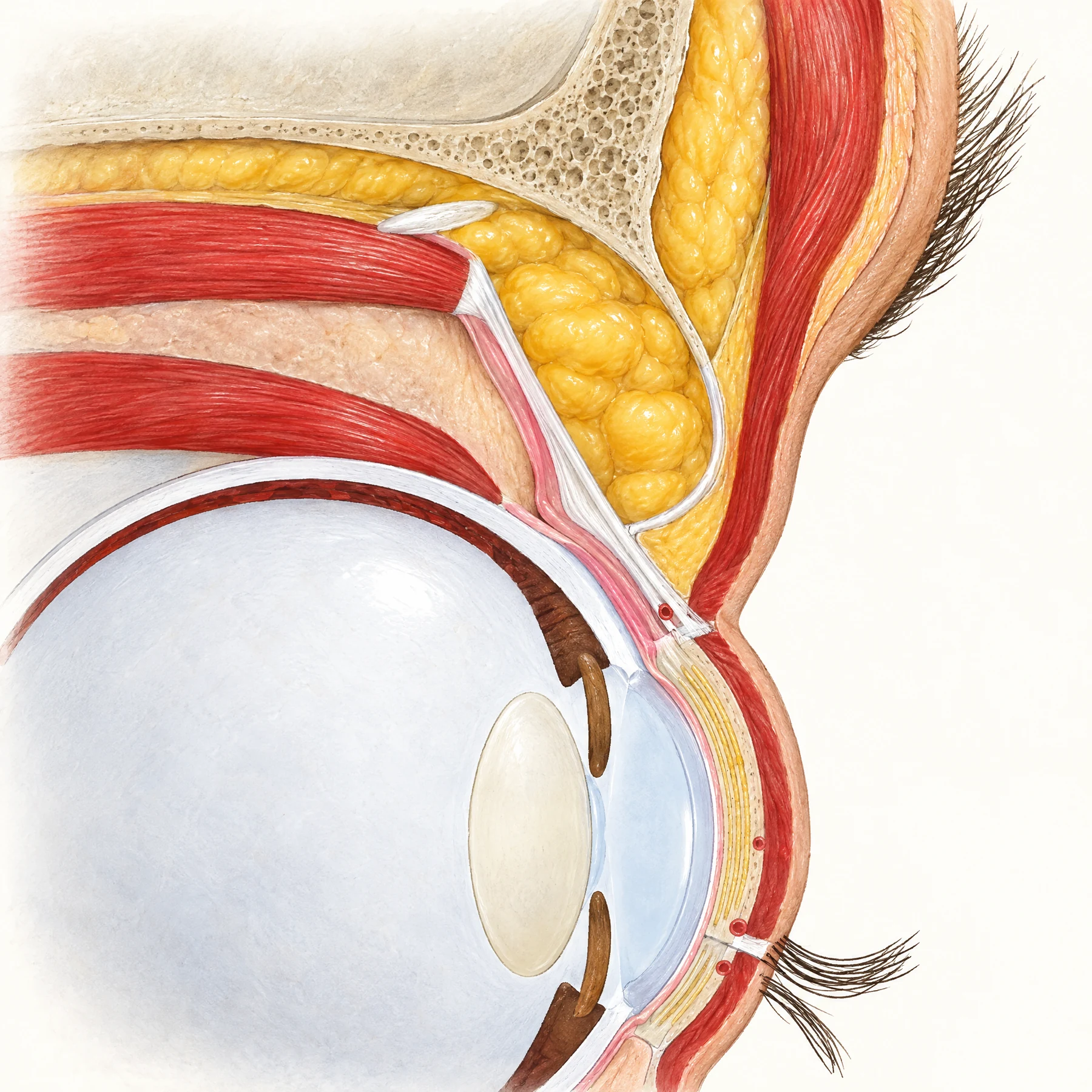
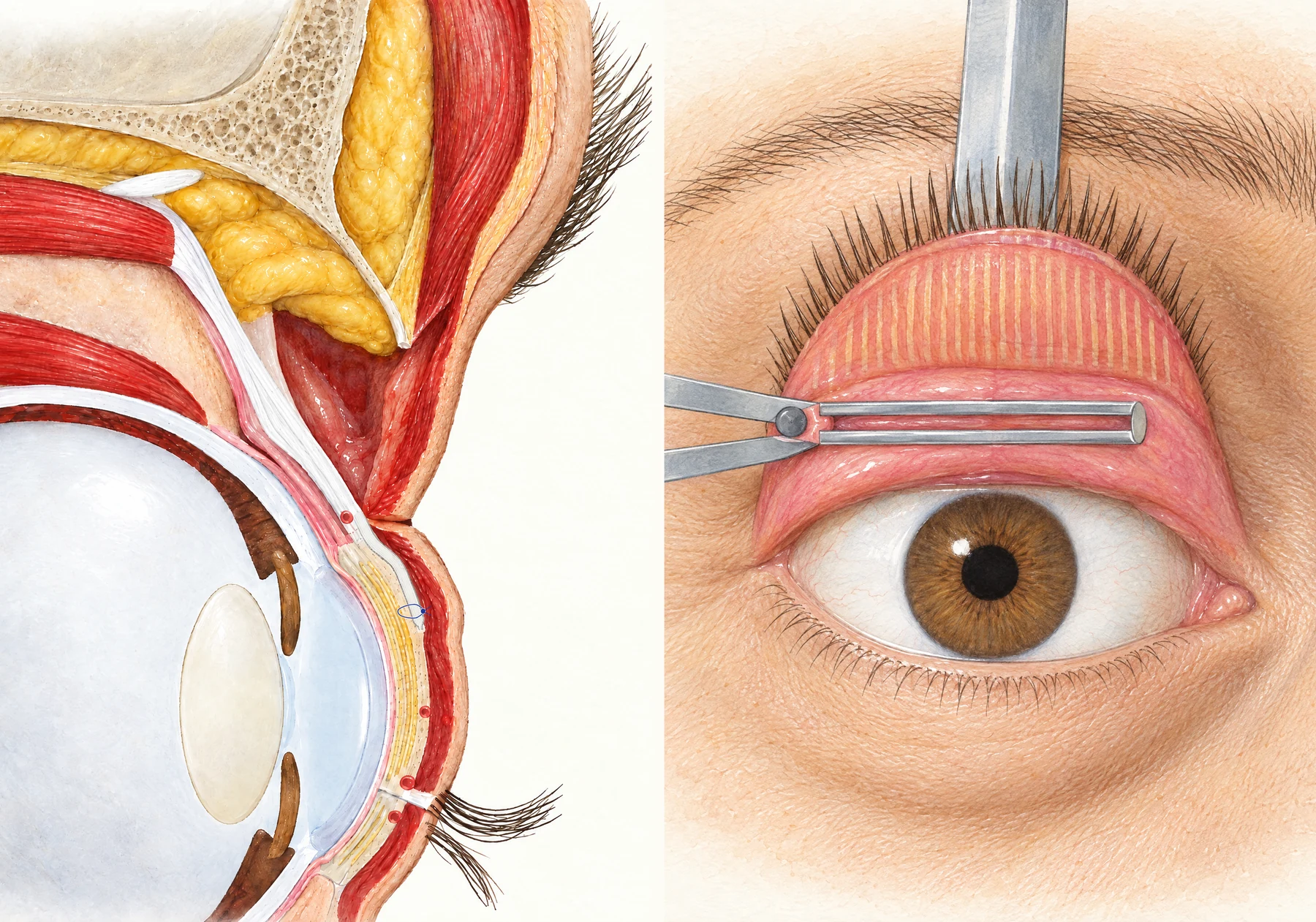
- The combined procedure excises excess skin, orbicularis muscle and, in some cases, orbital fat; the levator aponeurosis is advanced onto the tarsus and the crease is formed during closure (PMID 8532281). An early review of combined-case technique covered anesthesia choice, adjustable sutures to set lid height more precisely, and brow-suspension material for severe cases, with the patient's own fascia lata named the material of choice when available (PMID 10150819). General technique for the blepharoplasty part and the levator-advancement or Müller-muscle-conjunctival-resection (MMCR) options for the ptosis part are covered in upper blepharoplasty and blepharoptosis repair and not repeated here.
- Adding the blepharoplasty to an MMCR reduced the lid lift obtained from a given amount of Müller's muscle resection by up to 1 mm, so surgeons combining the two were advised to resect more muscle than for MMCR alone (PMID 10749155).
- In a trial of combined upper blepharoplasty and external levator advancement (ELA), resecting the preseptal orbicularis muscle made no significant difference to dry eye, eyelid appearance or satisfaction compared with leaving it alone (PMID 41575571).
- For severe ptosis with poor or absent levator function, a single orbicularis-oculi-and-orbital-septum flap advanced to the tarsus gave good results in about 7 in 10 eyelids; the rest had poor results, and a few needed reoperation (PMID 9495457).
- A similar orbicularis flap corrected undercorrected ptosis in patients who had already had more than two levator resections, with satisfactory results at 3-year follow-up (PMID 12800907).
- Mild involutional ptosis is generally corrected by aponeurosis advancement alone; moderate or severe ptosis uses Müller's muscle and the aponeurosis together, with skin excision kept limited to avoid lagophthalmos (PMID 32718105).
- In Asian patients, double eyelid surgery and ptosis repair are usually done together, but symmetry is harder to achieve than with either operation alone: only about 3 in 10 eyelids were perfectly symmetric after surgery, and symmetry that looked good right after surgery gave way to asymmetry within 6 months in most patients (PMID 17955284).
Results and evidence
- For severe ptosis, MMCR succeeded in about 97 of 100 eyelids against about 77 of 100 for levator surgery; adding blepharoplasty did not change these results (PMID 32387434).
- In patients having upper blepharoplasty with either technique, final lid height was similar (about 3 mm) and the cosmetic score was better after MMCR; reoperation was needed in about 8 in 100 after levator advancement and 3 in 100 after MMCR (PMID 29369985). Pooled studies agree that MMCR had fewer reoperations and better cosmetic scores than levator advancement overall (PMID 36692699).
- Blepharoplasty plus ptosis correction needed revision in about 9 in 100 cases against about 4 in 100 for blepharoplasty alone, with no difference between MMCR and levator advancement (PMID 38315110).
- In the largest reported revision comparison, about 3 in 4 ptosis-surgery patients also had upper blepharoplasty, and about 9 in 100 needed revision overall. Revision was more likely after the front (anterior) approach than the inside (posterior) approach, even after adjusting for gender and concurrent blepharoplasty (PMID 28582369).
- An American Academy of Ophthalmology review found quality-of-life gains from ptosis surgery, alone or with blepharoplasty, persisted 1.5 to 3.6 years after surgery (PMID 40913605).
Risks and complications
- Dry eye: symptoms and surface staining worsened after blepharoplasty combined with MMCR, while blepharoplasty alone did not change dry-eye tests (PMID 31770512). After levator advancement, dry eye rose temporarily at 1 and 3 months, most when combined with blepharoplasty, and returned near baseline by 6 months (PMID 40141678).
- At 3 or more years of follow-up, patients who had MMCR with blepharoplasty still showed worse surface staining and shorter tear break-up time than before surgery, while patients who had blepharoplasty alone showed no significant change (PMID 38221896).
- Refraction: most patients had a small shift in their glasses prescription at 3 months after blepharoplasty alone or with MMCR, with the largest change in the combined group (PMID 32135543).
- The brow drops about 2 mm after ptosis correction, relevant when blepharoplasty is planned around the brow (PMID 36890345).
- In elderly patients (average age about 76) having combined levator advancement and blepharoplasty, the lid rose from about 1 mm to 2.5 mm on average; surface staining worsened when the lid rose more than 2.5 mm, and most symptom items, including poor visibility, eye fatigue and headaches, worsened significantly (PMID 37808334).
- Concomitant blepharoplasty was one of several independent predictors of ptosis-repair failure, along with chronic prostaglandin or corticosteroid eye-drop use, surgical approach, lower lid height before surgery, prior eye surgery, age, and lower levator function (PMID 39222381).
- Subcutaneous tranexamic acid reduced bruising after eyelid surgery including levator advancement (PMID 38624153).
Recovery
- Dry eye after combined levator advancement and blepharoplasty peaks at 1 to 3 months and is near baseline by 6 months in most patients (PMID 40141678), though signs can persist at 3 or more years when MMCR is the ptosis component (PMID 38221896). General recovery timelines are covered in upper blepharoplasty and blepharoptosis repair.
Combined procedures
- A brow lift was added to about 1 in 3 upper blepharoplasties in a series where about 1 in 5 patients also had ptosis correction (PMID 38315110); surgeons who do many blepharoplasties more often combine brow lift with ptosis repair (PMID 33346340). Brow lift technique and its own outcomes are covered in temporal and lateral brow lift and browpexy and direct brow lift.
- When ptosis repair alone does not fully correct a low or hollow-appearing lid, advancing the posterior layer of the preaponeurotic fat membrane has been added to levator advancement as an extra step in a small series (PMID 41652024).
Current questions
- How much the combination itself drives complications, versus the ptosis part alone, is not fully separated in the literature: one large series found concomitant blepharoplasty raised failure risk after adjustment for other factors (PMID 39222381), but a trial of orbicularis resection within the combined operation found no measurable downside to the blepharoplasty step itself (PMID 41575571).
- Symmetry after combined Asian double-eyelid and ptosis surgery remains difficult, with most eyelids symmetric right after surgery but asymmetric by 6 months in one series (PMID 17955284).
- Undiagnosed ptosis before blepharoplasty is a recognized but incompletely solved screening problem; eyebrow asymmetry is proposed as a clinical clue but has not been validated as a formal screening tool (PMID 37694225).
- MMCR or levator advancement for the ptosis part: pooled data favor MMCR for predictability and cosmesis (PMID 36692699, PMID 29369985), while most surveyed aesthetic surgeons default to levator advancement (PMID 33346340).
- Elderly patients combining both procedures show measurable dry-eye and visual-comfort trade-offs against the benefit of lid elevation, without an established threshold for when the combination is unsafe (PMID 37808334).
Terms
- Dermatochalasis: excess, lax eyelid skin, the primary target of blepharoplasty (PMID 3045728).
- Blepharoptosis (ptosis): an upper lid margin that sits too low, corrected by levator advancement or Müller muscle-conjunctival resection (PMID 7111498).
- MRD1: distance from the corneal light reflex to the upper lid margin, used to measure ptosis correction (PMID 10749155).
- MMCR: Müller muscle-conjunctival resection, an inside-the-lid approach to ptosis repair, often combined with blepharoplasty (PMID 32387434).
- External levator advancement (ELA): reattaching the levator aponeurosis to the tarsus through a lid-crease incision, often the same incision used for blepharoplasty (PMID 41575571).
- Surgically induced refractive change (SIRC): a measurable shift in refraction after eyelid surgery, largest when blepharoplasty and ptosis repair are combined (PMID 32135543).
- Preaponeurotic fat membrane: a fibrous layer around the preaponeurotic fat pad that can be advanced as an added step when ptosis correction alone is insufficient (PMID 41652024).
- Hering's law: equal nerve drive to both upper lids, so correcting ptosis in one eye can unmask or worsen it in the other during combined surgery (PMID 17955284).